Product Design, Manufacturing & Innovation Resources
Home » The Weissenberg Effect (fluids)

The Weissenberg Effect (fluids)

1947
  • Karl Weissenberg
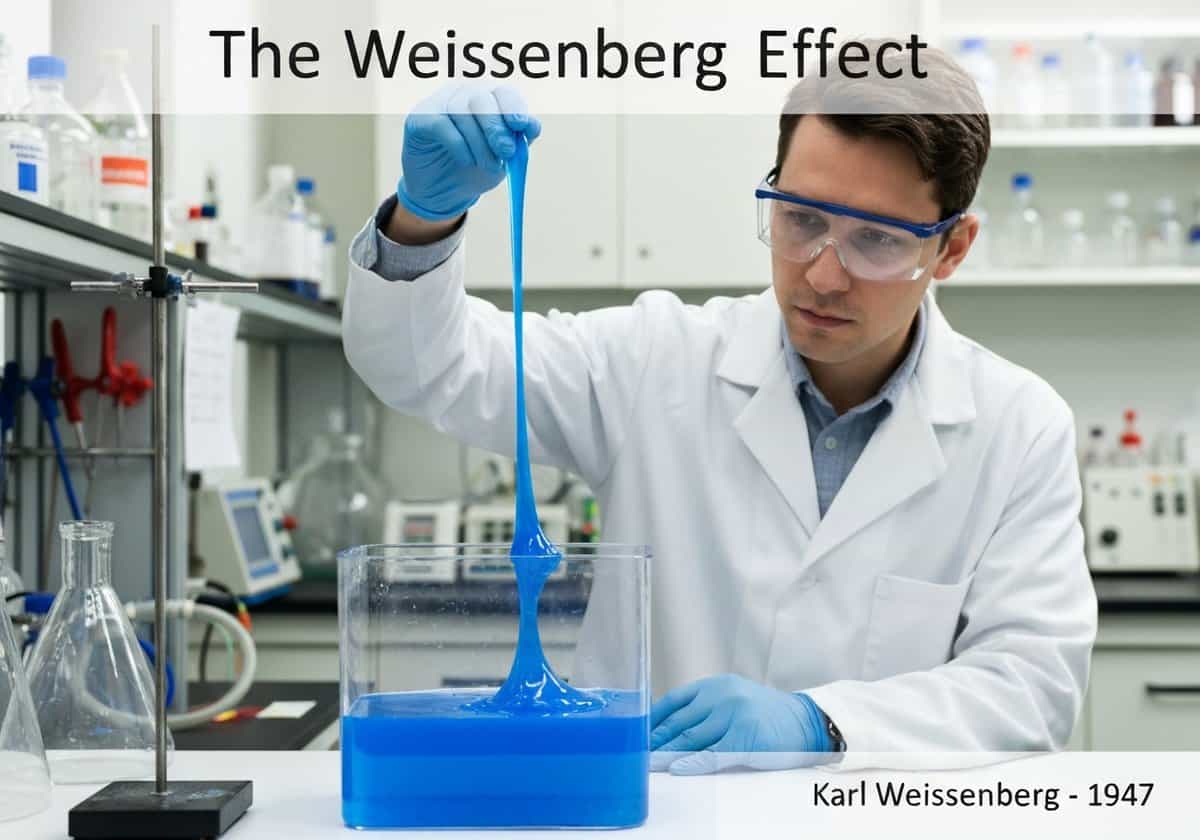
Researcher demonstrating the Weissenberg Effect with viscoelastic fluid in a laboratory.

(generated image for illustration only)

The Weissenberg effect is a phenomenon in viscoelastic fluids where the fluid climbs up a rotating rod inserted into it. This is contrary to the behavior of Newtonian fluids, which are pushed outwards by centrifugal force, forming a vortex. The effect is caused by normal stress differences that develop in the fluid under shear.


The Weissenberg effect is a direct consequence of the elastic nature of certain non-Newtonian fluids. When a simple fluid like water is sheared between a rotating rod and a stationary container, the fluid elements are stretched in the direction of flow (the tangential direction). In a purely viscous Newtonian fluid, this results in shear stress but no stress perpendicular (normal) to the shear plane. However, in a viscoelastic fluid, such as a polymer solution, the long polymer chains resist this stretching, creating an elastic tension along the curved streamlines, much like stretched rubber bands.

This tension creates a “hoop stress” that acts inwards, towards the center of rotation. This inward-directed force generates a pressure gradient, pushing the fluid up the rotating rod, which is the path of least resistance. The magnitude of this effect is related to the first normal stress difference, \(N_1 = \tau_{\ heta\theta} – \tau_{rr}\), a key parameter in rheology that quantifies the fluid’s elasticity. The Weissenberg effect is a powerful visual demonstration of fluid elasticity and is a fundamental concept in the study of polymer melts and solutions.

UNESCO Nomenclature: 2210
– Mechanics

Type

Physical Phenomenon

Disruption

Substantial

Usage

Niche/Specialized

Precursors

  • Development of the theory of viscoelasticity
  • Studies on polymer solutions and their unusual flow behaviors
  • Invention of the cone-and-plate rheometer by Weissenberg, which allowed for the measurement of normal stresses

Applications

  • characterizing viscoelastic properties of polymers in rheometers
  • design of mixers for viscoelastic materials like bread dough or polymer melts
  • understanding flow instabilities in polymer processing
  • aiding in the design of pumps for non-newtonian fluids

Patents:

NA

Potential Innovations Ideas

Due to scrapping bot traffic, currently more than 40k per day, this content is reserved to community members.
> Login < or > Register < (100% free) to access this, so as all other restricted content and tools.

Related to: weissenberg effect, rod-climbing, viscoelasticity, normal stress, rheology, polymer melts, non-newtonian, hoop stress.

Historical Context

The Weissenberg Effect (fluids)

1933
1937
1940
1947
1950
1950
1950
1932
1936-01-01
1938
1940
1950
1950
1950
1950

(if date is unknown or not relevant, e.g. "fluid mechanics", a rounded estimation of its notable emergence is provided)

Related Invention, Innovation & Technical Principles

Full size images and downloads are only available, 100% free, for registered members.

> Login <