Product Design, Manufacturing & Innovation Resources
Home » Ultraviolet Spectrum Subdivisions (UVA, UVB, UVC)

Ultraviolet Spectrum Subdivisions (UVA, UVB, UVC)

1932
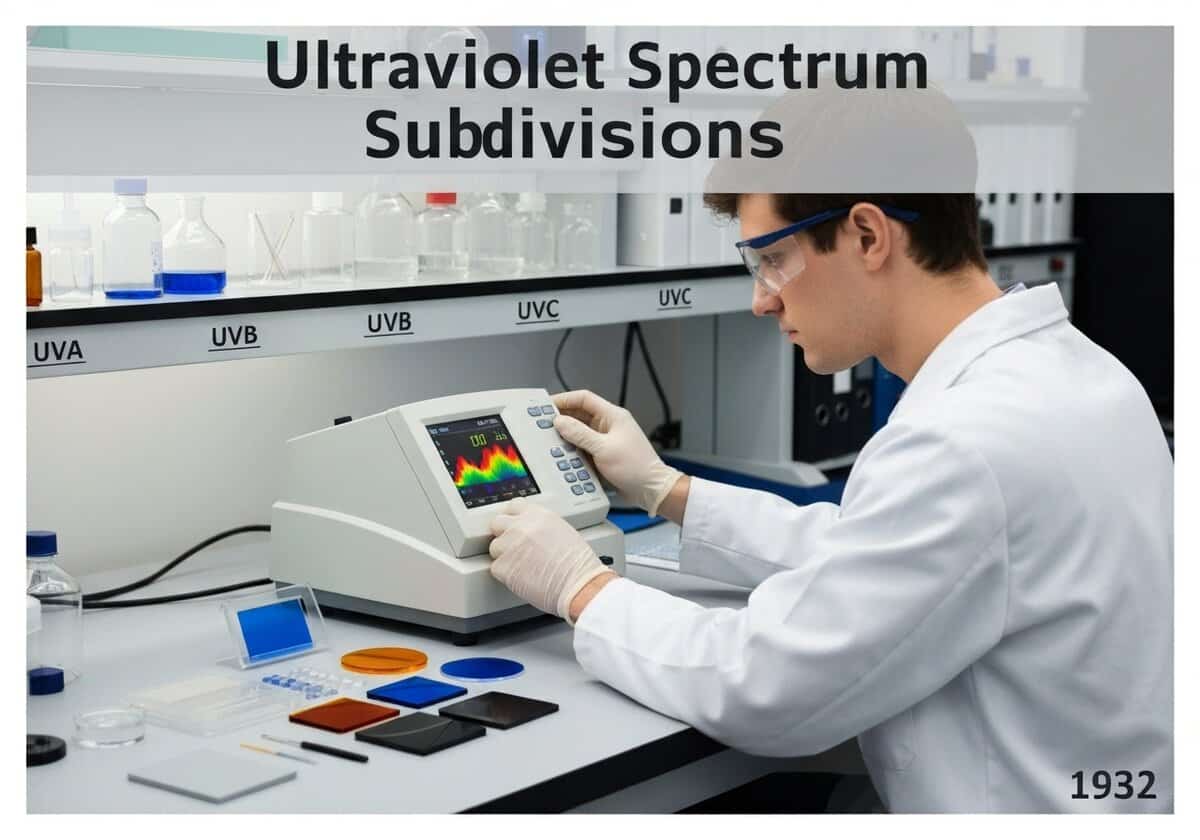
Laboratory analysis of ultraviolet spectrum subdivisions for photometry applications.

(generated image for illustration only)

The ultraviolet spectrum is commonly subdivided into UVA (400–315 nm), UVB (315–280 nm), and UVC (280–100 nm). UVA, or long-wave UV, is the least energetic and penetrates the skin deepest. UVB, or medium-wave UV, causes sunburn and is crucial for vitamin D synthesis. UVC, or short-wave UV, is the most energetic and germicidal but is completely absorbed by Earth’s atmosphere.
The division of the ultraviolet spectrum into distinct bands is based on their wavelength and corresponding biological effects. This classification, standardized by bodies like the International Commission on Illumination (CIE), is crucial for understanding UV’s impact on living organisms and materials. UVA (long-wave) is the most prevalent UV radiation reaching the Earth’s surface (~95%), as it is less affected by the ozone layer. It penetrates into the deeper layers of the skin (dermis) and is primarily responsible for skin aging (photoaging) and can contribute to skin cancer. UVB (medium-wave) is partially absorbed by the ozone layer. It primarily affects the outer layer of the skin (epidermis), causing sunburn, DNA damage, and is the main driver for most skin cancers, but it is also the specific wavelength range that initiates vitamin D production. UVC (short-wave) has the highest energy and is extremely dangerous to living organisms. Its photons have enough energy to break molecular bonds, making it a potent mutagen and germicide. Fortunately, UVC from the sun is entirely absorbed by oxygen and ozone in the stratosphere and does not reach the Earth’s surface. A further category, Vacuum UV (VUV), spans from 100 to 200 nm and is so named because it is strongly absorbed by air (specifically molecular oxygen), requiring a vacuum for it to propagate. These subdivisions are not just academic; they are fundamental to fields ranging from public health and dermatology to industrial applications like sterilization and polymer curing.

UNESCO Nomenclature: 2210
– Optics

Type

Classification System

Disruption

Substantial

Usage

Widespread Use

Precursors

  • Discovery of ultraviolet radiation by Johann Ritter
  • Development of spectroscopy and accurate wavelength measurement
  • Early research into the biological effects of light (photobiology)
  • Discovery of the ozone layer and its properties

Applications

  • sunscreen formulation (uva/uvb protection)
  • uv germicidal irradiation (uvc)
  • phototherapy for skin conditions (uvb)
  • tanning beds (uva)
  • material science for testing uv degradation
  • vitamin d synthesis research

Patents:

NA

Potential Innovations Ideas

Due to scrapping bot traffic, currently more than 40k per day, this content is reserved to community members.
> Login < or > Register < (100% free) to access this, so as all other restricted content and tools.

Related to: uva, uvb, uvc, ultraviolet spectrum, wavelength, photobiology, dermatology, ozone layer, germicidal, vitamin d.

Historical Context

Ultraviolet Spectrum Subdivisions (UVA, UVB, UVC)

1930
1930
1931
1932
1933
1937
1940
1930
1930
1930
1931
1932
1936-01-01
1938
1940

(if date is unknown or not relevant, e.g. "fluid mechanics", a rounded estimation of its notable emergence is provided)

Related Invention, Innovation & Technical Principles

Full size images and downloads are only available, 100% free, for registered members.

> Login <