Product Design, Manufacturing & Innovation Resources
Lar » Subdivisões do espectro ultravioleta (UVA, UVB, UVC)

Subdivisões do espectro ultravioleta (UVA, UVB, UVC)

1932
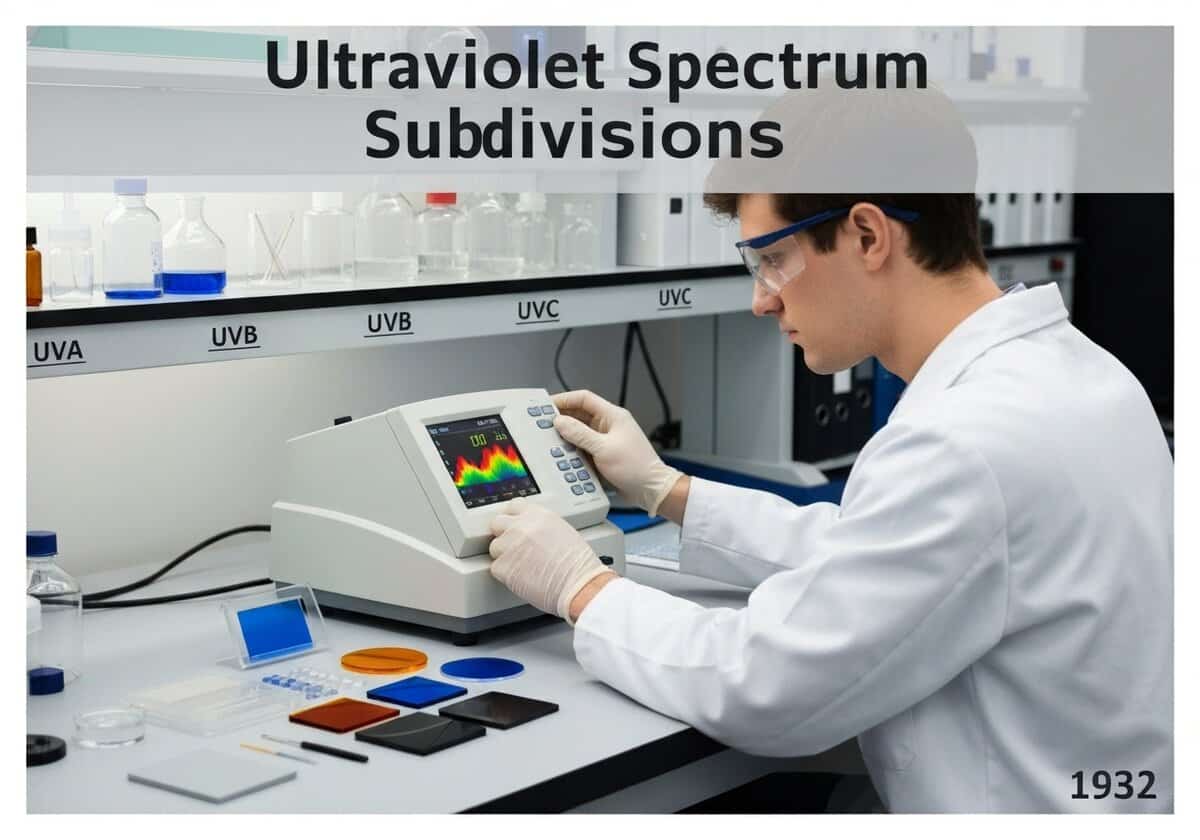
Laboratory analysis of ultraviolet spectrum subdivisions for photometry applications.

(Imagem gerada apenas para fins ilustrativos)

O ultravioleta spectrum is commonly subdivided into UVA (400–315 nm), UVB (315–280 nm), and UVC (280–100 nm). UVA, or long-wave UV, is the least energetic and penetrates the skin deepest. UVB, or medium-wave UV, causes sunburn and is crucial for vitamin D synthesis. UVC, or short-wave UV, is the most energetic and germicidal but is completely absorbed by Earth’s atmosphere.
The division of the ultraviolet spectrum into distinct bands is based on their wavelength and corresponding biological effects. This classification, standardized by bodies like the International Commission on Illumination (CIE), is crucial for understanding UV’s impact on living organisms and materials. UVA (long-wave) is the most prevalent UV radiation reaching the Earth’s surface (~95%), as it is less affected by the ozone layer. It penetrates into the deeper layers of the skin (dermis) and is primarily responsible for skin aging (photoaging) and can contribute to skin cancer. UVB (medium-wave) is partially absorbed by the ozone layer. It primarily affects the outer layer of the skin (epidermis), causing sunburn, DNA damage, and is the main driver for most skin cancers, but it is also the specific wavelength range that initiates vitamin D production. UVC (short-wave) has the highest energy and is extremely dangerous to living organisms. Its photons have enough energy to break molecular bonds, making it a potent mutagen and germicide. Fortunately, UVC from the sun is entirely absorbed by oxygen and ozone in the stratosphere and does not reach the Earth’s surface. A further category, Vacuum UV (VUV), spans from 100 to 200 nm and is so named because it is strongly absorbed by air (specifically molecular oxygen), requiring a vacuum for it to propagate. These subdivisions are not just academic; they are fundamental to fields ranging from public health and dermatology to industrial applications like sterilization and polymer curing.

UNESCO Nomenclature: 2210
Óptica

Tipo

Classification System

Interrupção

Substancial

Uso

Uso generalizado

Precursores

  • Discovery of ultraviolet radiation by Johann Ritter
  • Development of spectroscopy and accurate wavelength measurement
  • Early research into the biological effects of light (photobiology)
  • Discovery of the ozone layer and its properties

Aplicações

  • sunscreen formulation (uva/uvb protection)
  • uv germicidal irradiation (uvc)
  • phototherapy for skin conditions (uvb)
  • tanning beds (uva)
  • material science for testing uv degradation
  • vitamin d synthesis research

Patentes:

NA

Ideias de Inovação Potencial

Devido ao tráfego de bots de coleta de dados, atualmente superior a 40 mil por dia, este conteúdo é reservado aos membros da comunidade.
> Login < ou > Registrar < (100% gratuito) para acessar isso, assim como todo o restante do conteúdo e das ferramentas restritas.

Related to: uva, uvb, uvc, ultraviolet spectrum, wavelength, photobiology, dermatology, ozone layer, germicidal, vitamin d.

Contexto histórico

Subdivisões do espectro ultravioleta (UVA, UVB, UVC)

1930
1930
1931
1932
1933
1937
1940
1930
1930
1930
1931
1932
1936-01-01
1938
1940

(Caso a data seja desconhecida ou irrelevante, por exemplo, "mecânica dos fluidos", é fornecida uma estimativa aproximada de seu surgimento notável)

Princípios relacionados à invenção, inovação e tecnologia

Imagens em tamanho real e downloads estão disponíveis apenas, 100% gratuitos, para membros registrados.