Product Design, Manufacturing & Innovation Resources
Home » Ultraviolet Radiations

Ultraviolet Radiations

1801
  • Johann Wilhelm Ritter
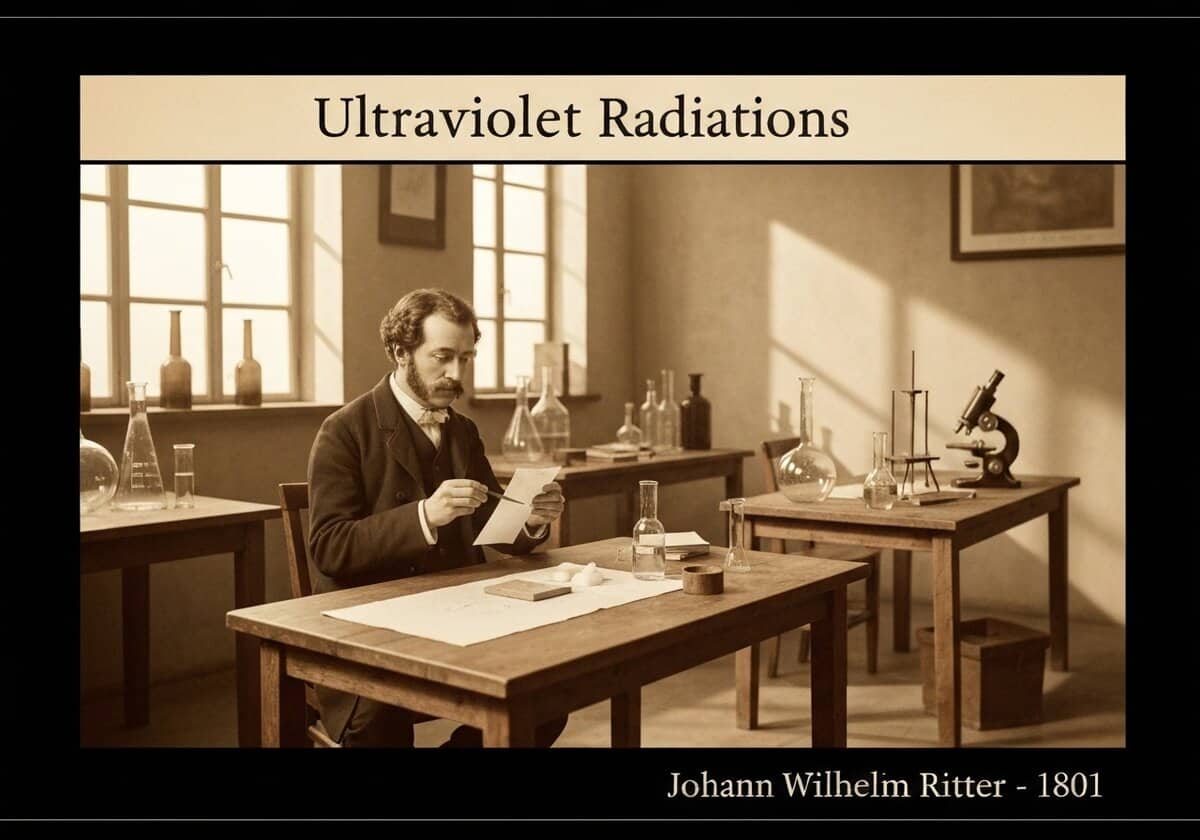
Johann Wilhelm Ritter's experiment with ultraviolet light and silver chloride paper in optics.

(generated image for illustration only)

In 1801, Johann Wilhelm Ritter observed that invisible rays beyond the violet end of the solar spectrum darkened silver chloride-soaked paper more quickly than violet light itself. This demonstrated the existence of a form of light beyond the visible spectrum, which he termed “oxidizing rays” to contrast with “heat rays” (infrared) discovered the previous year.
Johann Wilhelm Ritter’s experiment was a direct follow-up to William Herschel’s discovery of infrared radiation in 1800. Herschel had used a prism to split sunlight and placed thermometers beyond the red end of the spectrum, noting a temperature increase. Ritter, intrigued by this, decided to test the other end of the spectrum. He knew that silver chloride decomposed in the presence of light, and that this effect was more pronounced in violet light. He exposed strips of paper soaked in silver chloride to the solar spectrum produced by a prism. As expected, the paper darkened in the visible spectrum, with the effect increasing from red to violet. Crucially, he placed a strip just beyond the violet end, in a region where no visible light was present, and found that this strip darkened even more rapidly than the one in the violet light. This confirmed the existence of radiation with chemical activity stronger than visible light, located beyond the violet. His initial name, “oxidizing rays,” highlighted its chemical properties, which was later replaced by “chemical rays” and eventually “ultraviolet rays.” This discovery fundamentally expanded the known electromagnetic spectrum, proving that human vision perceives only a small fraction of it.

UNESCO Nomenclature: 2210
– Optics

Type

Scientific Discovery

Disruption

Foundational

Usage

Widespread Use

Precursors

  • Isaac Newton’s work on the visible spectrum using prisms
  • William Herschel’s discovery of infrared radiation (1800)
  • Carl Wilhelm Scheele’s observations on the darkening of silver salts by light

Applications

  • spectroscopy
  • uv photography
  • medical imaging
  • sterilization techniques
  • astronomical observation

Patents:

NA

Potential Innovations Ideas

Due to scrapping bot traffic, currently more than 40k per day, this content is reserved to community members.
> Login < or > Register < (100% free) to access this, so as all other restricted content and tools.

Related to: ultraviolet discovery, Johann Ritter, silver chloride, electromagnetic spectrum, spectroscopy, actinic rays, chemical rays, optics, physics history, light.

Historical Context

Ultraviolet Radiations

1800
1800
1800
1801
1802
1808
1811
1800
1800
1800
1800
1802
1802
1810
1816

(if date is unknown or not relevant, e.g. "fluid mechanics", a rounded estimation of its notable emergence is provided)

Related Invention, Innovation & Technical Principles

Full size images and downloads are only available, 100% free, for registered members.

> Login <