Product Design, Manufacturing & Innovation Resources
Home » Type II Superconductors

Type II Superconductors

1957
  • Alexei Abrikosov
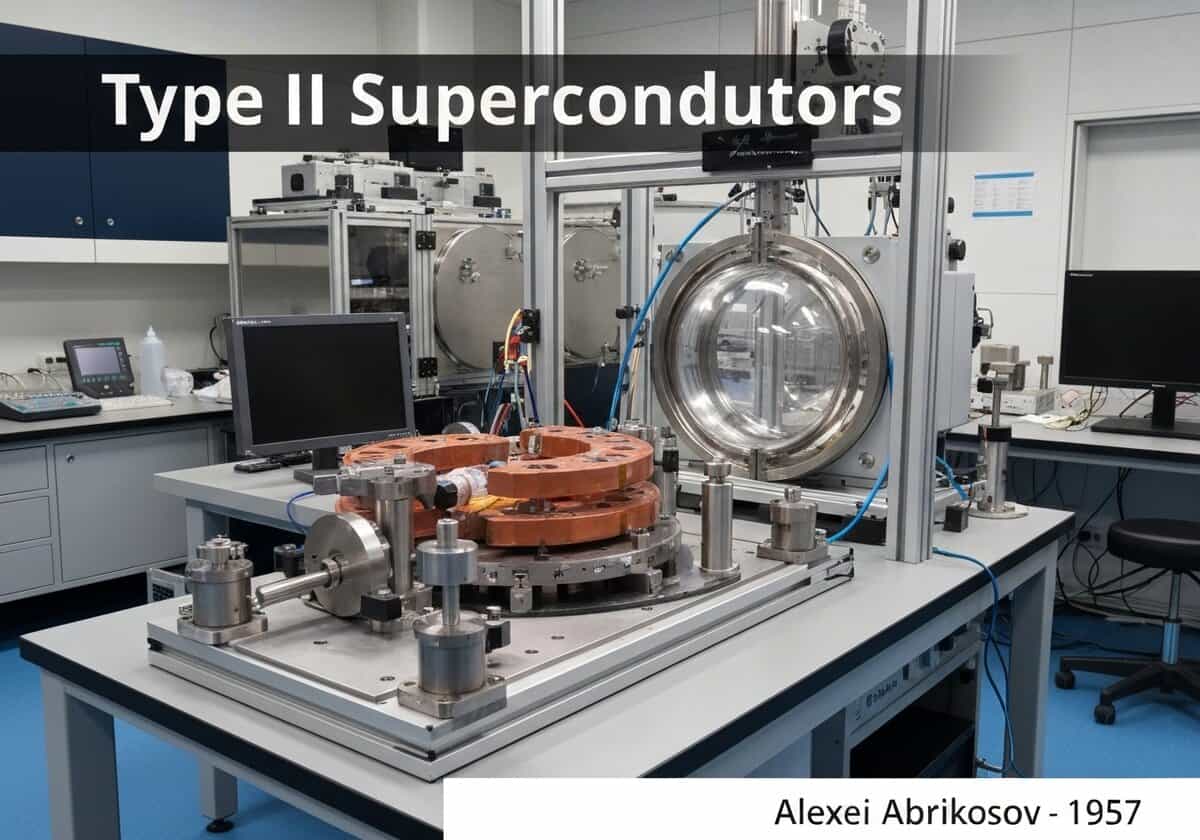
Superconducting magnet setup demonstrating Type II superconductors in a laboratory.

(generated image for illustration only)

Theoretically predicted by Alexei Abrikosov in 1957 based on Ginzburg-Landau theory, Type II superconductors are characterized by two critical magnetic fields, \(H_{c1}\) and \(H_{c2}\). Between these fields, they enter a mixed or “vortex” state, allowing partial magnetic field penetration through quantized flux tubes called Abrikosov vortices. This allows them to remain superconducting in much higher magnetic fields than Type I superconductors.

The existence of Type II superconductors is crucial for most high-field applications of superconductivity. A Type I superconductor completely expels magnetic fields up to a critical field \(H_c\), above which it abruptly transitions to the normal state. This \(H_c\) is generally too low for building powerful magnets. Abrikosov showed that for materials where the Ginzburg-Landau parameter \(\kappa > 1/\sqrt{2}\), it is energetically favorable for the material to allow magnetic flux to penetrate in a quantized manner rather than becoming fully normal. This penetration occurs above a lower critical field \(H_{c1}\). The flux enters in the form of cylindrical filaments called vortices or fluxons. Within the core of each vortex, the material is in the normal state, but the surrounding bulk remains superconducting. Each vortex carries a single quantum of magnetic flux, \(\Phi_0 = h/2e\). As the external field increases, more vortices enter the material, forming a regular triangular lattice known as an Abrikosov vortex lattice. The material remains superconducting, with zero resistance, until an upper critical field \(H_{c2}\) is reached, at which point the vortex cores overlap and the entire material becomes normal. Since \(H_{c2}\) can be hundreds of times larger than \(H_{c1}\), Type II materials are essential for generating strong magnetic fields. All high-temperature superconductors and many alloys like Niobium-titanium (NbTi) and Niobium-tin (Nb3Sn) are Type II.

UNESCO Nomenclature: 2211
– Solid state physics

Type

Material Classification

Disruption

Substantial

Usage

Widespread Use

Precursors

  • Ginzburg-Landau theory (1950)
  • discovery of superconductivity
  • Meissner effect
  • concept of magnetic flux quantization

Applications

  • superconducting magnets for mri and nmr machines
  • particle accelerators (e.g., lhc)
  • maglev trains
  • high-field research magnets
  • superconducting magnetic energy storage (smes)

Patents:

NA

Potential Innovations Ideas

Due to scrapping bot traffic, currently more than 40k per day, this content is reserved to community members.
> Login < or > Register < (100% free) to access this, so as all other restricted content and tools.

Related to: Type II superconductor, Abrikosov vortex, mixed state, critical magnetic field, flux quantization, Ginzburg-Landau theory, flux pinning, high-field magnets, NbTi, YBCO.

Historical Context

Type II Superconductors

1950
1950
1957
1957
1959-11
1960
1960
1950
1950
1950
1957
1958
1960
1960
1960

(if date is unknown or not relevant, e.g. "fluid mechanics", a rounded estimation of its notable emergence is provided)

Related Invention, Innovation & Technical Principles

Full size images and downloads are only available, 100% free, for registered members.

> Login <