Product Design, Manufacturing & Innovation Resources
Home » Thomson Effect

Thomson Effect

1851
  • William Thomson (Lord Kelvin)
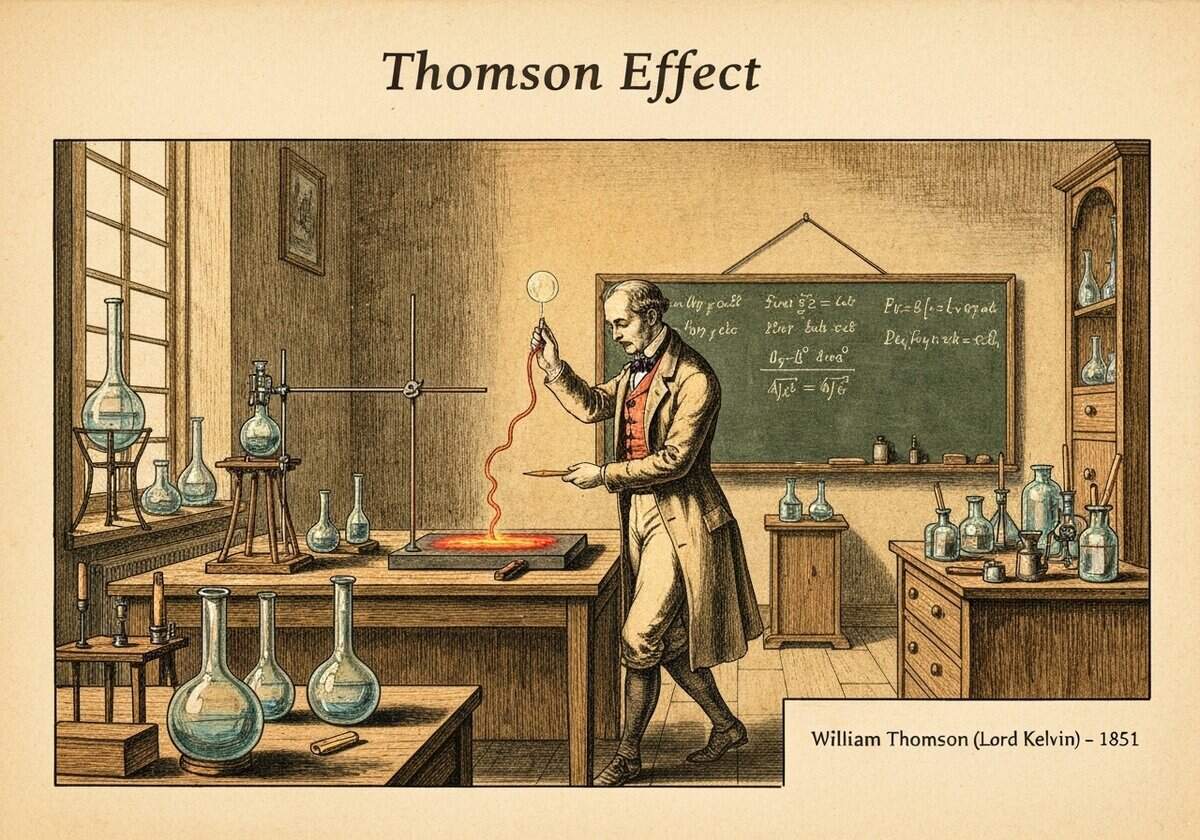
Current-carrying conductor experiment demonstrating Thomson Effect in thermoelectricity.

(generated image for illustration only)

The Thomson effect describes the heating or cooling of a current-carrying conductor when a temperature gradient exists along its length. Heat is produced or absorbed when current flows through a material with a temperature gradient. The rate of heat production per unit length is given by \(\frac{dQ}{dx} = -\mathcal{K} J \frac{dT}{dx}\), where \(\mathcal{K}\) is the Thomson coefficient.

The Thomson effect arises because the Seebeck coefficient of a material is generally dependent on temperature. As charge carriers move along a conductor from a hot region to a cold region (or vice versa), their average energy changes not only due to the temperature but also due to the changing Seebeck coefficient. When an electric current (J) flows through a conductor with a temperature gradient (\(frac{dT}{dx}\)), this effect becomes apparent.

If the current flows in the same direction as the heat flow (from hot to cold), heat may be absorbed or released depending on the sign of the Thomson coefficient (\(mathcal{K}\)) for that material. This heating or cooling is distinct from and superimposed upon the irreversible Joule heating (\(I^2R\)) that always occurs. The Thomson effect is crucial for a complete thermodynamic description of thermoelectric phenomena and is linked to the Seebeck and Peltier effects through the Kelvin relations, which are foundational to the field.

UNESCO Nomenclature: 2211
– Solid state physics

Type

Physical Effect

Disruption

Incremental

Usage

Niche/Specialized

Precursors

  • discovery of the seebeck effect (1821)
  • discovery of the peltier effect (1834)
  • sadi carnot’s work on thermodynamics and heat engines
  • james prescott joule’s work on the heating effect of electric current

Applications

  • provides a complete theoretical framework for thermoelectricity
  • used in the accurate modeling of thermoelectric generators and coolers
  • helps characterize materials by relating the three thermoelectric coefficients

Patents:

NA

Potential Innovations Ideas

Due to scrapping bot traffic, currently more than 40k per day, this content is reserved to community members.
> Login < or > Register < (100% free) to access this, so as all other restricted content and tools.

Related to: Thomson effect, Lord Kelvin, thermoelectricity, Seebeck coefficient, temperature gradient, Joule heating, heat transport, Kelvin relations, thermodynamic relations, transport phenomena.

Historical Context

Thomson Effect

1850
1850
1850
1851
1852
1859
1860
1850
1850
1850
1850
1851
1854
1859
1861

(if date is unknown or not relevant, e.g. "fluid mechanics", a rounded estimation of its notable emergence is provided)

Related Invention, Innovation & Technical Principles

Full size images and downloads are only available, 100% free, for registered members.

> Login <