Product Design, Manufacturing & Innovation Resources
Home » Time-Dependent Viscosity: Thixotropy and Rheopexy

Time-Dependent Viscosity: Thixotropy and Rheopexy

1927
  • Herbert Freundlich
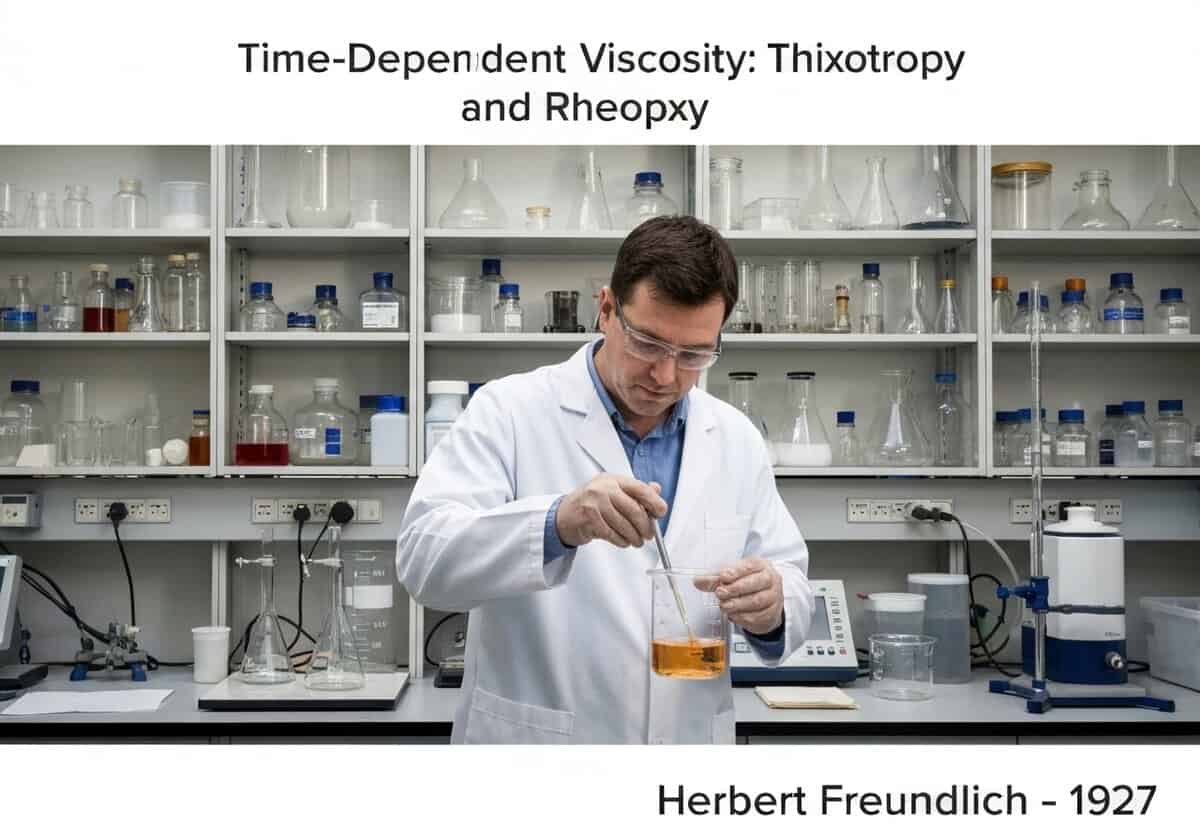
Scientist stirring thixotropic fluid demonstrating time-dependent viscosity changes in mechanics.

(generated image for illustration only)

Thixotropy and rheopexy describe time-dependent changes in viscosity. A thixotropic fluid’s viscosity decreases over time under constant shear stress (e.g., yogurt becomes runnier when stirred). A rheopectic (or anti-thixotropic) fluid’s viscosity increases over time under constant shear (e.g., some lubricants). These effects are reversible; the fluid returns to its original state after a period of rest.

Thixotropy and rheopexy are distinct from shear-thinning and shear-thickening. While the latter describe how viscosity changes with the *rate* of shear, thixotropy and rheopexy describe how viscosity changes with the *duration* of shear at a constant rate. The underlying cause is a reversible change in the fluid’s microstructure that takes time to occur.

In a thixotropic fluid, the internal structure (e.g., a network of flocculated particles) breaks down under shear. This breakdown is not instantaneous, so the viscosity gradually decreases as shearing continues. When the shear is removed, the structure slowly rebuilds, and the viscosity increases back to its original value. This time lag is crucial for applications like paint. Rheopexy is the opposite and much rarer phenomenon. Here, shearing promotes the formation of an internal structure over time, leading to a gradual increase in viscosity. For example, in some suspensions, gentle, regular shearing can help particles organize into a more ordered, flow-resistant state more quickly than if left at rest. This time-dependent behavior is often visualized by a hysteresis loop in a plot of shear stress versus shear rate.

UNESCO Nomenclature: 2210
– Mechanics

Type

Physical Property

Disruption

Substantial

Usage

Widespread Use

Precursors

  • Observations of gels and sols, particularly in colloid chemistry
  • Studies by Péterfi and Freundlich on the reversible sol-gel transition
  • Distinction from simple shear-thinning/thickening behavior

Applications

  • thixotropic paints that are easy to stir but thicken on the wall to prevent drips
  • soldering pastes that are easy to apply but hold components in place
  • biological synovial fluid in joints, which thins during movement
  • drilling muds that liquefy when pumped but gel when pumping stops
  • rheopectic lubricants that thicken in high-shear environments to provide better protection

Patents:

NA

Potential Innovations Ideas

Due to scrapping bot traffic, currently more than 40k per day, this content is reserved to community members.
> Login < or > Register < (100% free) to access this, so as all other restricted content and tools.

Related to: thixotropy, rheopexy, time-dependent viscosity, rheology, non-newtonian, hysteresis loop, yogurt, paint.

Historical Context

Time-Dependent Viscosity: Thixotropy and Rheopexy

1924
1925
1926
1927
1927
1930
1930
1924
1925
1926
1926
1927
1930
1930
1930

(if date is unknown or not relevant, e.g. "fluid mechanics", a rounded estimation of its notable emergence is provided)

Related Invention, Innovation & Technical Principles

Full size images and downloads are only available, 100% free, for registered members.

> Login <