Product Design, Manufacturing & Innovation Resources
Home » Spin Coating for Thin Film Deposition

Spin Coating for Thin Film Deposition

1958
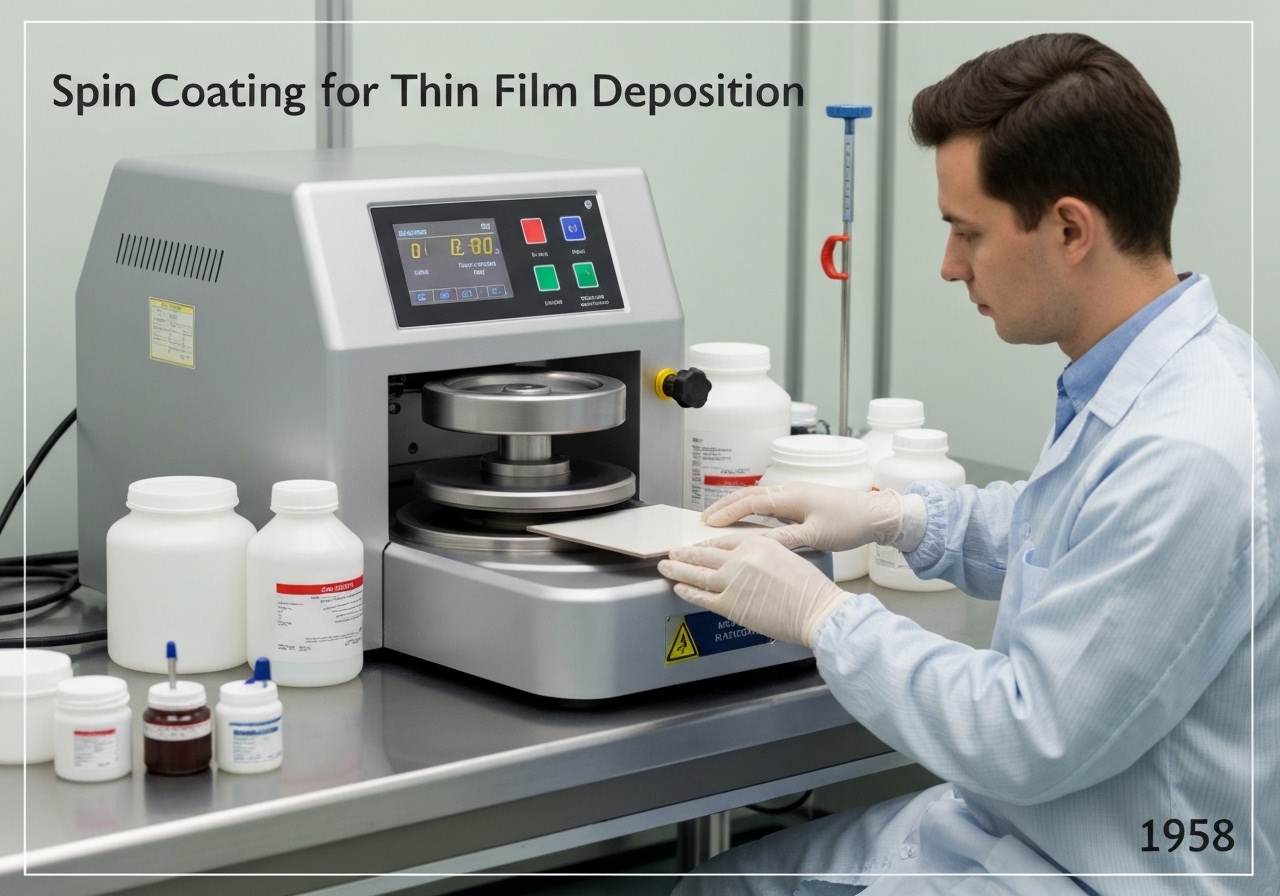
Laboratory technician performing spin coating for thin film deposition in a cleanroom.

(generated image for illustration only)

Spin coating is a procedure for depositing uniform thin films onto flat substrates. An excess of a coating solution is placed on the substrate, which is then rotated at high speed. Centrifugal force spreads the solution, and solvent evaporation or curing solidifies the film, with the final thickness determined by viscosity, concentration, and spin speed.


The spin coating process is divided into four main stages: deposition, spin-up, spin-off, and evaporation. In the deposition stage, an excess of the coating fluid is dispensed onto the substrate’s surface. During the spin-up stage, the substrate is rapidly accelerated to its final, desired rotation speed, causing the fluid to flow radially outward due to centrifugal force. The spin-off stage follows, where the excess fluid is ejected from the substrate’s edge, and the film thins. The final stage is evaporation, where the solvent evaporates from the film, leaving behind the solid coating. The thickness of the resulting film is highly dependent on several parameters. The key relationship was modeled by Emslie, Bonner, and Peck, showing that the final film thickness \(h_f\) is proportional to the inverse square root of the angular velocity \(\omega\), the initial solution concentration, and the solvent evaporation rate, and is also a function of the fluid viscosity \(\nu\). The formula is often simplified as \(h_f \propto \omega^{-1/2}\). This technique is favored for its simplicity, speed, and ability to produce highly uniform films with thicknesses ranging from a few nanometers to several micrometers on a laboratory scale. However, it is inherently a batch process and can be wasteful, as a significant portion of the initial solution is flung off the substrate.

UNESCO Nomenclature: 3322
– Technology of materials

Type

Physical Process

Disruption

Incremental

Usage

Widespread Use

Precursors

  • discovery of centrifugal force by Christiaan Huygens
  • development of the electric motor
  • synthesis of soluble polymers and photoresists
  • understanding of fluid dynamics and solvent evaporation principles

Applications

  • fabrication of microelectronics and semiconductor devices
  • manufacturing of optical coatings like anti-reflection layers
  • creation of organic light-emitting diodes (OLEDs)
  • production of compact discs (CDs) and digital versatile discs (DVDs)
  • research and development of novel materials and sensors

Patents:

NA

Potential Innovations Ideas

Due to scrapping bot traffic, currently more than 40k per day, this content is reserved to community members.
> Login < or > Register < (100% free) to access this, so as all other restricted content and tools.

Related to: spin coating, thin film, deposition, substrate, centrifugal force, semiconductor, photolithography, polymer solution, uniform coating, materials science.

Historical Context

Spin Coating for Thin Film Deposition

1950
1950
1955
1958
1960
1960
1960
1950
1950
1955
1956
1960
1960
1960
1960

(if date is unknown or not relevant, e.g. "fluid mechanics", a rounded estimation of its notable emergence is provided)

Related Invention, Innovation & Technical Principles

Full size images and downloads are only available, 100% free, for registered members.

> Login <