Product Design, Manufacturing & Innovation Resources
Home » Simulink: Model-Based Design

Simulink: Model-Based Design

1990
  • MathWorks
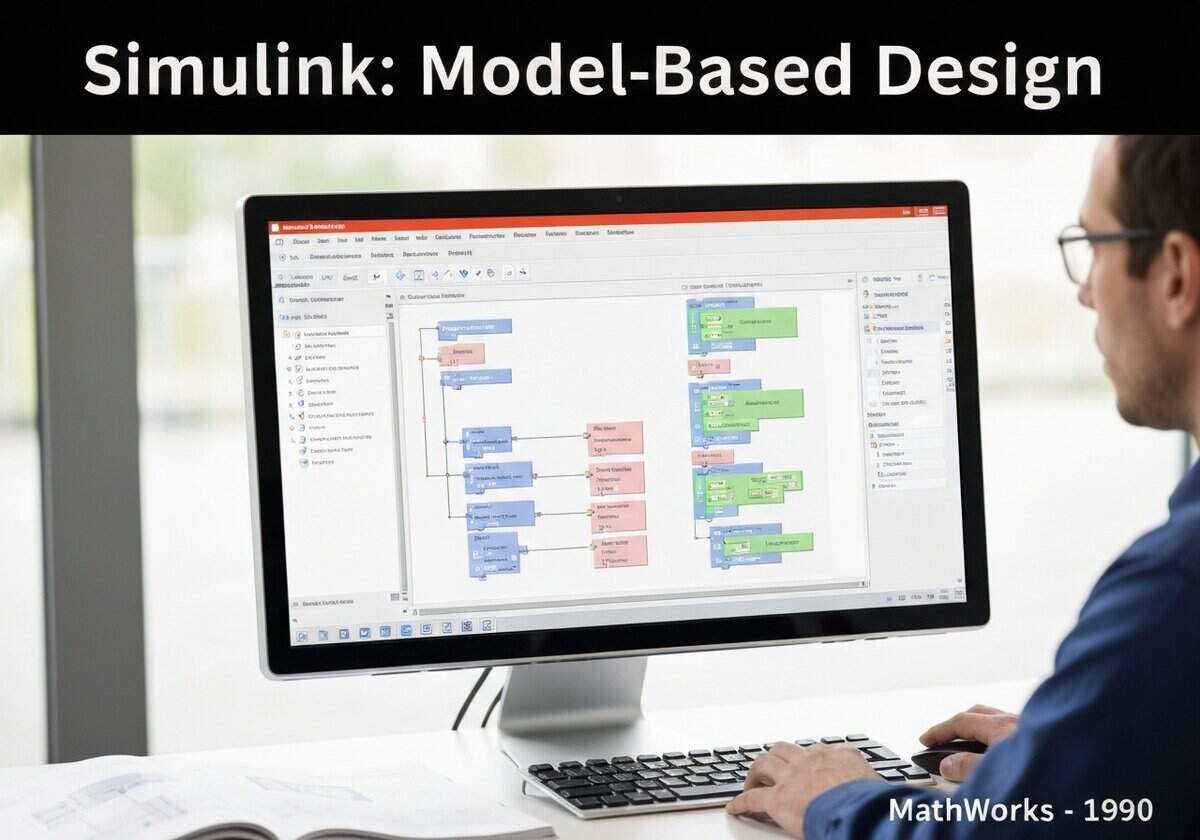
Engineer using Simulink for automotive control system design in a modern office.

(generated image for illustration only)

Simulink is a graphical programming environment integrated with MATLAB for modeling, simulating, and analyzing multi-domain dynamical systems. It uses a block diagram interface where users connect blocks representing system components (e.g., transfer functions, signal generators). Simulink is widely used for Model-Based Design, enabling simulation, automatic code generation for embedded systems, and continuous testing and verification.

Simulink provides a visual, block-based language that abstracts the underlying differential equations governing a system’s behavior. This approach, known as Model-Based Design (MBD), places a system model at the center of the development process. Instead of writing textual code, engineers and scientists can build a model by dragging and dropping blocks from extensive libraries and connecting them to represent signal flow. The environment includes a set of numerical solvers for simulating the system’s behavior over time, allowing for rapid prototyping and analysis of dynamic systems, including linear, nonlinear, continuous-time, discrete-time, and hybrid systems.

A key innovation of Simulink is its ability to bridge the gap between system design and implementation. With add-on products like Simulink Coder, the graphical model can be used to automatically generate high-quality, efficient C and C++ code for deployment on embedded processors. This dramatically reduces manual coding errors and accelerates the development cycle for complex control systems found in cars, aircraft, and industrial machinery. The model becomes a single source of truth for simulation, testing, and final implementation, enabling practices like hardware-in-the-loop (HIL) simulation, where the generated code runs on a real-time processor that interacts with physical hardware.

UNESCO Nomenclature: 3304
– Control engineering

Type

Software/Algorithm

Disruption

Incremental

Usage

Widespread Use

Precursors

  • Analog computing concepts
  • SPICE (Simulation Program with Integrated Circuit Emphasis)
  • SystemBuild (early graphical modeling tool)
  • Stateflow (for state machine modeling)

Applications

  • automotive control systems design (e.g., abs, engine control units)
  • aerospace flight control and simulation
  • industrial automation and process control
  • digital signal processing algorithm design
  • communications systems modeling
  • renewable energy systems design (e.g., wind turbine controllers)

Patents:

NA

Potential Innovations Ideas

Due to scrapping bot traffic, currently more than 40k per day, this content is reserved to community members.
> Login < or > Register < (100% free) to access this, so as all other restricted content and tools.

Related to: Simulink, model-based design, MBD, block diagram, simulation, control systems, embedded systems, code generation, dynamical systems, MATLAB.

Historical Context

Simulink: Model-Based Design

1989
1990
1990
1990
1990
1990
1990
1987-03
1990
1990
1990
1990
1990
1990
1990

(if date is unknown or not relevant, e.g. "fluid mechanics", a rounded estimation of its notable emergence is provided)

Related Invention, Innovation & Technical Principles

Full size images and downloads are only available, 100% free, for registered members.

> Login <