Product Design, Manufacturing & Innovation Resources
Home » Schrödinger Equation

Schrödinger Equation

1926
  • Erwin Schrödinger
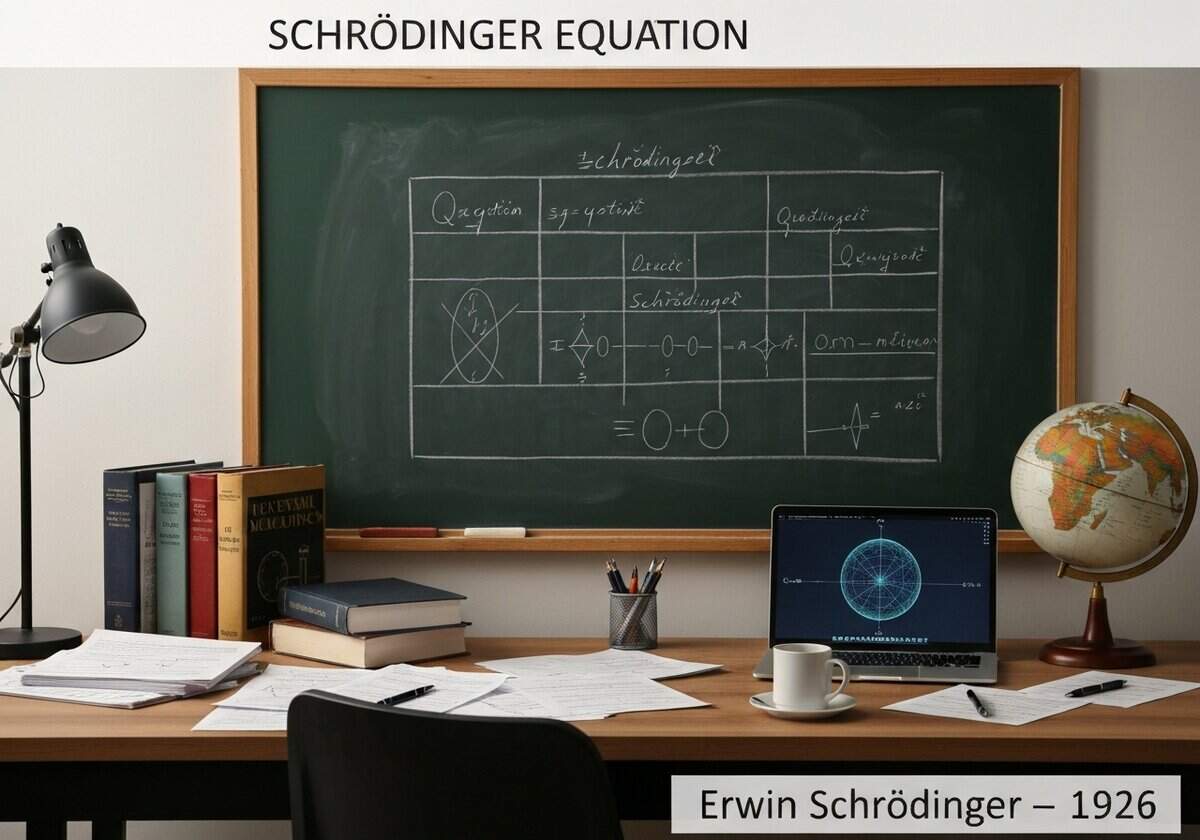
Physicist's workspace with Schrödinger Equation and quantum mechanics materials.

(generated image for illustration only)

This is a fundamental equation in quantum mechanics that describes how the quantum state of a physical system changes over time. It is a linear partial differential equation for the wavefunction, \(\Psi(x, t)\). The time-dependent version is \(i\hbar\frac{\partial}{\partial t}\Psi = \hat{H}\Psi\), where \(\hat{H}\) is the Hamiltonian operator, representing the total energy of the system.


The Schrödinger equation is the quantum mechanical counterpart to Newton’s second law in classical mechanics. While Newton’s law predicts the trajectory of a particle, the Schrödinger equation predicts the future behavior of a system’s wavefunction. The wavefunction, \(\Psi\), is a complex-valued probability amplitude, and the square of its magnitude, \(|\Psi|^2\), gives the probability density of finding the particle at a given position and time. The equation comes in two main forms: time-dependent and time-independent.

The time-dependent Schrödinger equation (TDSE), \(i\hbar\frac{\partial}{\partial t}\Psi(x, t) = \hat{H}\Psi(x, t)\), describes a system evolving in time. The time-independent Schrödinger equation (TISE), \(\hat{H}\Psi(x) = E\Psi(x)\), is used for systems in a stationary state, where the energy \(E\) is constant. Solving the TISE for a given potential yields the allowed energy eigenvalues (\(E\)) and the corresponding energy eigenfunctions (\(\Psi\)), which represent the stable states of the system, such as the electron orbitals in an atom. The Hamiltonian operator \(\hat{H}\) is constructed from the classical expression for the total energy (kinetic plus potential) by replacing classical variables with their corresponding quantum operators. For a single non-relativistic particle, \(\hat{H} = -\frac{\hbar^2}{2m}\nabla^2 + V(x, t)\).

UNESCO Nomenclature: 2210
– Quantum Physics

Type

Abstract System

Disruption

Revolutionary

Usage

Widespread Use

Precursors

  • Hamiltonian mechanics (1833)
  • De Broglie’s wave-particle duality hypothesis (1924)
  • Matrix mechanics (Heisenberg, 1925)
  • Classical wave equations

Applications

  • predicting atomic and molecular orbitals (quantum chemistry)
  • designing semiconductor devices
  • modeling nuclear reactions
  • understanding superconductivity
  • quantum computing algorithm design

Patents:

NA

Potential Innovations Ideas

Due to scrapping bot traffic, currently more than 40k per day, this content is reserved to community members.
> Login < or > Register < (100% free) to access this, so as all other restricted content and tools.

Related to: Schrödinger equation, wavefunction, Hamiltonian operator, quantum state, partial differential equation, quantum mechanics, probability amplitude, energy levels.

Historical Context

Schrödinger Equation

1922
1924
1925
1926
1926
1927
1930
1921
1924
1924
1925
1926
1927
1927
1930

(if date is unknown or not relevant, e.g. "fluid mechanics", a rounded estimation of its notable emergence is provided)

Related Invention, Innovation & Technical Principles

Full size images and downloads are only available, 100% free, for registered members.

> Login <