Product Design, Manufacturing & Innovation Resources
Home » Rare-Earth Magnets

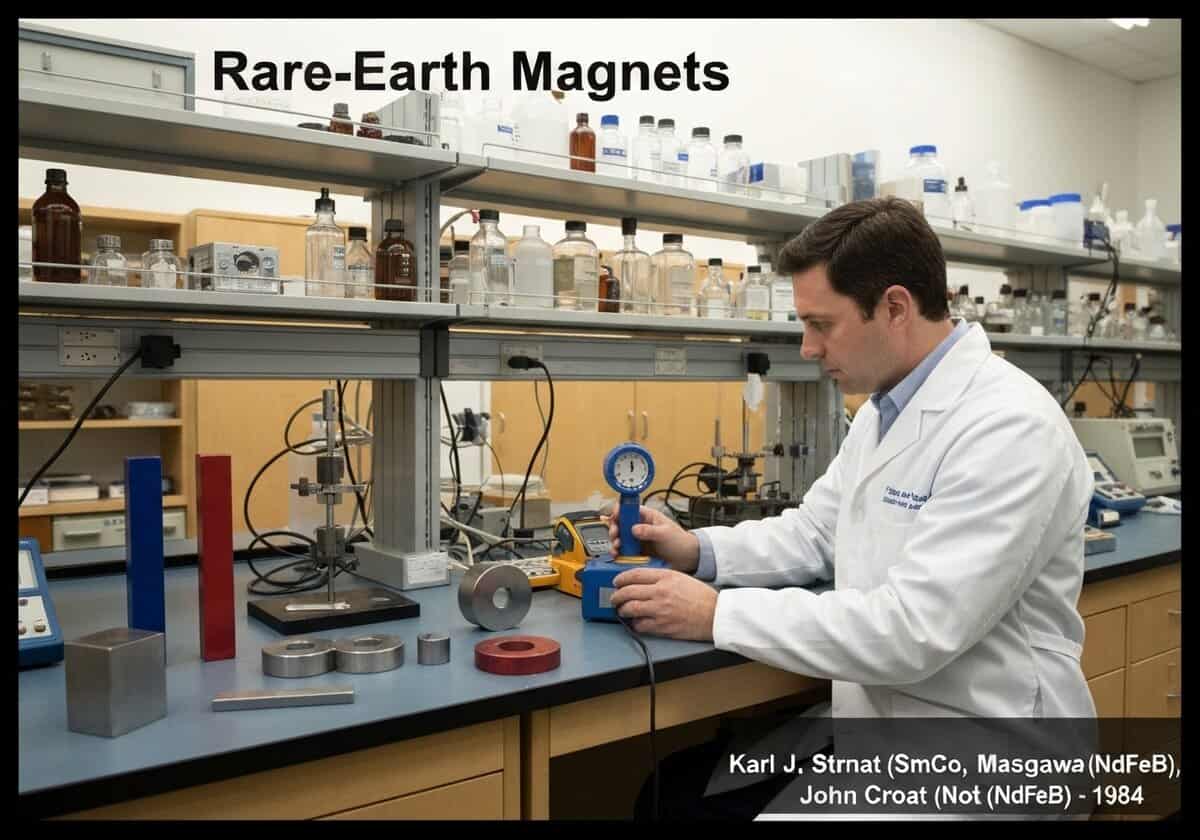
Rare-Earth Magnets

1984
  • Karl J. Strnat (SmCo)
  • Masato Sagawa (NdFeB)
  • John Croat (NdFeB)
Testing rare-earth magnets in a solid state physics laboratory.

(generated image for illustration only)

Rare-earth magnets are strong permanent magnets made from alloys of rare-earth elements. Developed in the 1970s and 1980s, the most common types are neodymium magnets (NdFeB) and samarium–cobalt magnets (SmCo). They are the strongest type of permanent magnets made, producing significantly stronger magnetic fields than ferrite or alnico magnets, enabling miniaturization and improved performance in many technologies. Note: the term ‘rare-earth element’ is a historical misnomer. These elements are not exceptionally rare in the Earth’s crust. Cerium, the most abundant, is the 25th most abundant element, similar to copper. Even the least abundant stable rare earth, lutetium, is nearly 200 times more common than gold. The ‘rare’ label arose because they were difficult to separate.
The exceptional strength of rare-earth magnets stems from their unique crystalline structure and the properties of the rare-earth elements. The lanthanide elements, such as neodymium and samarium, possess high magnetic anisotropy. This means their crystal lattice has a preferred axis of magnetization, making it very difficult to change the direction of their magnetic moments once aligned. This property leads to a very high coercivity (resistance to demagnetization). The transition metals in the alloy, like iron or cobalt, contribute a very high magnetic saturation, meaning they can sustain a very strong magnetic field. The combination of high coercivity and high magnetic saturation results in a very high maximum energy product (\((BH)_{max}\)), which is the primary figure of merit for permanent magnets.

Samarium-cobalt magnets were developed first in the early 1970s and have a higher Curie temperature, making them suitable for high-temperature applications. Neodymium magnets, developed in 1984 independently by General Motors and Sumitomo Special Metals, are even stronger but have a lower Curie temperature, though modern alloys have improved this. The development of rare-earth magnets was a revolutionary step in materials science, enabling the creation of smaller, lighter, and more powerful electric motors, generators, and other devices that were previously impractical.

UNESCO Nomenclature: 2211
– Solid state physics

Type

Physical Device

Disruption

Revolutionary

Usage

Widespread Use

Precursors

  • discovery of rare-earth elements
  • development of powder metallurgy and sintering techniques
  • understanding of ferromagnetism and magnetic anisotropy
  • development of alnico and ferrite magnets

Applications

  • hard disk drives (voice coil motors)
  • electric vehicle motors
  • wind turbine generators
  • headphones and loudspeakers
  • mri scanners
  • cordless tools
  • magnetic clasps and toys

Patents:

  • US4496395
  • US4770723

Potential Innovations Ideas

Due to scrapping bot traffic, currently more than 40k per day, this content is reserved to community members.
> Login < or > Register < (100% free) to access this, so as all other restricted content and tools.

Related to: rare-earth magnet, neodymium magnet, ndfeb, samarium-cobalt, smco, permanent magnet, coercivity, magnetic anisotropy, energy product, materials science.

Historical Context

Rare-Earth Magnets

1980
1980
1980
1984
1985
1986
1990
1975
1980
1980
1980
1984
1986
1986
1991

(if date is unknown or not relevant, e.g. "fluid mechanics", a rounded estimation of its notable emergence is provided)

Related Invention, Innovation & Technical Principles

Full size images and downloads are only available, 100% free, for registered members.

> Login <