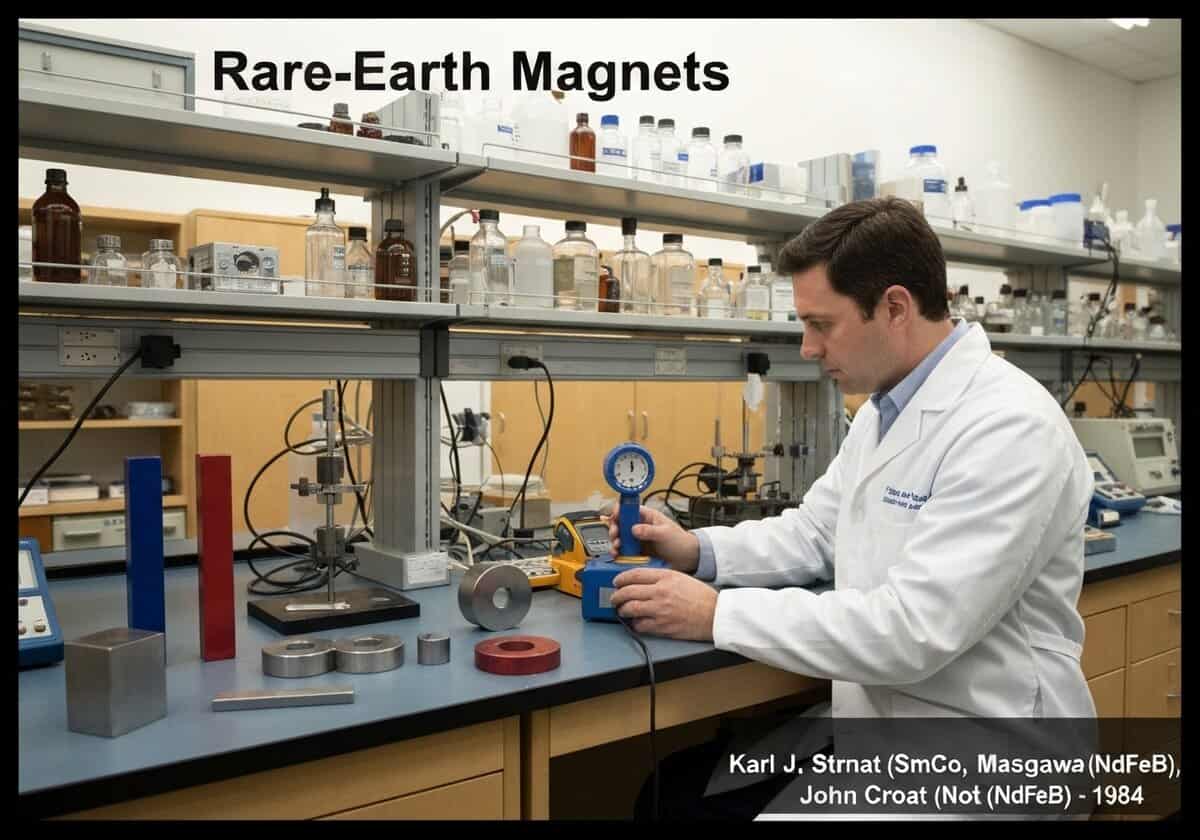
Rare-Earth Magnets
1984
- Karl J. Strnat (SmCo)
- Masato Sagawa (NdFeB)
- John Croat (NdFeB)
Terre rare Les aimants sont des aimants permanents puissants fabriqués à partir d'alliages de éléments des terres rares. Developed in the 1970s and 1980s, the most common types are neodymium magnets (NdFeB) and samarium–cobalt magnets (SmCo). They are the strongest type of permanent magnets made, producing significantly stronger magnetic fields than ferrite or alnico magnets, enabling miniaturization and improved performance in many technologies. Note: the term ‘rare-earth element’ is a historical misnomer. These elements are not exceptionally rare in the Earth’s crust. Cerium, the most abundant, is the 25th most abundant element, similar to copper. Even the least abundant stable terres rares, lutetium, is nearly 200 times more common than gold. The ‘rare’ label arose because they were difficult to separate.
La force exceptionnelle des aimants en terres rares provient de leur structure cristalline unique et des propriétés des éléments des terres rares. Les éléments lanthanides, tels que le néodyme et le samarium, possèdent une forte anisotropie magnétique. Cela signifie que leur réseau cristallin présente un axe d'aimantation préférentiel, ce qui rend très difficile le changement de direction de leurs moments magnétiques une fois qu'ils sont alignés. Cette propriété se traduit par une coercivité (résistance à la désaimantation) très élevée. Les métaux de transition de l'alliage, comme le fer ou le cobalt, contribuent à une saturation magnétique très élevée, ce qui signifie qu'ils peuvent supporter un champ magnétique très fort. La combinaison d'une coercivité et d'une saturation magnétique élevées se traduit par un produit d'énergie maximale très élevé ([latex](BH)_{max}[/latex]), qui est le principal facteur de mérite des aimants permanents.
Samarium-cobalt magnets were developed first in the early 1970s and have a higher Curie temperature, making them suitable for high-temperature applications. Neodymium magnets, developed in 1984 independently by General Motors and Sumitomo Special Metals, are even stronger but have a lower Curie temperature, though modern alloys have improved this. The development of rare-earth magnets was a revolutionary step in materials science, enabling the creation of smaller, lighter, and more powerful electric motors, generators, and other devices that were previously impractical.
UNESCO Nomenclature: 2211
- Physique de l'état solide
Taper
Dispositif physique
Perturbation
Révolutionnaire
Usage
Utilisation généralisée
Précurseurs
- discovery of rare-earth elements
- development of powder metallurgy and sintering techniques
- understanding of ferromagnetism and magnetic anisotropy
- development of alnico and ferrite magnets
Applications
- hard disk drives (voice coil motors)
- electric vehicle motors
- wind turbine generators
- headphones and loudspeakers
- mri scanners
- cordless tools
- magnetic clasps and toys
Idées d'innovations potentielles
En raison du trafic généré par les robots de scraping, actuellement supérieur à 40 000 par jour, ce contenu est réservé aux membres de la communauté.
> Connexion < ou > Registre < (100% gratuit) pour y accéder, ainsi qu'à tous les autres contenus et outils à accès restreint.
Voir aussi : aimant en terres rares, aimant en néodyme, ndfeb, samarium-cobalt, smco, aimant permanent, coercivité, anisotropie magnétique, produit énergétique, science des matériaux.