Product Design, Manufacturing & Innovation Resources
Home » Q-switching (lasers)

Q-switching (lasers)

1962
  • R. W. Hellwarth
  • F. J. McClung
Q-switched laser system in a modern laboratory for non-linear optics applications.

(generated image for illustration only)

Q-switching is a technique for producing high-intensity, short-duration laser pulses. It works by temporarily preventing laser action, allowing the gain medium to store a large amount of energy via population inversion. The laser’s quality factor (Q-factor) is then rapidly switched to a high value, causing the stored energy to be released in a single, powerful nanosecond pulse.

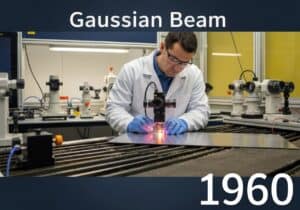
The term ‘Q-switching’ refers to the modulation of the quality factor (Q-factor) of the laser’s optical resonator. The Q-factor is a measure of the energy storage capability of the resonator; a high Q-factor means low loss, while a low Q-factor means high loss. The Q-switching process involves two stages. First, the Q-factor of the cavity is deliberately kept low (high loss) while the gain medium is being pumped. This prevents the buildup of stimulated emission and stops lasing from starting, even though a very large population inversion is being created. The gain medium acts as an energy storage capacitor.

Once the maximum possible energy is stored in the gain medium, the Q-factor is suddenly switched to a high value (low loss). This is done using a Q-switch device placed inside the cavity. With the losses now very low, the optical gain far exceeds the lasing threshold. The intense field of spontaneously emitted photons inside the cavity rapidly triggers a massive cascade of stimulated emission, depleting the stored energy in the gain medium almost instantaneously. This results in the emission of a single, giant pulse of light with a very high peak power (megawatts to gigawatts) and a short duration, typically on the order of nanoseconds. Common Q-switch devices include rotating mirrors (the original method), acousto-optic modulators, and electro-optic modulators (Pockels cells).

UNESCO Nomenclature: 2210
– Optics

Type

Technique

Disruption

Substantial

Usage

Widespread Use

Precursors

  • invention of the laser
  • understanding of laser cavity dynamics and the Q-factor
  • development of fast optical shutters (e.g., Kerr cells)

Applications

  • laser tattoo removal
  • industrial material processing (cutting, drilling)
  • lidar systems for mapping and range finding
  • pumping other lasers (e.g., dye lasers)
  • nonlinear optics research

Patents:

NA

Potential Innovations Ideas

Due to scrapping bot traffic, currently more than 40k per day, this content is reserved to community members.
> Login < or > Register < (100% free) to access this, so as all other restricted content and tools.

Related to: Q-switching, pulsed laser, giant pulse, peak power, Q-factor, laser cavity, population inversion, energy storage, acousto-optic modulator, Pockels cell.

Historical Context

Q-switching (lasers)

1960
1960
1961
1962
1963
1965
1970
1960
1960
1960-05-16
1962
1963
1964
1968
1970

(if date is unknown or not relevant, e.g. "fluid mechanics", a rounded estimation of its notable emergence is provided)

Related Invention, Innovation & Technical Principles

Full size images and downloads are only available, 100% free, for registered members.

> Login <