Product Design, Manufacturing & Innovation Resources
Home » Peroxyoxalate Chemiluminescence

Peroxyoxalate Chemiluminescence

1960
  • Michael M. Rauhut
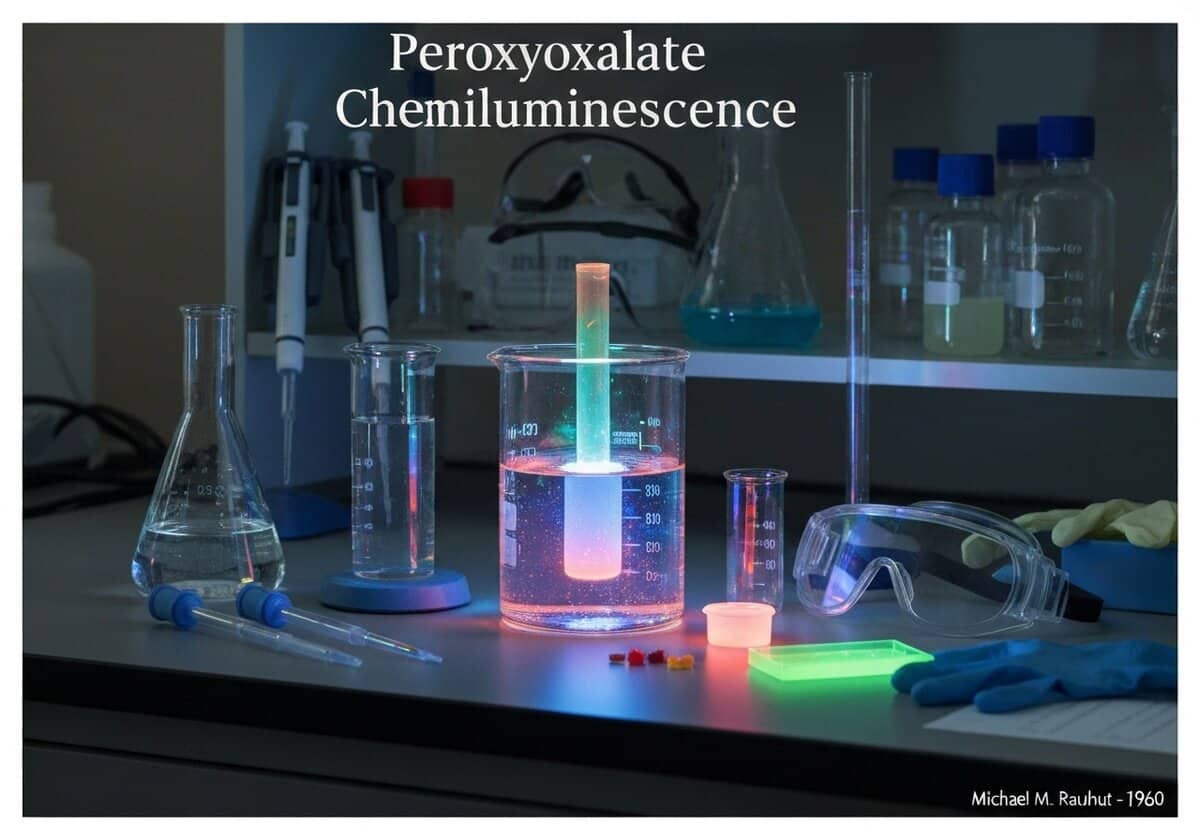
Laboratory setup for peroxyoxalate chemiluminescence reaction in organic chemistry.

(generated image for illustration only)

This is the chemical process responsible for the light in glow sticks. It involves the reaction of a diaryl oxalate ester (like diphenyl oxalate) with hydrogen peroxide in the presence of a fluorescent dye (fluorophore). The reaction produces a high-energy chemical intermediate, which then transfers its energy to the dye molecule. The excited dye molecule then relaxes, emitting a photon of a specific color.
The peroxyoxalate reaction is one of the most efficient non-biological chemiluminescent processes known, with quantum yields reaching up to 23%. The mechanism is complex but is believed to involve the formation of a highly unstable, high-energy intermediate, often proposed to be 1,2-dioxetanedione (\(C_2O_4\)). This intermediate is generated from the reaction between the oxalate ester and hydrogen peroxide. The key step is the chemically initiated electron exchange luminescence (CIEEL). The unstable intermediate transfers an electron to the nearby fluorophore, causing the intermediate to fragment (into two molecules of \(CO_2\)) and the fluorophore to become a radical cation. An immediate back-electron transfer from the fragmented intermediate to the fluorophore radical cation generates the fluorophore in an electronically excited state. This excited fluorophore then emits light. The color of the light is determined entirely by the choice of fluorophore (e.g., 9,10-diphenylanthracene for blue, rhodamine B for red), not by the primary oxalate reaction. This allows for the production of a wide spectrum of colors simply by changing the dye additive.

UNESCO Nomenclature: 2203
– Organic chemistry

Type

Chemical Process

Disruption

Substantial

Usage

Widespread Use

Precursors

  • synthesis of oxalate esters
  • discovery and understanding of fluorescence and fluorophores
  • research into reaction mechanisms involving high-energy intermediates
  • industrial chemistry development for safe packaging of reactive chemicals

Applications

  • emergency lighting (glow sticks)
  • military applications for marking and illumination
  • recreational uses (parties, concerts)
  • deep-sea fishing lures
  • analytical chemistry techniques

Patents:

  • US3597362

Potential Innovations Ideas

Due to scrapping bot traffic, currently more than 40k per day, this content is reserved to community members.
> Login < or > Register < (100% free) to access this, so as all other restricted content and tools.

Related to: peroxyoxalate, chemiluminescence, glow stick, light stick, diphenyl oxalate, hydrogen peroxide, fluorophore, CIEEL, 1,2-dioxetanedione, quantum yield.

Historical Context

Peroxyoxalate Chemiluminescence

1960
1960
1960
1960
1960
1960
1961
1960
1960
1960
1960
1960
1960
1960-05-16
1962

(if date is unknown or not relevant, e.g. "fluid mechanics", a rounded estimation of its notable emergence is provided)

Related Invention, Innovation & Technical Principles

Full size images and downloads are only available, 100% free, for registered members.

> Login <