Product Design, Manufacturing & Innovation Resources
Home » The Perfect Gas Model

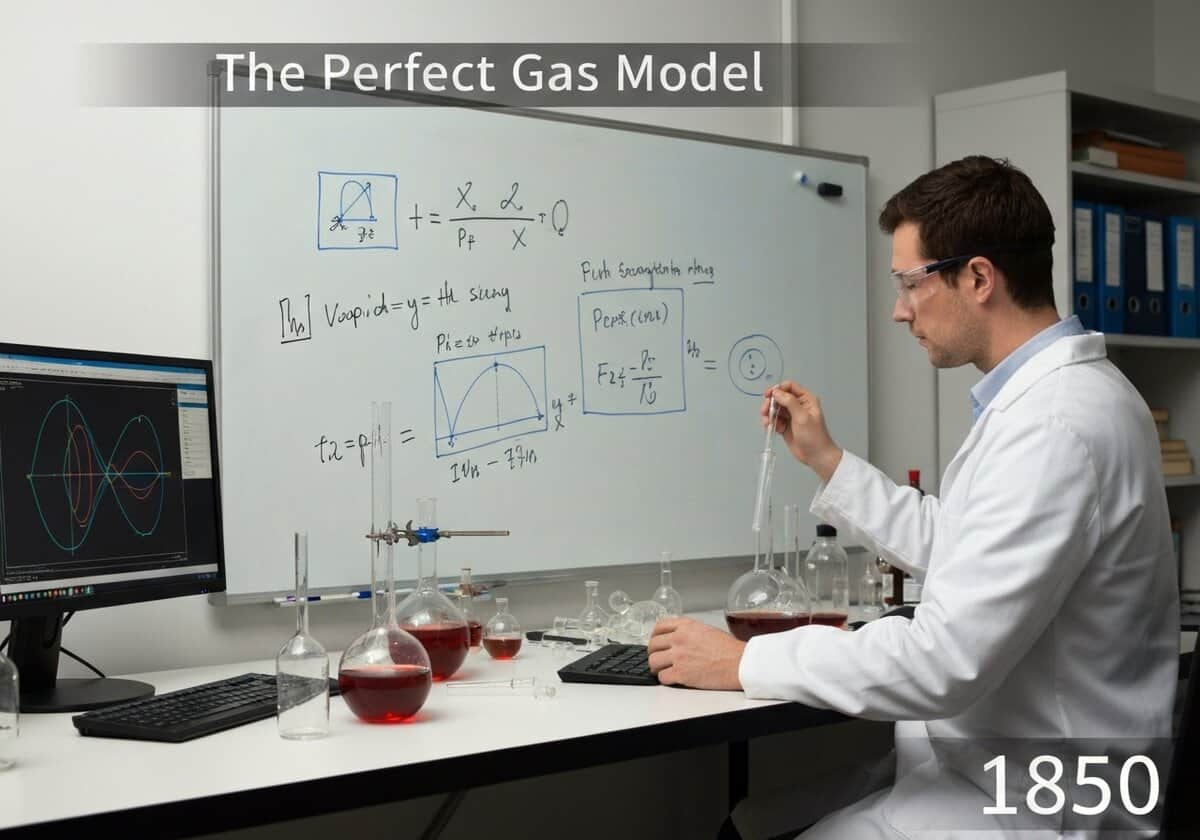
The Perfect Gas Model

1850
Laboratory scene illustrating thermodynamic experiments on the Perfect Gas Model.

(generated image for illustration only)

A perfect gas is a theoretical model of a gas where intermolecular forces are neglected and specific heat capacities (\(C_P\) and \(C_V\)) are assumed to be constant with respect to temperature. This simplifies thermodynamic calculations significantly. It is a specific case of the ideal gas, where specific heats can vary with temperature, making it a more constrained model.

The perfect gas model is a refinement and simplification used extensively in thermodynamics and fluid mechanics. While the ideal gas law, \(PV=nRT\), only assumes negligible intermolecular forces and molecular volume, the perfect gas model adds the constraint that the specific heats at constant pressure (\(C_P\)) and constant volume (\(C_V\)) are constant. This additional assumption is crucial because it implies that the internal energy (\(U\)) and enthalpy (\(H\)) are solely linear functions of temperature. Specifically, \(dU = C_V dT\) and \(dH = C_P dT\).

This simplification is reasonably accurate for monatomic gases (like helium, argon) and diatomic gases (like nitrogen, oxygen) over a moderate range of temperatures where vibrational modes are not significantly excited. However, for polyatomic gases or over wide temperature ranges, the specific heats do change, and the more general semi-perfect (or thermally perfect) gas model is required. The perfect gas model is foundational in education for introducing thermodynamic concepts and provides a first-order approximation for many real-world engineering problems, especially in gas dynamics and propulsion systems analysis.

UNESCO Nomenclature: 2212
– Thermodynamics

Type

Abstract System

Disruption

Substantial

Usage

Widespread Use

Precursors

  • ideal gas law
  • joule’s first law (internal energy of an ideal gas depends only on temperature)
  • kinetic theory of gases
  • boyle’s law
  • charles’s law

Applications

  • thermodynamic cycle analysis (e.g., otto, diesel, brayton cycles)
  • preliminary aerospace engineering calculations
  • fluid dynamics simulations
  • chemical engineering process design
  • meteorology and atmospheric modeling

Patents:

NA

Potential Innovations Ideas

Due to scrapping bot traffic, currently more than 40k per day, this content is reserved to community members.
> Login < or > Register < (100% free) to access this, so as all other restricted content and tools.

Related to: perfect gas, ideal gas, thermodynamics, specific heat, constant heat capacity, theoretical model, equation of state, internal energy, enthalpy, fluid dynamics.

Historical Context

The Perfect Gas Model

1850
1850
1850
1850
1850
1851
1852
1847
1850
1850
1850
1850
1850
1851
1854

(if date is unknown or not relevant, e.g. "fluid mechanics", a rounded estimation of its notable emergence is provided)

Related Invention, Innovation & Technical Principles

Full size images and downloads are only available, 100% free, for registered members.

> Login <