Product Design, Manufacturing & Innovation Resources
Home » Parametric Modeling in CAD

Parametric Modeling in CAD

1987
  • Samuel Geisberg
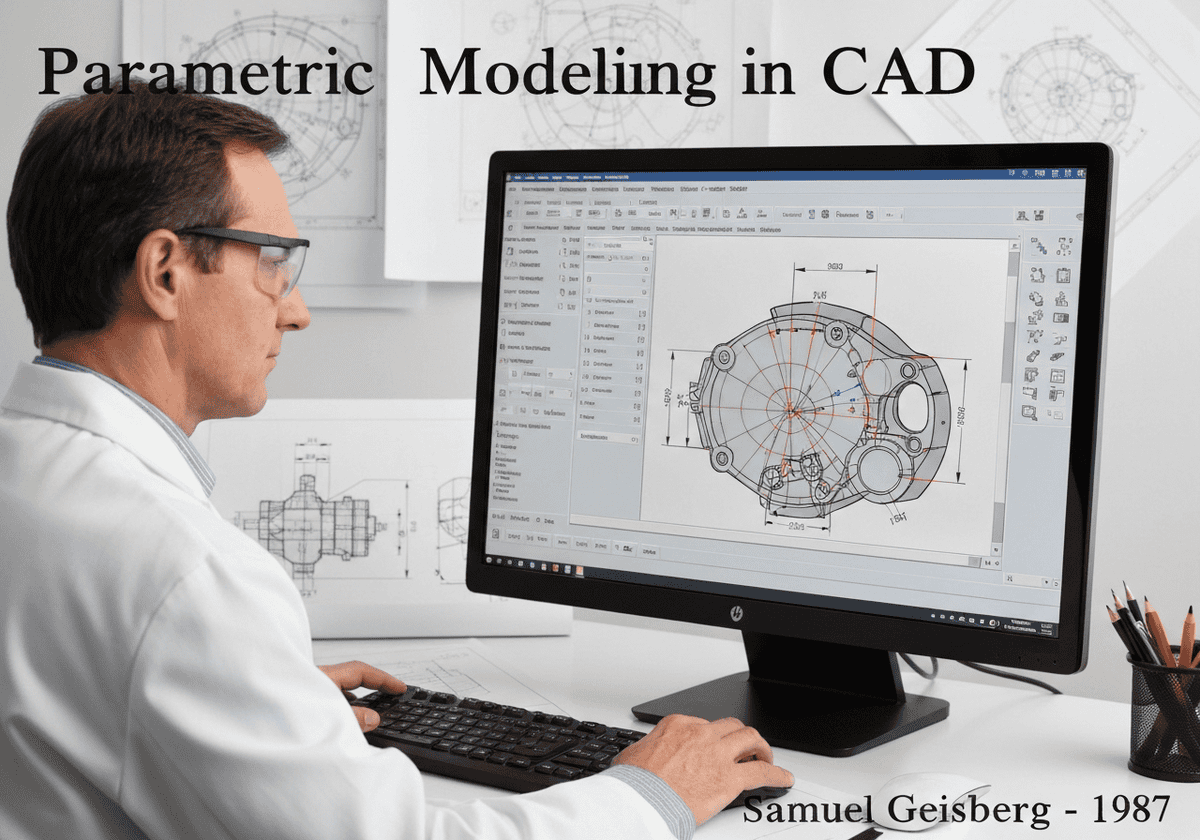
Mechanical engineer using CAD software for parametric modeling of engine components.

(generated image for illustration only)

Parametric modeling is a CAD paradigm where designs are defined by parameters and constraints rather than just geometric shapes. Dimensions and relationships between features (e.g., parallelism, tangency) are stored as parameters. Modifying a parameter value automatically updates the entire model, maintaining the defined constraints. This approach facilitates design iteration, automation, and the creation of design families.


Parametric modeling represents a significant evolution from earlier ‘dumb’ 2D or 3D CAD systems, where geometry was explicitly defined and had no inherent intelligence. In a parametric system, the model is not just a collection of lines and surfaces, but a structured recipe of how it was built. This is often referred to as ‘history-based’ or ‘feature-based’ modeling. Each operation, such as an extrusion, a cut, or a fillet, is recorded as a ‘feature’ in a model tree. These features are defined by parameters, which can be numerical values (like length or radius) or geometric constraints (like perpendicularity or concentricity).

The power of this approach lies in its ‘design intent’ capture. The designer embeds rules and relationships into the model. For example, a hole can be defined to always be centered on a face and have a diameter that is half the face’s width. If the width of the face is later changed, the hole’s position and size will automatically update to maintain the specified relationships. This makes design changes significantly faster and less error-prone. It also allows for the creation of configurable parts or assemblies. By linking parameters to a spreadsheet or a design table, a user can generate hundreds of variations of a part (a ‘design family’) simply by changing the input values, which is invaluable for creating standard components like screws, bolts, or beams of different sizes.

UNESCO Nomenclature: 3305
– Computer science

Type

Software/Algorithm

Disruption

Revolutionary

Usage

Widespread Use

Precursors

  • sketchpad’s constraint system
  • non-parametric 3d solid modeling
  • development of feature recognition algorithms
  • advances in computational geometry

Applications

  • mechanical engineering design (e.g., engine parts)
  • architectural design (building information modeling – bim)
  • product design and rapid prototyping
  • aerospace component design
  • automated generation of manufacturing drawings

Patents:

NA

Potential Innovations Ideas

Due to scrapping bot traffic, currently more than 40k per day, this content is reserved to community members.
> Login < or > Register < (100% free) to access this, so as all other restricted content and tools.

Related to: parametric modeling, cad, constraints, design intent, feature-based modeling, pro/engineer, solidworks, history-based modeling.

Historical Context

Parametric Modeling in CAD

1981
1986
1986
1987
1989
1990
1990
1980
1984
1986
1986
1987-03
1990
1990
1990

(if date is unknown or not relevant, e.g. "fluid mechanics", a rounded estimation of its notable emergence is provided)

Related Invention, Innovation & Technical Principles

Full size images and downloads are only available, 100% free, for registered members.

> Login <