Product Design, Manufacturing & Innovation Resources
Home » Numerical Control

Numerical Control

1950
  • John T. Parsons
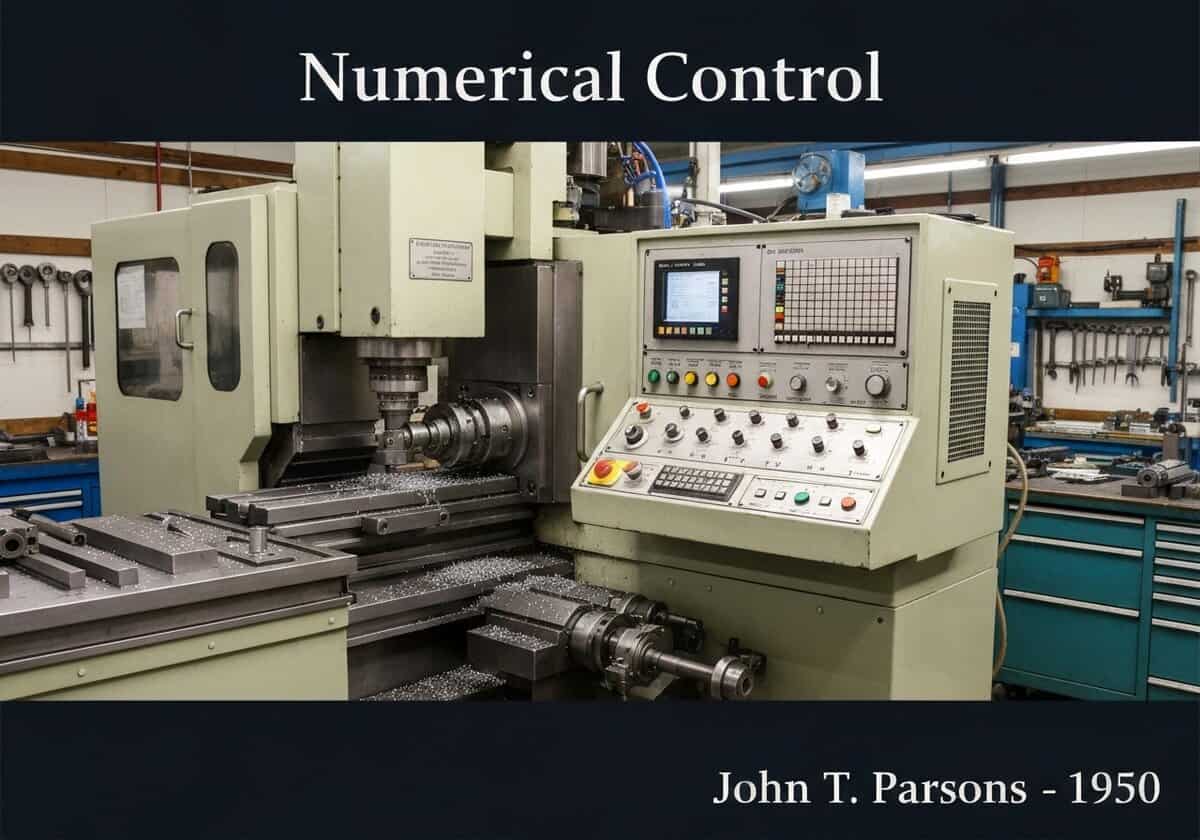
CNC machine with control panel in an automated manufacturing workshop.

(generated image for illustration only)

Numerical Control (NC) is the automated control of machining tools using a program composed of precisely coded alphanumeric data. This program dictates the tool’s path, feed rate, speed, and other operational parameters. Early NC systems utilized punched paper tape as the input medium, marking a significant technological leap from manual control via handwheels or physical templates.


The concept of Numerical Control (NC) emerged in the post-World War II era as a solution to the challenge of manufacturing complex curved profiles for helicopter rotor blades and aircraft components. John T. Parsons, working for his family’s company, Parsons Corporation, conceived of using mathematical coordinate data to define the toolpath for a milling machine. The core idea was to feed the machine a series of discrete points defining a surface, and have the machine’s control system move the cutting tool between these points. This replaced the traditional, skill-intensive method of using physical templates (cams and tracers) or manual operation, which were slow and prone to error for complex shapes.

In 1949, Parsons partnered with the MIT Servomechanisms Laboratory, funded by the U.S. Air Force, to bring this concept to fruition. The project resulted in the first successful demonstration of an NC milling machine in 1952. This prototype used a vacuum tube-based controller that read instructions from a 1-inch wide, 7-track punched paper tape. The tape contained coded information for the desired positions of the machine’s three axes (X, Y, Z). Servomotors, receiving signals from the controller, would then drive the machine table and cutting head to the specified coordinates. The novelty was revolutionary: for the first time, a machine tool’s movements were governed not by a physical guide but by abstract, programmable data. This decoupled the part’s geometry from any physical master pattern, introducing unprecedented flexibility, repeatability, and accuracy into the manufacturing process. It laid the foundational groundwork for all subsequent automated machining.

UNESCO Nomenclature: 3301
– Automation

Type

Abstract System

Disruption

Revolutionary

Usage

Obsolete

Precursors

  • the jacquard loom’s use of punched cards to control weaving patterns
  • player pianos (pianolas) using punched paper rolls to automate music playback
  • the development of servomechanisms for remote positioning and control
  • advancements in boolean logic and digital computing theory

Applications

  • computer numerical control (CNC) machines
  • automated manufacturing processes
  • robotics and industrial automation
  • 3d printing (additive manufacturing)
  • automated inspection systems

Patents:

  • US2820187A

Potential Innovations Ideas

Due to scrapping bot traffic, currently more than 40k per day, this content is reserved to community members.
> Login < or > Register < (100% free) to access this, so as all other restricted content and tools.

Related to: numerical control, NC, automation, manufacturing, punched tape, john t. parsons, servomechanism, machining, toolpath, automation history.

Historical Context

Numerical Control

1950
1950
1950
1950
1950
1955
1956
1950
1950
1950
1950
1950
1950
1955
1958

(if date is unknown or not relevant, e.g. "fluid mechanics", a rounded estimation of its notable emergence is provided)

Related Invention, Innovation & Technical Principles

Full size images and downloads are only available, 100% free, for registered members.

> Login <