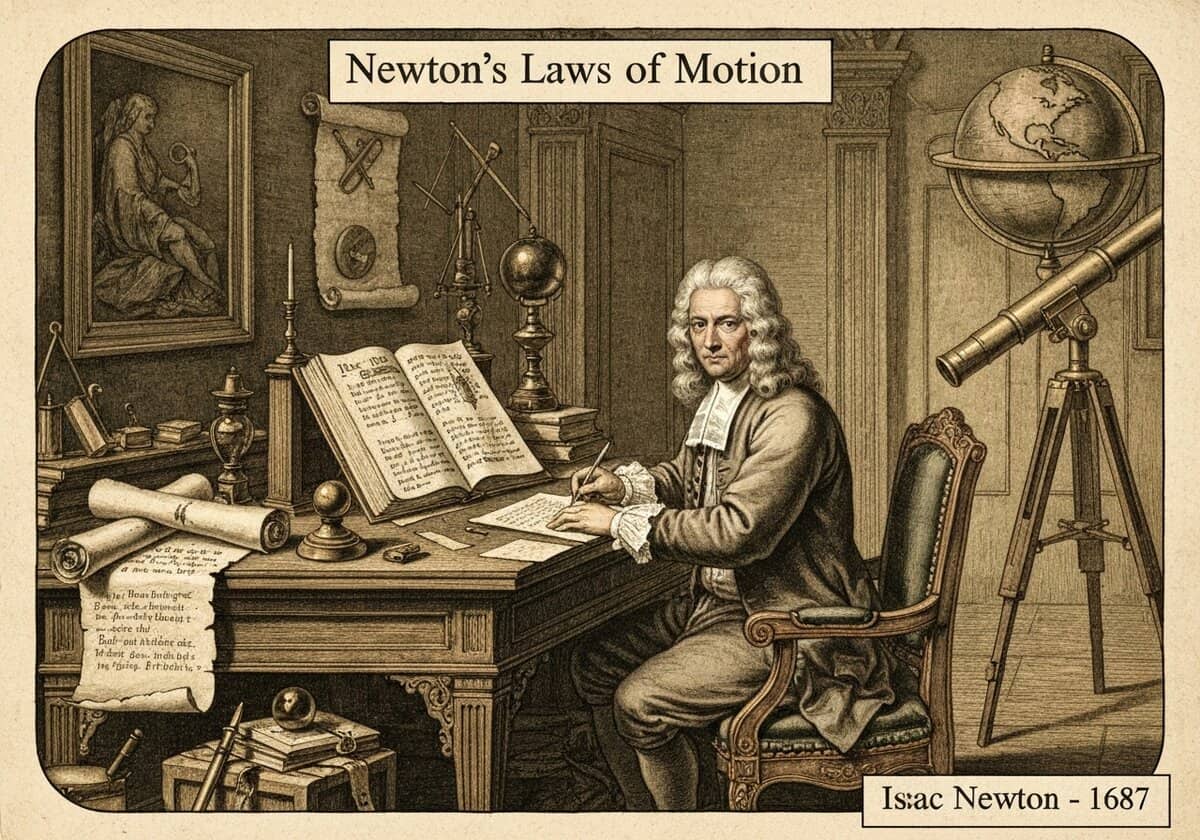
Newton’s Laws of Motion
A set of three physical laws forming the basis of classical mechanics. The first law (inertia) states an object remains at rest or in uniform motion unless acted upon by a net external force. The second law quantifies force as mass times acceleration, \(\vec{F} = m\vec{a}\). The third law states that for every action, there is an equal and opposite reaction.
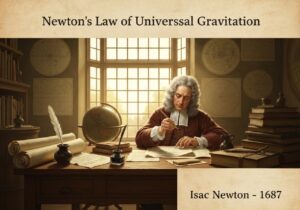
Published in his 1687 work, *Philosophiæ Naturalis Principia Mathematica*, Newton’s three laws of motion revolutionized science. They provided a complete framework for describing the motion of everyday objects, forming the bedrock of what is now known as classical mechanics.
The First Law, the law of inertia, defines an inertial reference frame—a frame of reference where the law holds true. It states that an object’s velocity is constant unless a net force acts upon it. This was a departure from the Aristotelian idea that motion required a continuous force.
The Second Law is the quantitative core of classical dynamics. It states that the net force on an object is equal to the rate of change of its momentum. For an object with constant mass \(m\), this simplifies to the famous equation \(\vec{F} = m\vec{a}\), where \(\vec{F}\) is the net force vector and \(\vec{a}\) is the resulting acceleration vector. This is a differential equation, and solving it allows for the prediction of an object’s trajectory through time.
The Third Law, the law of action and reaction, states that forces always occur in pairs. If object A exerts a force on object B, then object B simultaneously exerts a force on object A that is equal in magnitude and opposite in direction. This principle is fundamental to understanding interactions and directly leads to the law of conservation of momentum.
These laws are remarkably accurate for the macroscopic world at speeds much less than the speed of light. Their validity breaks down in the realms of special relativity (at high speeds) and quantum mechanics (at atomic and subatomic scales), where they are replaced by more general theories.
UNESCO Nomenclature: 2211
– Physics
Precursors
- Galileo’s concept of inertia
- Kepler’s laws of planetary motion
- Work of René Descartes on motion
- Aristotelian physics (as a framework to be replaced)
Applications
- vehicle engineering (cars, planes, rockets)
- structural engineering (bridges, buildings)
- robotics and automation
- ballistics and projectile motion calculations
- celestial mechanics and satellite orbits
Potential Innovations Ideas
Due to scrapping bot traffic, currently more than 40k per day, this content is reserved to community members.
> Login < or > Register < (100% free) to access this, so as all other restricted content and tools.
Related to: newton’s laws, classical mechanics, force, mass, acceleration, inertia, action-reaction, dynamics.