Product Design, Manufacturing & Innovation Resources
Home » Mineral Carbonation for CO2 Storage

Mineral Carbonation for CO2 Storage

2000
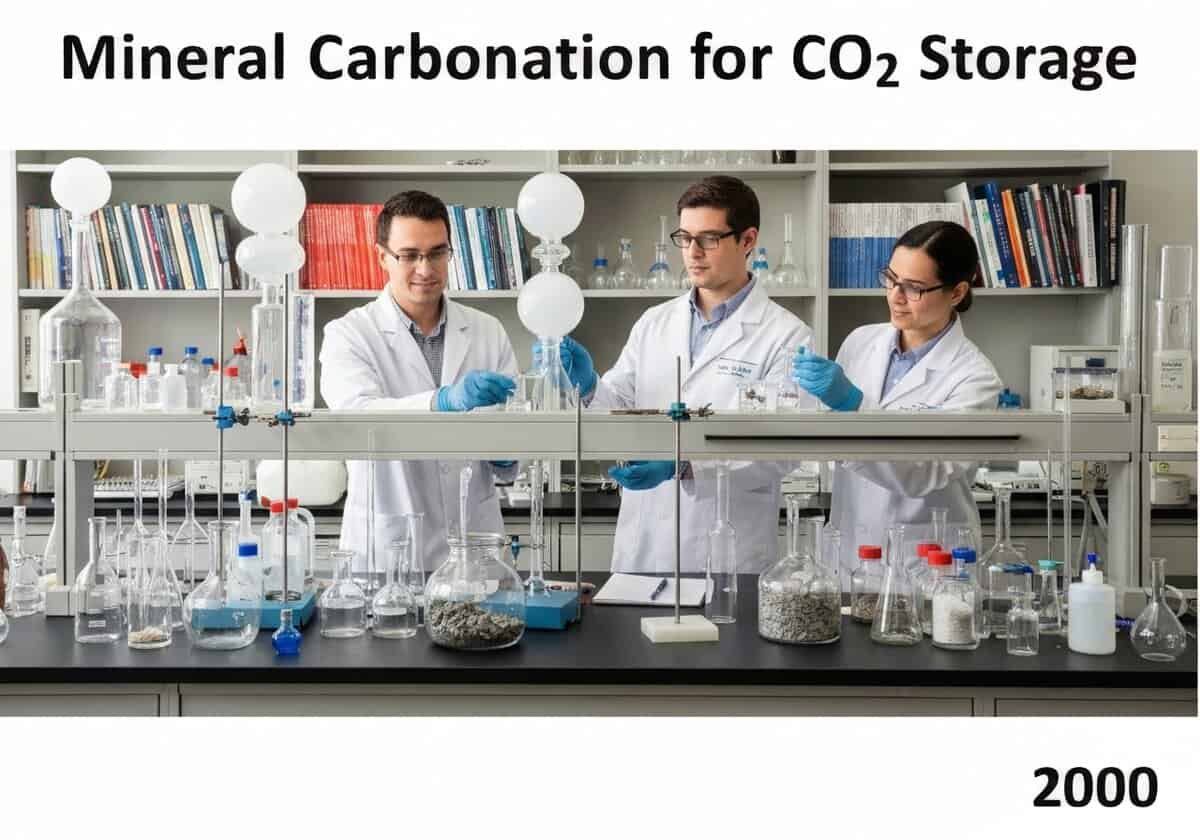
Laboratory experiment on mineral carbonation for CO2 storage in inorganic chemistry.

(generated image for illustration only)

A chemical process that mimics natural rock weathering to permanently store CO2. It involves reacting carbon dioxide with minerals containing metal oxides, such as magnesium oxide (MgO) and calcium oxide (CaO), to form stable carbonate minerals like magnesite (\(MgCO_3\)) and calcite (\(CaCO_3\)). This method offers very secure, long-term storage with a low risk of leakage.


Mineral carbonation is considered one of the safest methods for long-term carbon sequestration because it binds CO2 into a thermodynamically stable solid state, similar to how carbon is stored over geological timescales. The core chemical reactions are exothermic. For example, the carbonation of olivine (magnesium silicate) can be represented as: \(Mg_2SiO_4 (s) + 2CO_2 (g) \rightarrow 2MgCO_3 (s) + SiO_2 (s)\).

The process can be carried out *ex situ* or *in situ*. In *ex situ* processes, suitable rocks (like olivine or serpentine) or industrial wastes (like steel slag) are mined, crushed, and reacted with CO2 in a controlled industrial facility. The primary challenge is the slow reaction kinetics at ambient temperatures and pressures. To accelerate the reaction, the minerals often require energy-intensive pre-treatment, such as fine grinding or heating, which can create a significant energy penalty and increase costs.

In contrast, *in situ* mineral carbonation involves injecting CO2, often dissolved in water to create carbonic acid, into reactive rock formations underground, such as basalt. The carbonic acid dissolves the rock, releasing metal ions (Ca²⁺, Mg²⁺, Fe²⁺) which then react with the bicarbonate to precipitate as carbonate minerals within the rock’s pores. The CarbFix project in Iceland has successfully demonstrated this approach, showing that over 95% of injected CO2 can be mineralized in less than two years, a much faster rate than initially predicted.

UNESCO Nomenclature: 2401
– Chemistry

Type

Chemical Process

Disruption

Incremental

Usage

Emerging Technology

Precursors

  • understanding of chemical thermodynamics and reaction kinetics
  • knowledge of geochemistry and the natural rock weathering cycle
  • industrial processes for mineral grinding and processing
  • development of high-pressure chemical reactors
  • studies on the formation of carbonate rocks

Applications

  • production of carbon-negative concrete and construction aggregates
  • treatment of industrial waste streams like steel slag and mine tailings
  • in-situ carbonation projects in basaltic rock formations (e.g., carbfix project in iceland)
  • development of novel building materials that cure by absorbing CO2

Patents:

NA

Potential Innovations Ideas

Due to scrapping bot traffic, currently more than 40k per day, this content is reserved to community members.
> Login < or > Register < (100% free) to access this, so as all other restricted content and tools.

Related to: mineral carbonation, enhanced weathering, carbon mineralization, olivine, serpentine, calcite, magnesite, ex-situ, in-situ, carbfix.

Historical Context

1990
1990
1997
2000
1990
1990
1997
2000
2008

(if date is unknown or not relevant, e.g. "fluid mechanics", a rounded estimation of its notable emergence is provided)

Related Invention, Innovation & Technical Principles

Full size images and downloads are only available, 100% free, for registered members.

> Login <