Product Design, Manufacturing & Innovation Resources
Home » Earth’s Magnetosphere

Earth’s Magnetosphere

1960
  • James Van Allen
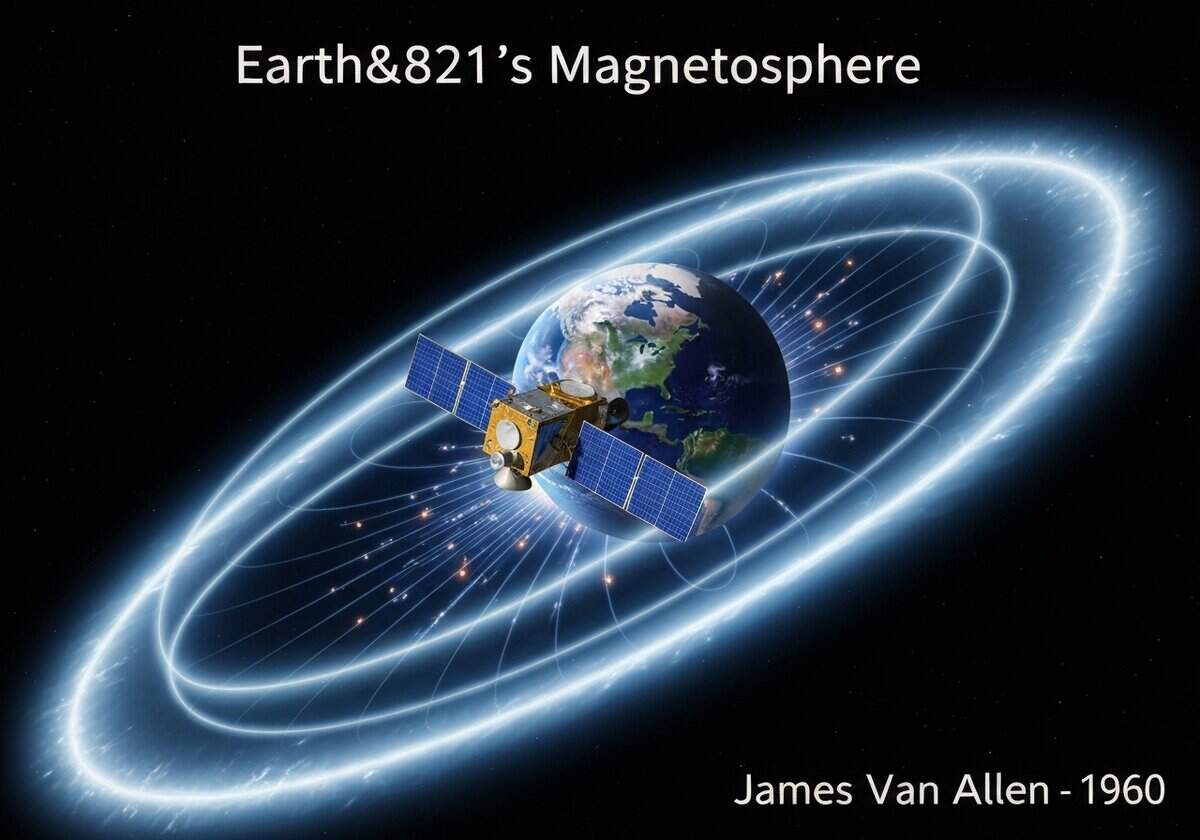
Satellite in low Earth orbit illustrating Earth's magnetosphere and its protective role against solar radiation.

(generated image for illustration only)

The magnetosphere is the region of space surrounding Earth where the planet’s magnetic field, rather than the solar wind’s magnetic field, is dominant. It is formed by the interaction of the solar wind with Earth’s intrinsic magnetic field. This interaction creates a bow shock and deflects most of the charged particles from the Sun, protecting the atmosphere from erosion.

The magnetosphere is a complex and dynamic structure shaped by the solar wind, a continuous stream of charged particles (mostly protons and electrons) flowing from the Sun. On the side facing the Sun, the magnetosphere is compressed and extends about 10 Earth radii. The outer boundary is the magnetopause. Upstream of the magnetopause is the bow shock, where the supersonic solar wind abruptly slows down. On the opposite side, the night side, the magnetosphere is stretched out into a long tail, the magnetotail, which extends hundreds of Earth radii.

Within the magnetosphere are the Van Allen radiation belts, two doughnut-shaped zones of energetic charged particles trapped by the magnetic field. The inner belt consists mainly of high-energy protons, while the outer belt is primarily composed of high-energy electrons. These belts pose a hazard to satellites. The magnetosphere also channels solar particles towards the magnetic poles, where they collide with atoms in the upper atmosphere, causing the spectacular auroras (aurora borealis and aurora australis). During intense solar events, known as geomagnetic storms, the magnetosphere can be severely compressed, leading to auroras at lower latitudes and posing risks to power grids and communication systems.

UNESCO Nomenclature: 2511
– Meteorology

Type

Physical Phenomenon

Disruption

Foundational

Usage

Widespread Use

Precursors

  • discovery of Earth’s magnetic field
  • theoretical prediction of the solar wind by Eugene Parker
  • development of rocketry and satellites for in-situ measurements
  • understanding of plasma physics

Applications

  • protecting satellites in orbit from harmful solar radiation
  • enabling radio communication over long distances by trapping plasma in the ionosphere
  • understanding and predicting space weather phenomena like geomagnetic storms
  • studying plasma physics in a natural laboratory
  • protecting life on Earth from cosmic rays and solar wind

Patents:

NA

Potential Innovations Ideas

Due to scrapping bot traffic, currently more than 40k per day, this content is reserved to community members.
> Login < or > Register < (100% free) to access this, so as all other restricted content and tools.

Related to: magnetosphere, solar wind, bow shock, magnetopause, Van Allen belts, aurora, space weather, plasma physics, geomagnetic storm, charged particles.

Historical Context

Earth’s Magnetosphere

1940
1946
1950
1960
1970
1970
1978
1940
1940
1950
1950
1960
1970
1975
1980

(if date is unknown or not relevant, e.g. "fluid mechanics", a rounded estimation of its notable emergence is provided)

Related Invention, Innovation & Technical Principles

Full size images and downloads are only available, 100% free, for registered members.

> Login <