Mach Number and Compressibility
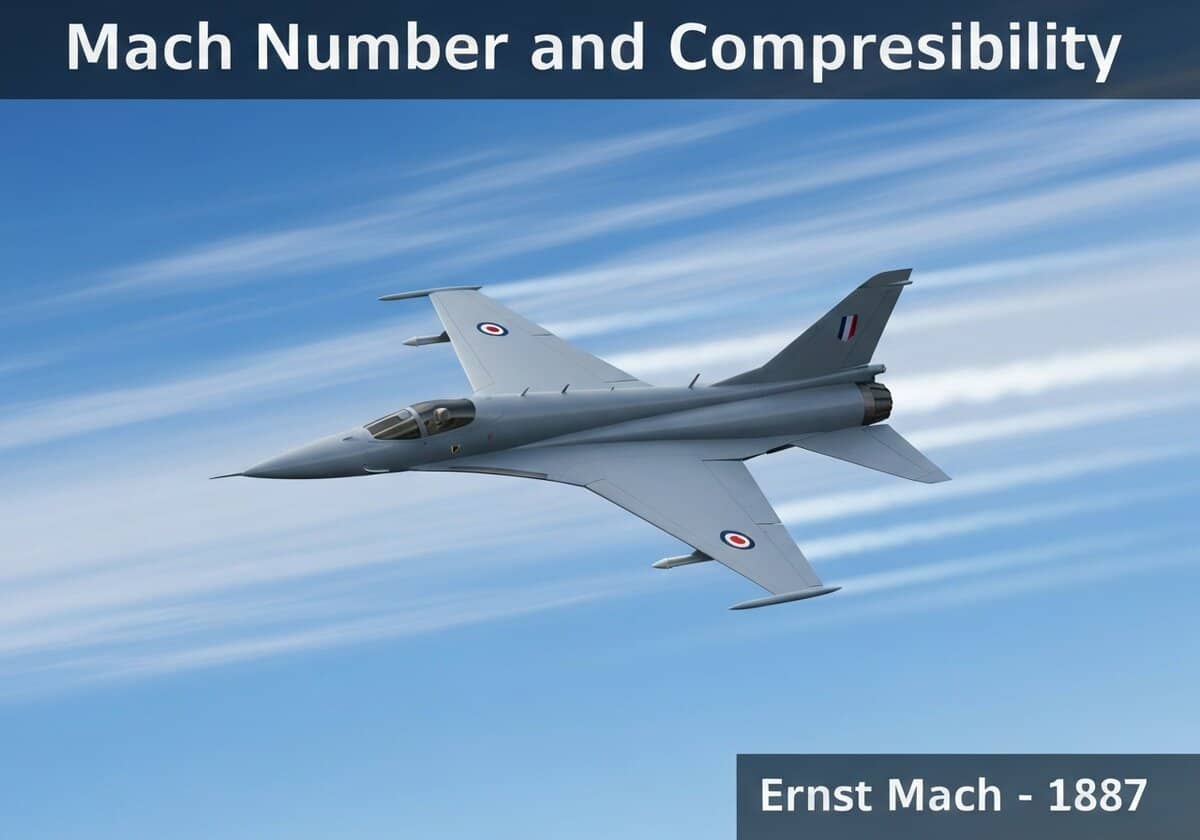
The Mach number (M) is a dimensionless quantity representing the ratio of flow velocity past a boundary to the local speed of sound: \(M = v/a\), where v is the flow velocity and a is the speed of sound. It is the primary indicator of compressibility effects. As Mach number approaches and exceeds 1, the density of the air changes significantly, altering aerodynamic forces.
The Mach number is the most important parameter when analyzing high-speed, compressible flows. Unlike low-speed (incompressible) flow where air density is assumed constant, at high speeds, this assumption breaks down. The Mach number categorizes flow into distinct regimes: subsonic (M < 1), transonic (0.8 < M 1), and hypersonic (M > 5). Each regime has unique physical characteristics.
In the subsonic regime, air behaves much like an incompressible fluid, and pressure disturbances propagate away from the aircraft in all directions. As an aircraft approaches Mach 1 (the transonic regime), air ahead of it has less ‘warning’ of its approach. Airflow begins to reach sonic speed in some areas, like the curved top of the wing, even if the aircraft itself is subsonic. This creates localized shock waves, which are abrupt discontinuities in pressure, density, and temperature. These shocks can cause a dramatic increase in drag (wave drag) and a loss of lift, a phenomenon known as the sound barrier.
Once an aircraft exceeds Mach 1 (supersonic flight), it outruns its own pressure waves. These waves coalesce to form a powerful shock wave, typically a cone-shaped one at the nose and tail, which is heard on the ground as a sonic boom. In supersonic and hypersonic flight, the physics is dominated by these shock waves. Aerodynamic design shifts from smooth, rounded shapes to sharp leading edges to manage the intense heating and forces associated with strong shocks. The study of compressibility is therefore essential for any vehicle designed to travel near or faster than the speed of sound.
UNESCO Nomenclature: 2210
– Mechanics
Precursors
- Studies on the speed of sound by various scientists including Pierre Gassendi and Isaac Newton
- Doppler effect, which describes changes in wave frequency with motion
- Early ballistic studies on projectiles moving faster than sound
Applications
- design of supersonic and hypersonic aircraft like jets and rockets
- understanding sonic booms
- design of high-speed turbine blades in jet engines
- ballistics and projectile design
- nozzles for rocket engines (de laval nozzle)
Potential Innovations Ideas
Due to scrapping bot traffic, currently more than 40k per day, this content is reserved to community members.
> Login < or > Register < (100% free) to access this, so as all other restricted content and tools.
Related to: mach number, compressibility, supersonic, transonic, hypersonic, shock wave, sound barrier, wave drag.