Product Design, Manufacturing & Innovation Resources
Home » Lorentz Force

Lorentz Force

1895
  • Hendrik Lorentz
  • Oliver Heaviside
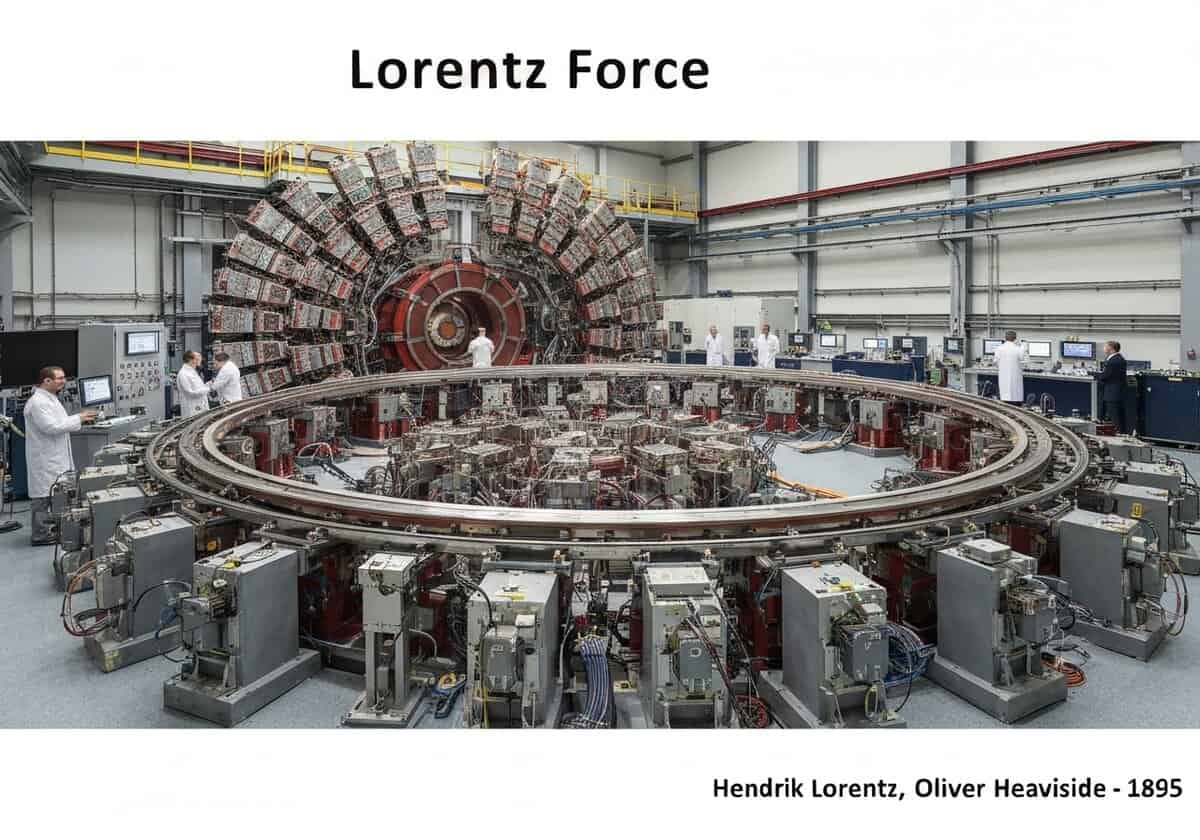
Modern particle accelerator demonstrating Lorentz force applications in electromagnetism.

(generated image for illustration only)

The Lorentz force law describes the total force experienced by a point charge moving through a combined electric and magnetic field. It is the sum of the electrostatic force and the magnetic force. The governing vector equation is \(\mathbf{F} = q(\mathbf{E} + \mathbf{v} \times \mathbf{B})\), where \(q\) is the charge, \(\mathbf{v}\) is its velocity, \(\mathbf{E}\) is the electric field, and \(\mathbf{B}\) is the magnetic field.
The Lorentz force law is a cornerstone of classical electrodynamics, providing the crucial link between electromagnetic fields and the mechanical motion of charged particles. The equation has two distinct components. The first term, \(q\mathbf{E}\), is the electric force, which acts in the direction of the electric field (for a positive charge) and is independent of the particle’s motion. The second term, \(q(\mathbf{v} \times \mathbf{B})\), is the magnetic force. The cross product dictates that this force is always perpendicular to both the particle’s velocity \(\mathbf{v}\) and the magnetic field \(\mathbf{B}\).

A key consequence of this perpendicularity is that a static magnetic field does no work on a free charge, as the force is always at a right angle to the direction of motion. It can change the particle’s direction, but not its kinetic energy. This principle causes charged particles to follow circular or helical paths in a uniform magnetic field, a behavior exploited in devices like mass spectrometers to separate ions by their mass-to-charge ratio and in particle accelerators to steer and focus beams. The law is fully consistent with Maxwell’s equations and is fundamental to understanding phenomena from the operation of electric motors to the behavior of plasmas in stars and fusion reactors.

UNESCO Nomenclature: 2205
– Electricity and Magnetism

Type

Physical Law

Disruption

Foundational

Usage

Widespread Use

Precursors

  • Ampère’s force law on current-carrying wires
  • Faraday’s law of induction
  • Maxwell’s equations
  • J.J. Thomson’s experiments with cathode rays which identified the electron

Applications

  • particle accelerators (cyclotrons, synchrotrons)
  • mass spectrometers
  • electric motors and generators
  • hall effect sensors
  • magnetrons in microwave ovens
  • cathode ray tubes
  • railguns

Patents:

NA

Potential Innovations Ideas

Due to scrapping bot traffic, currently more than 40k per day, this content is reserved to community members.
> Login < or > Register < (100% free) to access this, so as all other restricted content and tools.

Related to: lorentz force, electromagnetic field, electric field, magnetic field, charged particle, velocity, cross product, electromagnetism, force, particle motion.

Historical Context

Lorentz Force

1890
1890
1895
1895
1899
1900
1900
1890
1890
1895
1895
1896
1900
1900
1900

(if date is unknown or not relevant, e.g. "fluid mechanics", a rounded estimation of its notable emergence is provided)

Related Invention, Innovation & Technical Principles

Full size images and downloads are only available, 100% free, for registered members.

> Login <