Product Design, Manufacturing & Innovation Resources
Home » Lithium-ion Battery Electrochemistry

Lithium-ion Battery Electrochemistry

1985
  • M. Stanley Whittingham
  • John B. Goodenough
  • Akira Yoshino
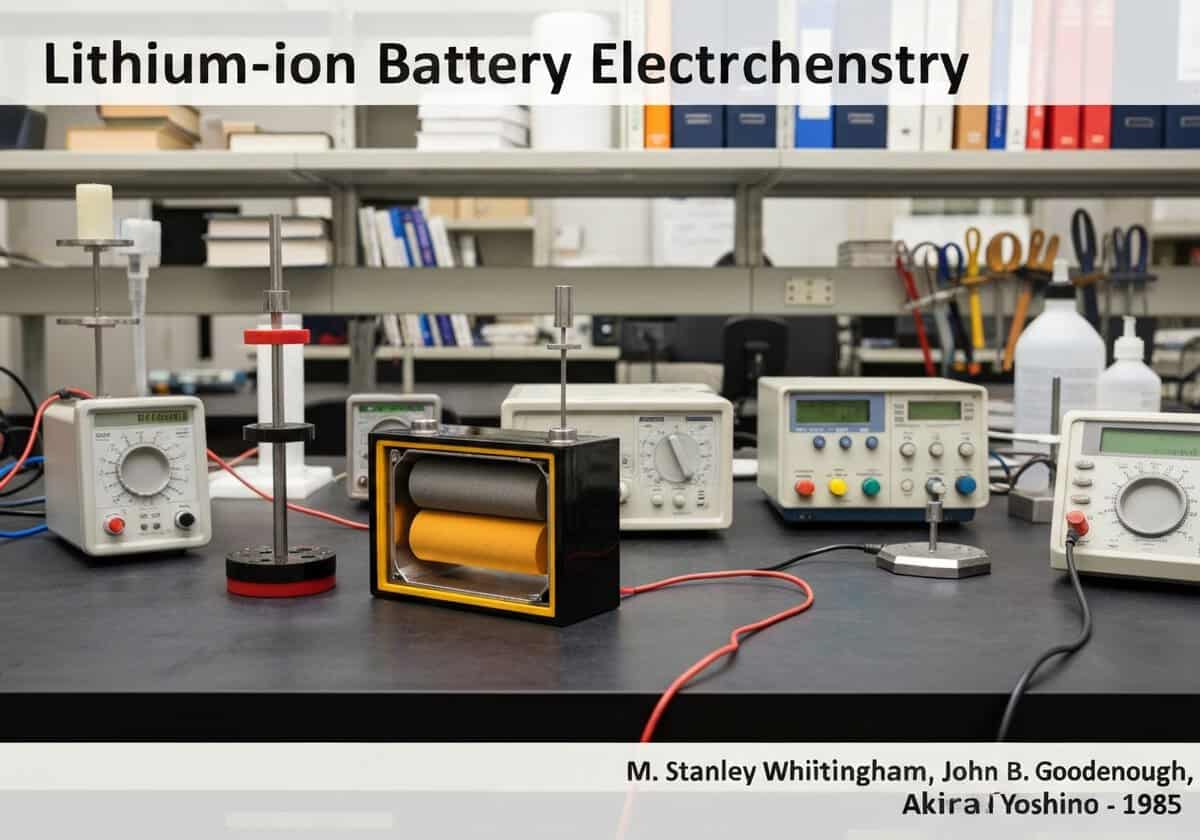
Lithium-ion battery components in a laboratory for electrochemical testing.

(generated image for illustration only)

A lithium-ion (Li-ion) battery is a rechargeable battery where lithium ions move from the negative electrode (anode) through an electrolyte to the positive electrode (cathode) during discharge, and back when charging. It utilizes an intercalated lithium compound as the cathode material and typically graphite as the anode. The high reactivity of lithium allows for high energy density.

The operation of a Li-ion battery is based on the concept of intercalation, where ions are reversibly inserted into a host material without significantly changing the host’s structure. During discharge, lithium atoms at the graphite anode are ionized, releasing an electron and a lithium ion ([latex]Li rightarrow Li^+ + e^-[/latex]). The electrons travel through the external circuit, providing power, while the lithium ions migrate through the electrolyte and separator to the cathode. At the cathode, they are intercalated into the crystal structure of the cathode material (e.g., Lithium Cobalt Oxide, [latex]LiCoO_2[/latex]). The overall reaction for a [latex]LiCoO_2[/latex] cathode and graphite ([latex]C_6[/latex]) anode is: [latex]Li_x C_6 + Li_{1-x} CoO_2 leftrightarrow C_6 + LiCoO_2[/latex]. The process is reversed during charging. The choice of materials for the anode, cathode, and electrolyte is crucial for the battery’s performance, including its energy density, power density, lifespan, and safety. John Goodenough’s contribution in the 1980s was identifying [latex]LiCoO_2[/latex] as a suitable cathode material, which significantly increased the potential voltage compared to earlier designs by M. Stanley Whittingham. Akira Yoshino later developed a safer anode using petroleum coke and then graphite, creating the first commercially viable and safe Li-ion battery.

UNESCO Nomenclature: 2203
– Physical chemistry

Type

Chemical Process

Disruption

Revolutionary

Usage

Widespread Use

Precursors

  • discovery of lithium by johan august arfwedson (1817)
  • development of the voltaic pile by alessandro volta (1800)
  • concept of intercalation chemistry
  • research on lithium batteries in the 1970s

Applications

  • smartphones and laptops
  • electric vehicles (evs)
  • grid-scale energy storage systems
  • cordless power tools
  • medical devices
  • aerospace applications

Patents:

  • US4357215A
  • JP2667902B2

Potential Innovations Ideas

Due to scrapping bot traffic, currently more than 40k per day, this content is reserved to community members.
> Login < or > Register < (100% free) to access this, so as all other restricted content and tools.

Related to: lithium-ion, battery, electrochemistry, intercalation, anode, cathode, electrolyte, energy density, rechargeable, electric vehicles.

Historical Context

Lithium-ion Battery Electrochemistry

1980
1980
1984
1985
1986
1990
1994
1980
1980
1980
1984
1986
1986
1991
1995

(if date is unknown or not relevant, e.g. "fluid mechanics", a rounded estimation of its notable emergence is provided)

Related Invention, Innovation & Technical Principles

Full size images and downloads are only available, 100% free, for registered members.

> Login <