Lambda Calculus
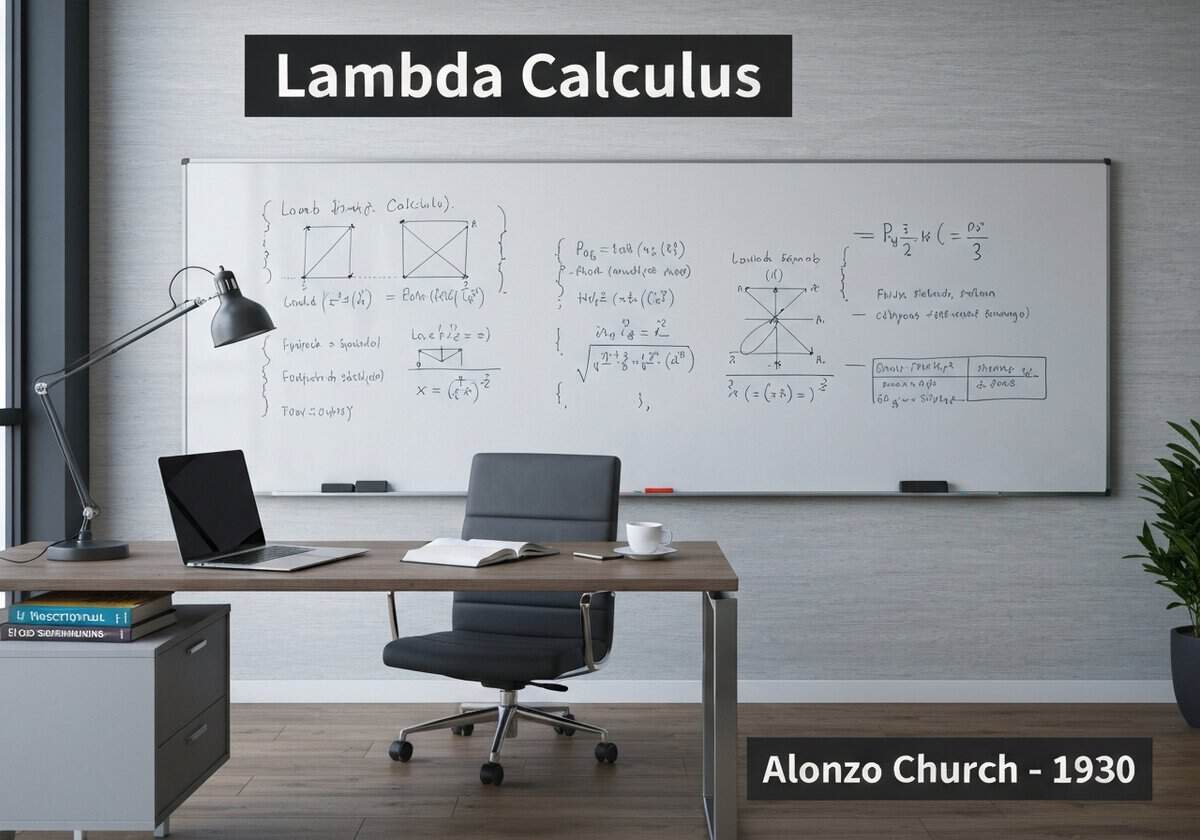
Lambda calculus is a formal system in mathematical logic for expressing computation based on function abstraction and application using variable binding and substitution. It is a universal model of computation that can be used to simulate any Turing machine. It forms the theoretical basis for functional programming languages like Lisp, Haskell, and F#.
Developed by Alonzo Church in the 1930s, lambda calculus provides a minimalist yet powerful framework for defining and applying functions. Its entire syntax consists of just three components: variables (e.g., `x`), abstractions, and applications. An abstraction, or lambda function, is an anonymous function definition, written as \(\lambda x.M\), where `x` is the input parameter and `M` is the body of the function. An application, written as `M N`, represents applying function `M` to argument `N`. Computation in lambda calculus proceeds through a process called beta reduction, where an application of a lambda function to an argument is resolved by substituting the argument for the bound variable within the function’s body. For example, applying \((\lambda x.x+1)\) to `3` reduces to `3+1`.
Despite its sparse syntax, lambda calculus is Turing complete. It can represent numbers (Church numerals), booleans, data structures, and control flow (like recursion) purely through functions. This demonstrates that the concept of a function is sufficient for universal computation. This contrasts with the Turing machine model, which is based on state and mutation. The Church-Rosser theorem is a key property of lambda calculus, stating that the order in which reductions are applied does not change the final result, a property known as confluence. This makes reasoning about program behavior much simpler than in imperative models where the order of state changes is critical.
Lambda calculus has had a profound influence on programming language design. It is the direct ancestor of the functional programming paradigm. Concepts that are now common in many languages, such as first-class functions (treating functions as data), higher-order functions (functions that take other functions as arguments), closures (functions that capture their lexical environment), and currying, all have their roots in lambda calculus. Languages like Lisp were among the first to implement these ideas, and modern languages from Haskell to JavaScript and Python have integrated them deeply into their design.
UNESCO Nomenclature: 1202
– Computer science
Precursors
- Gottlob Frege’s work on formal logic and functions in his ‘Begriffsschrift’
- Set theory developed by Georg Cantor
- Work on mathematical logic by Bertrand Russell and Alfred North Whitehead in ‘Principia Mathematica’
- Combinatory logic developed by Moses Schönfinkel and Haskell Curry
Applications
- functional programming languages (lisp, haskell, f#, ocaml)
- type theory research (e.g., calculus of constructions)
- proof assistants (coq, agda, isabelle)
- compiler design for functional languages
- formal verification of software and hardware
- the mapreduce programming model
Potential Innovations Ideas
Due to scrapping bot traffic, currently more than 40k per day, this content is reserved to community members.
> Login < or > Register < (100% free) to access this, so as all other restricted content and tools.
Related to: lambda calculus, functional programming, alonzo church, beta reduction, higher-order functions, lisp, haskell, formal system, computability, type theory.