Heterogeneous Catalysis
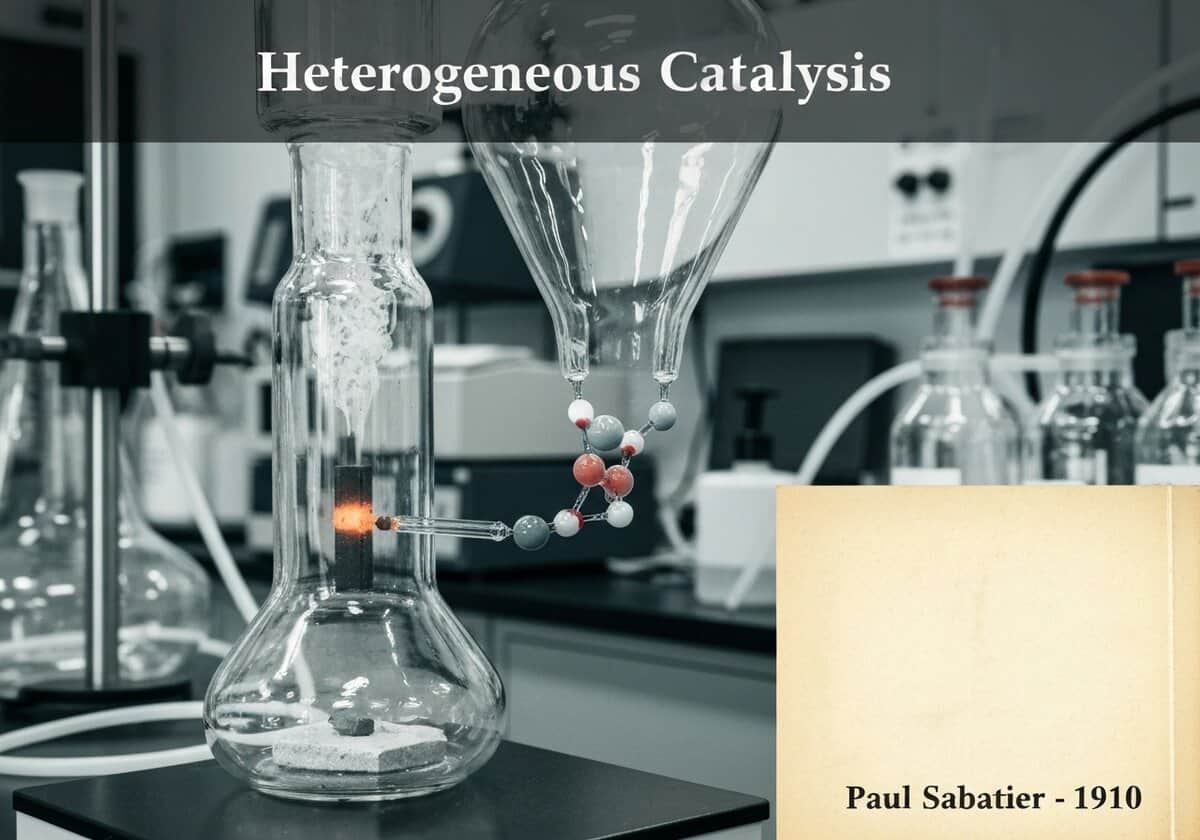
In heterogeneous catalysis, the catalyst is in a different phase from the reactants. Typically, a solid catalyst is used with gaseous or liquid reactants. The process involves several steps: diffusion of reactants to the catalyst surface, adsorption onto active sites, chemical reaction on the surface, desorption of products, and diffusion of products away from the surface.
Heterogeneous catalysis is the cornerstone of the modern chemical industry, accounting for the vast majority of large-scale industrial processes. The key advantage is the ease of separating the catalyst from the product stream, which simplifies purification and allows for continuous operation. The catalyst is often a porous solid with a high surface area, maximizing the number of available active sites. These catalysts can be unsupported (e.g., platinum gauze) or, more commonly, supported, where catalytically active metal nanoparticles are dispersed on a high-surface-area support material like alumina (\(Al_2O_3\)), silica (\(SiO_2\)), or activated carbon.
The mechanism, often described by the Langmuir–Hinshelwood model, involves the adsorption of reactant molecules onto the catalyst surface. This adsorption weakens the chemical bonds within the reactants, lowering the activation energy for the reaction. After the reaction occurs between adsorbed species, the product molecules desorb from the surface, freeing the active site for another catalytic cycle. The overall rate can be limited by any of these steps, from mass transport of reactants to the surface to the desorption of products. Catalyst deactivation through processes like poisoning (strong adsorption of impurities), coking (deposition of carbonaceous material), or sintering (loss of surface area at high temperatures) is a major practical challenge.
UNESCO Nomenclature: 2202
– Physical chemistry
Precursors
- discovery of adsorption by Carl Wilhelm Scheele and Felice Fontana
- Michael Faraday’s studies on platinum’s catalytic properties
- Paul Sabatier’s work on catalytic hydrogenation of organic compounds
- development of surface science techniques
Applications
- Haber-Bosch process for ammonia synthesis
- catalytic converters in automobiles
- fluid catalytic cracking (FCC) in petroleum refining
- Fischer-Tropsch process for synthetic fuels
- contact process for sulfuric acid production
Potential Innovations Ideas
Due to scrapping bot traffic, currently more than 40k per day, this content is reserved to community members.
> Login < or > Register < (100% free) to access this, so as all other restricted content and tools.
Related to: heterogeneous catalysis, solid catalyst, surface chemistry, adsorption, active site, desorption, Langmuir-Hinshelwood, catalyst support, industrial chemistry, mass transport.