Product Design, Manufacturing & Innovation Resources
Home » Heterochrony

Heterochrony

1977
  • Ernst Haeckel
  • Gavin de Beer
  • Stephen Jay Gould
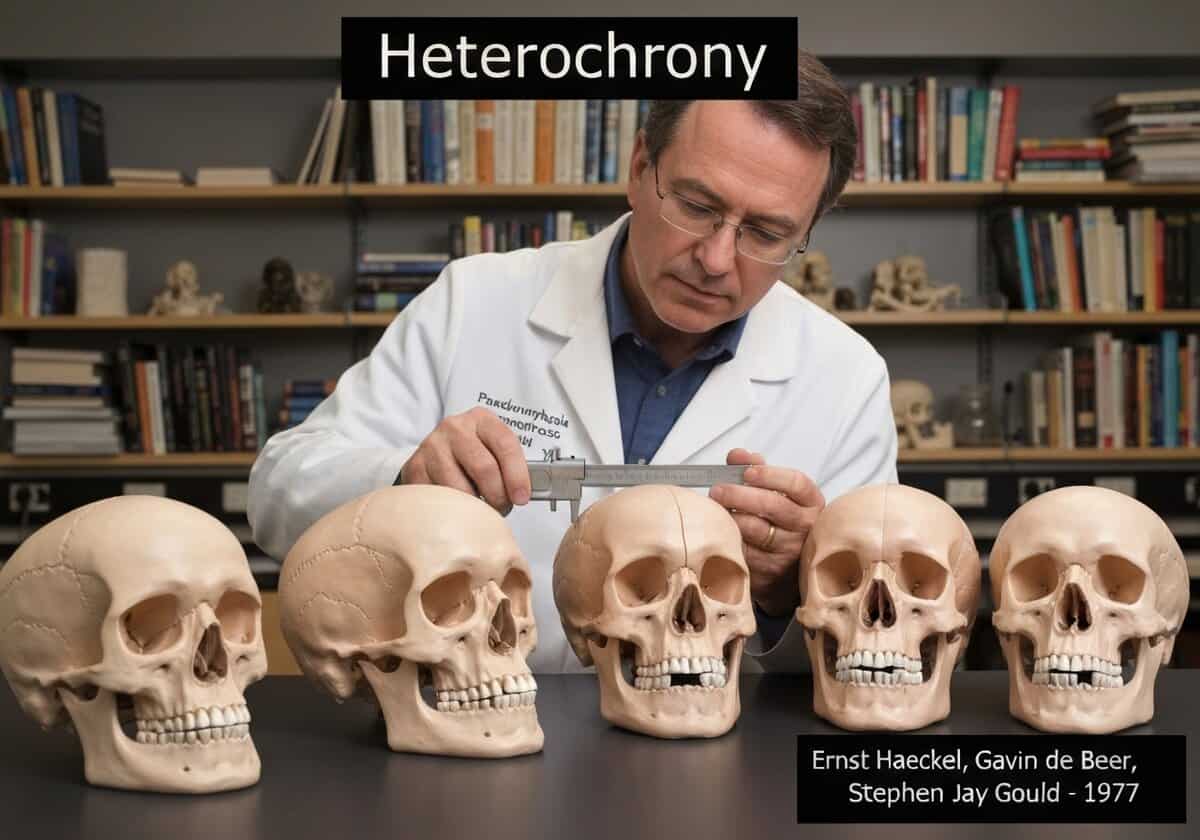
Developmental geneticist analyzing human skull models demonstrating heterochrony in evolution.

(generated image for illustration only)

Heterochrony is an evolutionary change in the rate or timing of developmental events relative to an ancestor. It is a major mechanism for producing morphological evolution. Key types include paedomorphosis (retention of juvenile features in the adult) and peramorphosis (exaggeration of adult features). The evolution of the human skull is often cited as an example of paedomorphosis relative to other apes.
While the idea of linking development and evolution is old, Stephen Jay Gould’s 1977 book ‘Ontogeny and Phylogeny’ provided the modern conceptual framework for heterochrony. He formalized it using a ‘clock’ model, distinguishing between changes in the rate of development (acceleration vs. neoteny) and changes in the timing of onset or offset of a developmental process (progenesis vs. hypermorphosis). These processes can be decoupled for different body parts, allowing for mosaic evolution.

Paedomorphosis, the retention of juvenile traits, can occur through neoteny (slowing the rate of development) or progenesis (stopping development early). The classic example is the axolotl, a salamander that retains its gills and aquatic lifestyle into adulthood (neoteny). Conversely, peramorphosis, or ‘over-development,’ can occur through acceleration (speeding up development) or hypermorphosis (extending the developmental period). The enormous antlers of the extinct Irish elk are a potential example of hypermorphosis. Heterochrony is a powerful and economical evolutionary mechanism because simple genetic changes, often in regulatory genes that control hormone levels or cell proliferation rates, can produce large-scale, coordinated changes in morphology, providing a route for rapid evolutionary shifts.

UNESCO Nomenclature: 2411
– Evolution

Type

Abstract System

Disruption

Incremental

Usage

Widespread Use

Precursors

  • ernst haeckel’s biogenetic law (‘ontogeny recapitulates phylogeny’)
  • walter garstang’s critique of haeckel’s law
  • gavin de beer’s work formalizing the concepts
  • advances in endocrinology and the understanding of growth hormones
  • classical embryological studies comparing developmental stages

Applications

  • explaining major evolutionary transitions, such as the origin of vertebrates
  • understanding human evolution, particularly neoteny in skull development
  • animal and plant breeding, by selecting for earlier or later maturation
  • paleontology, for interpreting fossil lineages
  • studying the mechanisms of aging and life history evolution

Patents:

NA

Potential Innovations Ideas

Due to scrapping bot traffic, currently more than 40k per day, this content is reserved to community members.
> Login < or > Register < (100% free) to access this, so as all other restricted content and tools.

Related to: heterochrony, paedomorphosis, neoteny, peramorphosis, stephen jay gould, developmental timing, ontogeny, phylogeny, evolution, morphology.

Historical Context

Heterochrony

1967
1970
1975
1977
1983
1987
1990
1960
1970
1973
1975
1979
1983
1988
1990

(if date is unknown or not relevant, e.g. "fluid mechanics", a rounded estimation of its notable emergence is provided)

Related Invention, Innovation & Technical Principles

Full size images and downloads are only available, 100% free, for registered members.

> Login <