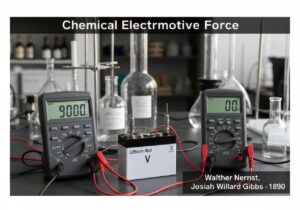
Nernst Equation for Fuel Cell Potential
The Nernst equation quantifies the reversible electromotive force (EMF) or open-circuit voltage of a fuel cell under non-standard conditions. It links the cell potential (\(E\)) to its standard potential (\(E^0\)), temperature, and the activities (approximated by partial pressures) of reactants and products. The equation is \(E = E^0 – \frac{RT}{nF} \ln Q\), where Q is the reaction quotient.
The Nernst equation is a cornerstone of electrochemistry, derived from the relationship between the change in Gibbs free energy and the cell potential, \(\Delta G = -nFE\). In the equation \(E = E^0 – \frac{RT}{nF} \ln Q\), \(R\) is the universal gas constant, \(T\) is the absolute temperature in Kelvin, \(n\) is the number of moles of electrons transferred per mole of reaction, and \(F\) is the Faraday constant (charge per mole of electrons). The reaction quotient \(Q\) for a hydrogen-oxygen fuel cell (\(H_2 + \frac{1}{2}O_2 \rightarrow H_2O\)) is \(Q = \frac{p_{H_2O}}{p_{H_2} \cdot p_{O_2}^{1/2}}\), where \(p\) represents the partial pressures of the gaseous species.
This equation reveals several key aspects of fuel cell behavior. Firstly, it shows that the cell voltage increases with higher reactant partial pressures (\(p_{H_2}\), \(p_{O_2}\)) and decreases as product partial pressure (\(p_{H_2O}\)) builds up. Secondly, it describes the temperature dependence of the ideal voltage. While the Nernst equation defines the maximum theoretical voltage, the actual operating voltage of a fuel cell is always lower due to irreversible losses known as overpotentials (or polarizations), which arise from reaction kinetics, internal resistance, and mass transport limitations once current is drawn from the cell.
UNESCO Nomenclature: 2203
– Physical chemistry
Precursors
- laws of thermodynamics, particularly the work of Gibbs on chemical potential
- Faraday’s laws of electrolysis
- the concept of chemical equilibrium and the law of mass action
Applications
- predicting the maximum possible voltage of a fuel cell under specific operating temperatures and pressures
- modeling fuel cell performance and voltage losses due to reactant depletion
- designing high-pressure fuel cell systems to increase voltage and efficiency
- fundamental research in electrochemistry and battery science
- calibration of ion-selective electrodes and pH meters
Potential Innovations Ideas
Due to scrapping bot traffic, currently more than 40k per day, this content is reserved to community members.
> Login < or > Register < (100% free) to access this, so as all other restricted content and tools.
Related to: Nernst equation, electrochemistry, cell potential, voltage, Gibbs free energy, reaction quotient, partial pressure, thermodynamics, walther nernst, open-circuit voltage.