The Four-Stroke Engine Cycle
1876
- Nicolaus Otto
- Eugen Langen
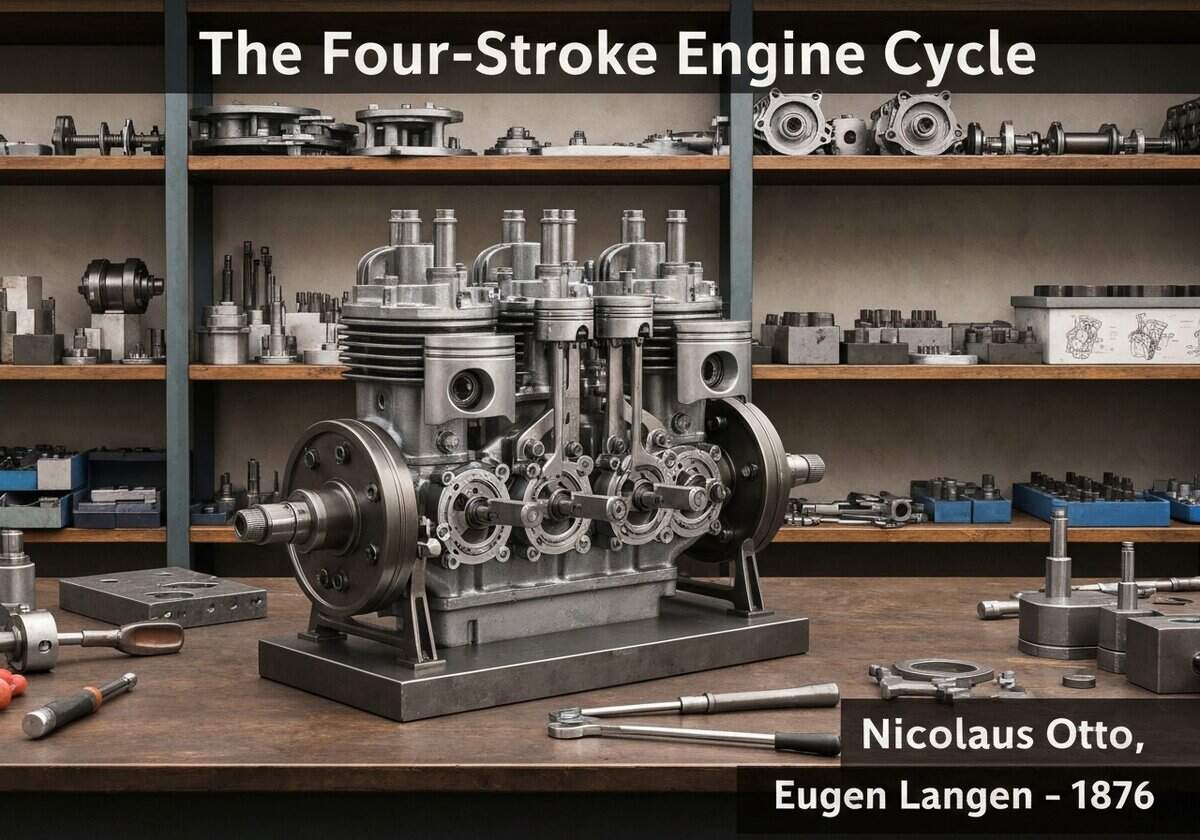
The practical application of the Otto cycle is the four-stroke engine, which completes a thermodynamic cycle in four distinct piston movements (strokes). These are: 1. Intake (suck), where the air-fuel mixture is drawn in; 2. Compression (squeeze), where the mixture is compressed; 3. Power or Combustion (bang), where ignition pushes the piston down; 4. Exhaust (blow), where burnt gases are expelled.
The four-stroke cycle, also known as the Otto cycle in practice, requires two full rotations of the crankshaft to complete. Each stroke corresponds to a 180-degree rotation of the crankshaft. The sequence is precisely timed by the camshaft, which operates the intake and exhaust valves.
1. Intake Stroke: The cycle begins with the piston at Top Dead Center (TDC). The intake valve opens, and the piston moves downward to Bottom Dead Center (BDC), creating a partial vacuum that draws the air-fuel mixture into the cylinder.
2. Compression Stroke: The intake valve closes, and the piston moves back up from BDC to TDC. This movement compresses the trapped air-fuel mixture, significantly increasing its pressure and temperature, preparing it for ignition.
3. Power (Combustion) Stroke: Just before the piston reaches TDC, the spark plug fires, igniting the compressed mixture. The rapid combustion creates a massive increase in pressure, forcing the piston down from TDC to BDC. This is the only stroke that produces mechanical work, providing power to the crankshaft.
4. Exhaust Stroke: As the piston reaches BDC, the exhaust valve opens. The piston then moves upward from BDC to TDC, pushing the burned gases out of the cylinder and into the exhaust system. Once the piston reaches TDC, the exhaust valve closes, the intake valve opens, and the cycle begins anew. This continuous sequence of events converts the chemical energy of fuel into rotational motion.
UNESCO Nomenclature: 3322
– Mechanical engineering
Precursors
- Lenoir two-stroke gas engine
- steam engine mechanics (piston, cylinder, crankshaft)
- Alphonse Beau De Rochas’s theoretical description of a four-stroke cycle
- development of reliable ignition systems
Applications
- automobiles
- motorcycles
- light aircraft
- lawnmowers
- portable generators
Patents:
- US Patent 194047
- German Patent 532
Potential Innovations Ideas
Due to scrapping bot traffic, currently more than 40k per day, this content is reserved to community members.
> Login < or > Register < (100% free) to access this, so as all other restricted content and tools.
Related to: four-stroke engine, intake, compression, power, exhaust, internal combustion, piston, crankshaft, camshaft, Nicolaus Otto.