Enzyme Catalysis (Biocatalysis)
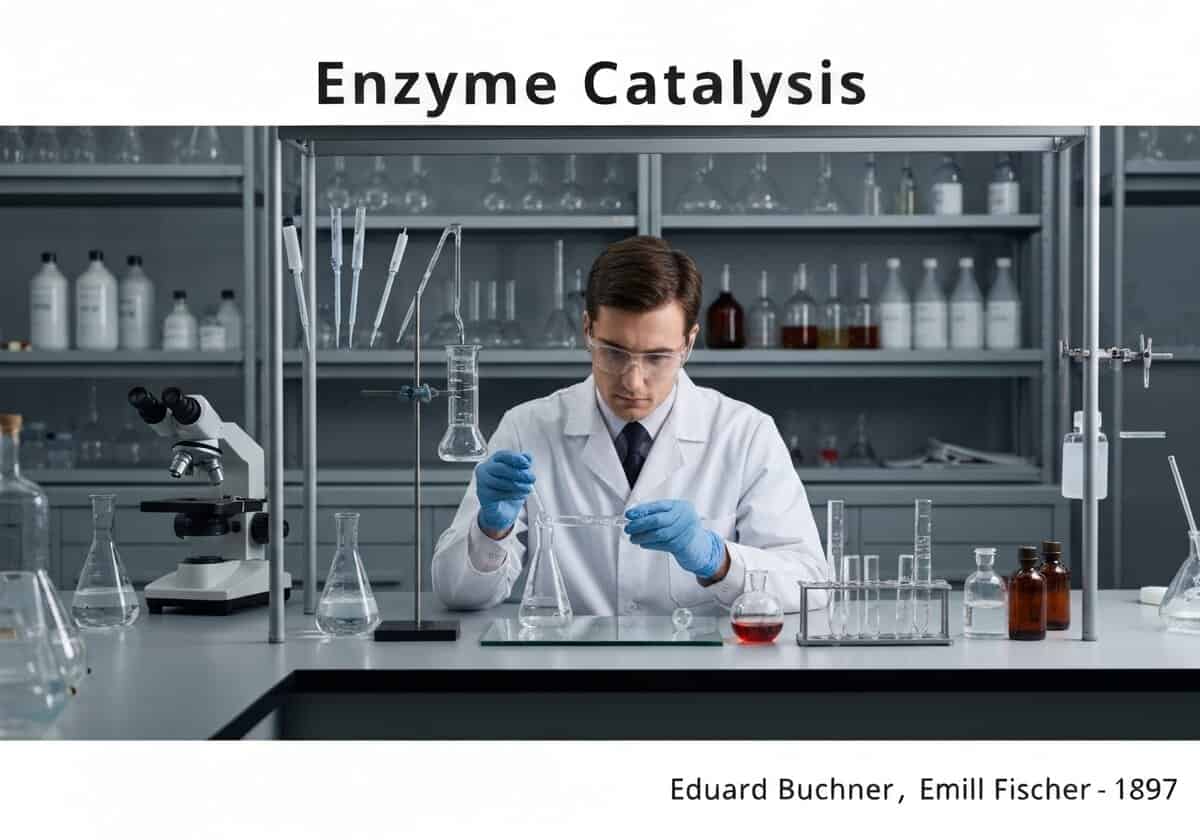
1897
- Eduard Buchner
- Emil Fischer
Enzymes are proteins that act as biological catalysts (biocatalysts). They exhibit remarkable specificity and efficiency, often accelerating reactions by factors of millions under mild physiological conditions (temperature, pH). The reaction occurs in a specific region of the enzyme called the active site, which binds the substrate through a lock-and-key or induced-fit mechanism.
Enzyme catalysis represents the pinnacle of catalytic efficiency and selectivity. These complex protein structures create a unique microenvironment within their active site that is perfectly tailored to stabilize the transition state of a specific reaction. This is achieved through a combination of factors: precise orientation of substrates, providing acidic or basic functional groups, straining substrate bonds, and providing an alternative covalent pathway. The kinetics of many enzyme-catalyzed reactions can be described by the Michaelis-Menten equation: \(v = \frac{V_{max}[S]}{K_M + [S]}\), where \(v\) is the reaction rate, \(V_{max}\) is the maximum rate, \([S]\) is the substrate concentration, and \(K_M\) (the Michaelis constant) is the substrate concentration at which the reaction rate is half of \(V_{max}\).
Emil Fischer’s original ‘lock-and-key’ model proposed a rigid active site perfectly matching the substrate. This was later refined by Daniel Koshland’s ‘induced-fit’ model, which suggests that the active site is flexible and changes conformation upon substrate binding to achieve optimal catalytic orientation. This specificity is often stereospecific, meaning enzymes can distinguish between stereoisomers, a critical feature for producing enantiomerically pure drugs. While historically used in food production, modern biotechnology has expanded their use to industrial synthesis, diagnostics, and therapeutics through techniques like directed evolution, which allows scientists to engineer enzymes with novel properties.
UNESCO Nomenclature: 2302
– Biochemistry
Precursors
- Louis Pasteur’s work linking fermentation to living organisms
- discovery and isolation of diastase (amylase) by Anselme Payen
- Emil Fischer’s lock-and-key theory of enzyme specificity
- Eduard Buchner’s discovery of cell-free fermentation
Applications
- production of high-fructose corn syrup
- use of proteases in laundry detergents
- synthesis of chiral pharmaceuticals
- cheese and yogurt production
- bioremediation to break down pollutants
Potential Innovations Ideas
Due to scrapping bot traffic, currently more than 40k per day, this content is reserved to community members.
> Login < or > Register < (100% free) to access this, so as all other restricted content and tools.
Related to: enzyme, biocatalysis, active site, Michaelis-Menten kinetics, specificity, induced fit, lock and key, substrate, protein, directed evolution.