Product Design, Manufacturing & Innovation Resources
Home » Detonation Chemistry of Nitroglycerin

Detonation Chemistry of Nitroglycerin

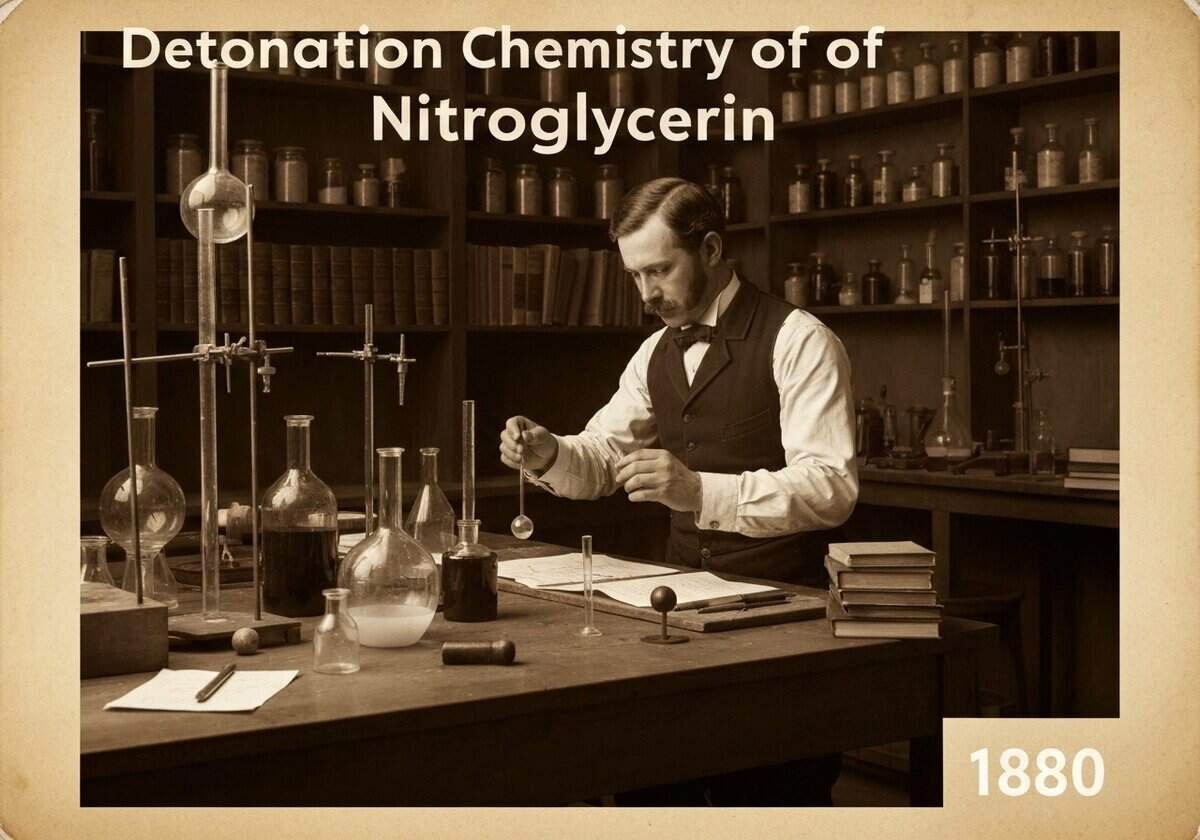
1880
Chemist measuring nitroglycerin in a historical laboratory, physical chemistry.

(generated image for illustration only)

Nitroglycerin is an oxygen-positive explosive, meaning it contains more oxygen than is needed to completely oxidize its carbon and hydrogen atoms during decomposition. This results in a very rapid, exothermic decomposition into gaseous products. The balanced chemical equation for its detonation is: \(4 C_3H_5(NO_3)_3(l) \rightarrow 12 CO_2(g) + 10 H_2O(g) + 6 N_2(g) + O_2(g)\). This reaction produces a massive volume expansion.


The detonation of nitroglycerin is a supersonic decomposition process that propagates through the material via a shock wave. The velocity of detonation (VoD) for liquid nitroglycerin is approximately 7,700 meters per second. The extreme speed of the reaction is due to its molecular structure; the fuel (the C-H backbone) and the oxidizer (the nitrate groups) are held in intimate contact within the same molecule. When initiated by a sufficient shock, the molecule essentially tears itself apart. The energy released, about 1.5 MJ per mole (6.3 MJ/kg), rapidly heats the resulting gases to temperatures around 5,000 °C. According to the ideal gas law, this high temperature and the conversion of a small volume of liquid into a large volume of gas (one mole of liquid NG produces 7.25 moles of gas) creates immense pressure, on the order of 20 GPa. This rapid pressure rise is what generates the powerful shockwave responsible for the explosive’s destructive effect. The presence of excess oxygen in the products is unusual for many organic explosives and contributes to the high temperature and efficiency of the detonation.

UNESCO Nomenclature: 2307
– Physical chemistry

Type

Chemical Process

Disruption

Substantial

Usage

Widespread Use

Precursors

  • development of stoichiometry by Jeremias Richter and John Dalton
  • formulation of the laws of thermodynamics
  • Chapman-Jouguet theory of detonation
  • synthesis of nitroglycerin

Applications

  • basis for calculating the power (brisance) of explosives
  • design of smokeless powders where the oxygen balance is critical
  • formulation of composite explosives
  • thermodynamic modeling of detonation processes
  • development of underwater explosives

Patents:

NA

Potential Innovations Ideas

Due to scrapping bot traffic, currently more than 40k per day, this content is reserved to community members.
> Login < or > Register < (100% free) to access this, so as all other restricted content and tools.

Related to: detonation, nitroglycerin, oxygen balance, exothermic, velocity of detonation, shock wave, thermochemistry, explosive decomposition, brisance, high explosive.

Historical Context

1880
1897
1970
1890
1955
1980

(if date is unknown or not relevant, e.g. "fluid mechanics", a rounded estimation of its notable emergence is provided)

Related Invention, Innovation & Technical Principles

Full size images and downloads are only available, 100% free, for registered members.

> Login <