Product Design, Manufacturing & Innovation Resources
Home » Electric Generator

Electric Generator

1831
  • Michael Faraday
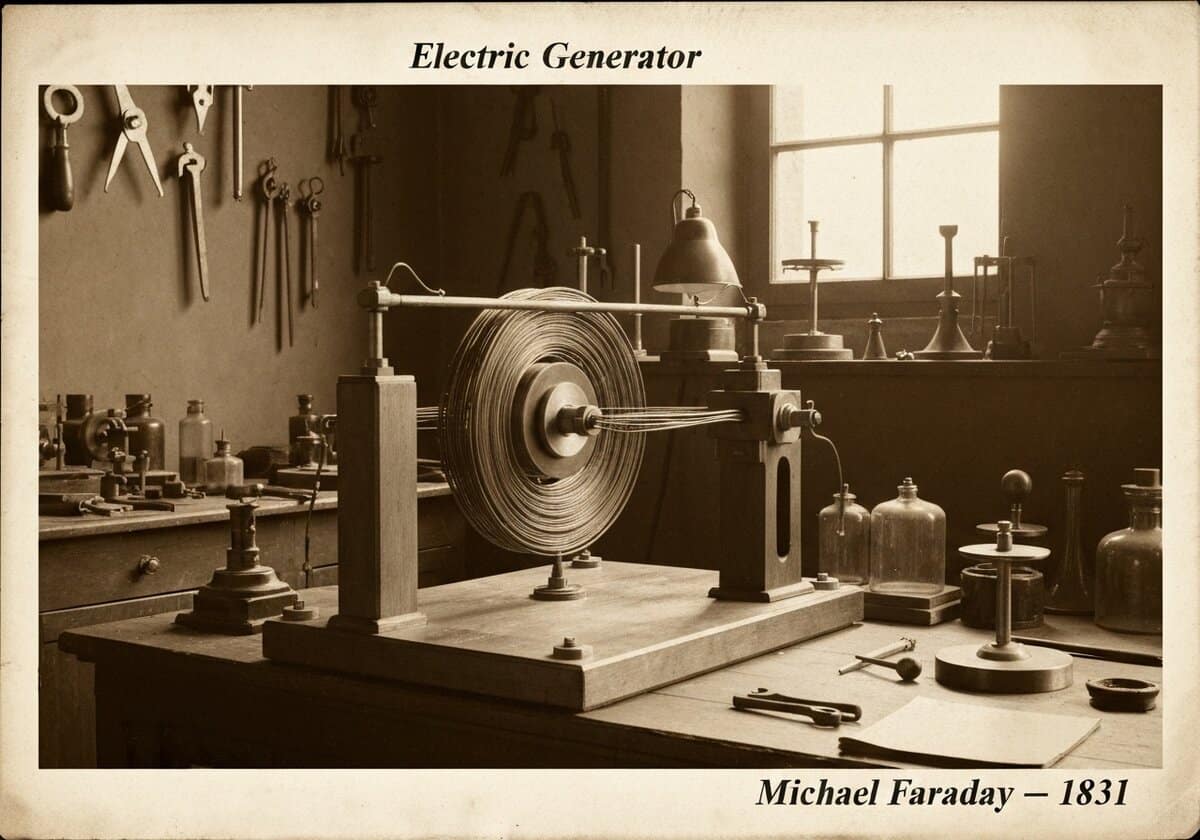
Electric generator apparatus demonstrating electromagnetic induction principles in electromagnetism.

(generated image for illustration only)

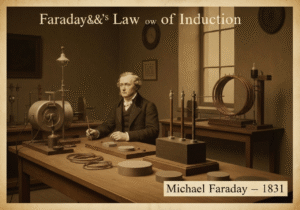
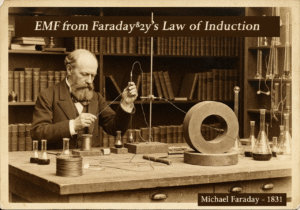
An electric generator is a device that converts mechanical energy into electrical energy by utilizing electromagnetic induction. The basic design involves a wire coil rotating within a magnetic field (or a magnet rotating within a coil). This continuous rotation alters the magnetic flux passing through the coil, inducing an alternating electromotive force (EMF) and current as described by Faraday’s law.
The operation of a generator is based on motional EMF. As a conductor moves through a magnetic field, the magnetic Lorentz force acts on the free charge carriers inside, pushing them along the conductor’s length and creating a potential difference. In a typical AC generator (or alternator), a loop of wire is rotated by an external mechanical force (like a turbine). As the loop rotates, the magnetic flux through it changes sinusoidally: \(Phi_B = BA cos(omega t)\). Applying Faraday’s law, the induced EMF is also sinusoidal: \(mathcal{E} = -frac{dPhi_B}{dt} = NBAomega sin(omega t)\), where N is the number of turns, B is the magnetic field, A is the area, and \(omega\) is the angular velocity. This produces alternating current (AC).

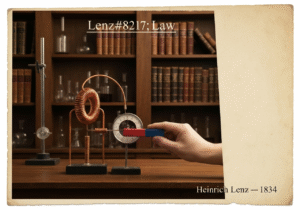
To produce direct current (DC), a device called a split-ring commutator is used. It reverses the connection to the external circuit every half rotation, rectifying the output so the current flows in a single direction. A generator does not create energy; it is an energy converter. The mechanical work done to rotate the coil against the opposing magnetic torque (a consequence of Lenz’s law) is transformed into electrical energy.

UNESCO Nomenclature: 2205
– Electricity and magnetism

Type

Physical Device

Disruption

Revolutionary

Usage

Widespread Use

Precursors

  • Faraday’s law of induction
  • Discovery of the magnetic Lorentz force
  • Invention of the voltaic pile (providing a source for creating electromagnets)
  • Hans Christian Ørsted’s discovery of electromagnetism

Applications

  • power plants (hydroelectric, thermal, nuclear)
  • wind turbines
  • automotive alternators
  • portable generators
  • bicycle dynamos
  • emergency power systems

Patents:

NA

Potential Innovations Ideas

Due to scrapping bot traffic, currently more than 40k per day, this content is reserved to community members.
> Login < or > Register < (100% free) to access this, so as all other restricted content and tools.

Related to: electric generator, dynamo, alternator, Faraday’s law, electromagnetic induction, mechanical energy, electrical energy, alternating current, Michael Faraday, motional EMF.

Historical Context

Electric Generator

1824
1827
1831
1831
1833
1834
1836
1822
1827
1831
1831
1832
1834
1835
1838

(if date is unknown or not relevant, e.g. "fluid mechanics", a rounded estimation of its notable emergence is provided)

Related Invention, Innovation & Technical Principles

Full size images and downloads are only available, 100% free, for registered members.

> Login <