Product Design, Manufacturing & Innovation Resources
Home » Dynamite

Dynamite

1867
  • Alfred Nobel
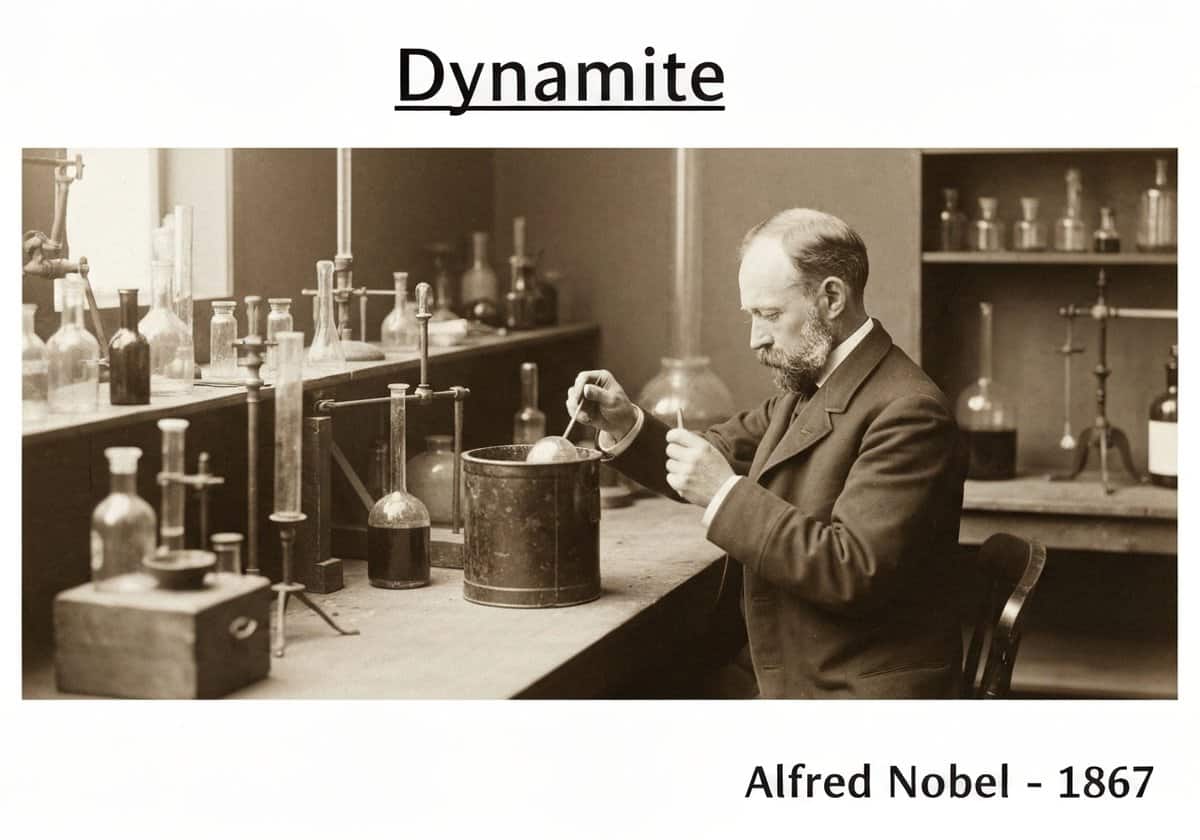
Alfred Nobel mixing nitroglycerin and kieselguhr in a laboratory for dynamite production.

(generated image for illustration only)

Alfred Nobel discovered that nitroglycerin could be made much safer to handle by absorbing it into an inert, porous material like kieselguhr (diatomaceous earth). This mixture, which he patented as dynamite, transformed the highly sensitive and dangerous liquid into a stable, solid explosive that could be reliably detonated only with a blasting cap, revolutionizing mining, construction, and demolition.
Before Nobel’s invention, liquid nitroglycerin was known as a powerful explosive but was notoriously unstable. It was prone to detonating from physical shock, temperature changes, or spontaneous decomposition, leading to numerous fatal accidents during its transport and use. This unpredictability severely limited its practical application. Nobel’s key insight was not just the absorption but the choice of absorbent. Kieselguhr, a fossilized diatomaceous earth, is highly porous and can absorb up to three times its weight in nitroglycerin, forming a putty-like substance. This physical stabilization prevented the liquid from pooling and becoming shock-sensitive. Crucially, while the kieselguhr stabilized the nitroglycerin, it did not significantly reduce its explosive power. To initiate detonation, Nobel also developed the blasting cap, a small device containing a more sensitive but less powerful primary explosive (like mercury fulminate) that, when ignited by a fuse, would provide the necessary shockwave to detonate the much more stable dynamite. This two-part system of a stable secondary explosive and a reliable initiator was the foundation of modern high explosives technology.

UNESCO Nomenclature: 3305
– Chemical engineering

Type

Chemical Process

Disruption

Revolutionary

Usage

Widespread Use

Precursors

  • synthesis of nitroglycerin by Ascanio Sobrero
  • discovery of kieselguhr’s absorbent properties
  • development of primary explosives like mercury fulminate
  • understanding of detonation and shockwaves

Applications

  • mining and quarrying
  • large-scale construction projects like canals and tunnels (e.g., panama canal)
  • demolition of buildings and structures
  • military engineering

Patents:

  • U.S. Patent 78,317
  • UK Patent 1345 (1867)

Potential Innovations Ideas

Due to scrapping bot traffic, currently more than 40k per day, this content is reserved to community members.
> Login < or > Register < (100% free) to access this, so as all other restricted content and tools.

Related to: dynamite, Alfred Nobel, nitroglycerin, stabilization, kieselguhr, diatomaceous earth, blasting cap, explosive safety, mining, demolition.

Historical Context

Dynamite

1850
1850
1850
1867
1875-01-01
1881
1884
1850
1850
1850
1860
1870
1876
1882-01-01
1886-04-23

(if date is unknown or not relevant, e.g. "fluid mechanics", a rounded estimation of its notable emergence is provided)

Related Invention, Innovation & Technical Principles

Full size images and downloads are only available, 100% free, for registered members.

> Login <