Distribution Ratio in LLE
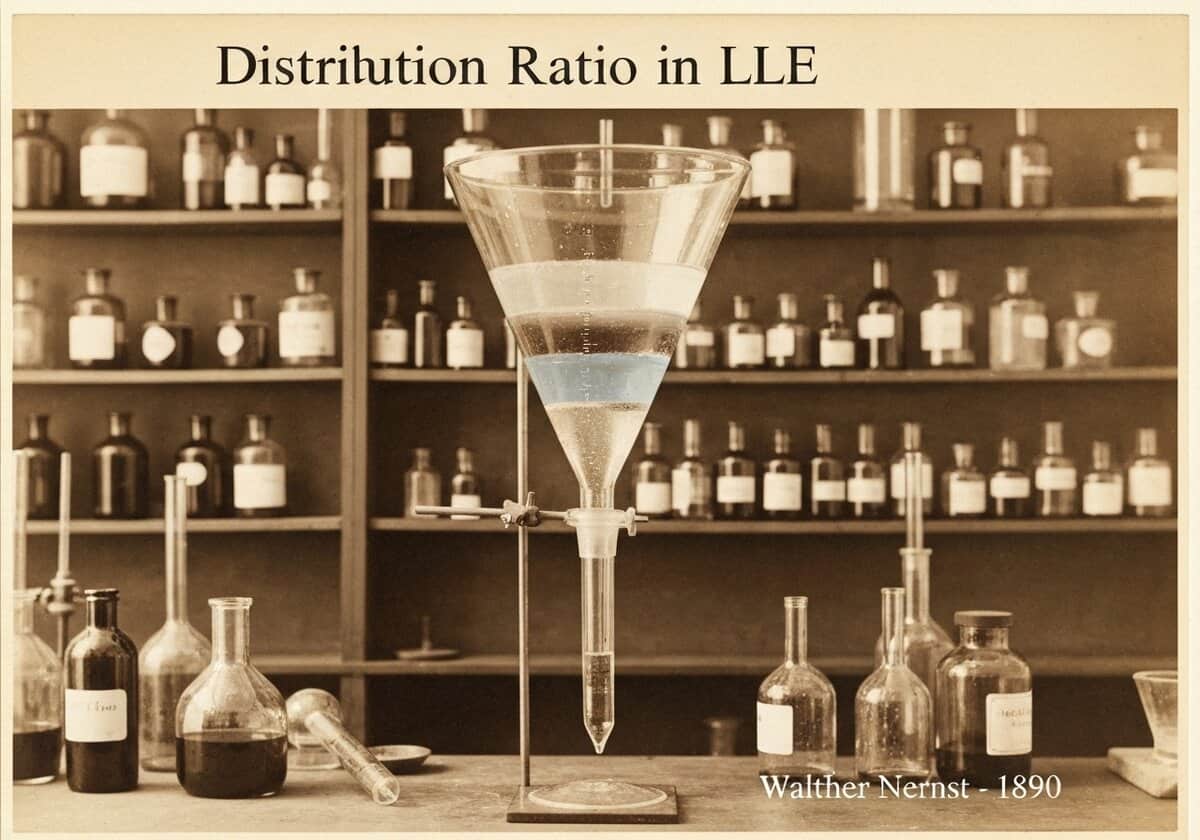
The distribution ratio (D) is a key equilibrium parameter in Liquid-Liquid Extraction (LLE), defined as the total analytical concentration of a solute in the organic phase divided by its total concentration in the aqueous phase. \(D = \frac{[S]_{org,total}}{[S]_{aq,total}}\). Unlike the partition coefficient (K_D), D accounts for all species of the solute, including dissociated or complexed forms, making it pH-dependent.
The distribution ratio, D, is a pragmatic and essential measure for quantifying the effectiveness of a liquid-liquid extraction process under specific conditions. It is distinct from the more fundamental partition coefficient, \(K_D\), which describes the distribution of a single, specific chemical species between the two phases (\(K_D = \frac{[S]_{org}}{[S]_{aq}}\)). The distribution ratio, D, considers the total concentration of the solute in all its possible forms (e.g., ionized, neutral, complexed) in each phase. This is particularly important for solutes that can undergo chemical reactions like acid-base dissociation or complexation.
For example, for a weak acid HA, the aqueous phase contains both HA and its conjugate base A⁻, while the organic phase typically contains only the neutral HA form. The distribution ratio would be \(D = \frac{[HA]_{org}}{[HA]_{aq} + [A^-]_{aq}}\). Because the concentration of A⁻ depends on the pH of the aqueous solution, the distribution ratio D becomes a function of pH. This dependency is exploited in pH-swing extractions, where a solute is extracted at one pH (where D is high) and stripped from the solvent at another pH (where D is low). The value of D directly influences the extraction efficiency (E), which is the fraction of solute transferred to the organic phase, given by \(E = \frac{D}{D + (V_{aq}/V_{org})}\), where V represents the phase volumes. Therefore, precise control and modeling of D are fundamental to designing efficient, multi-stage extraction processes.
UNESCO Nomenclature: 2202
– Analytical chemistry
Precursors
- Josiah Willard Gibbs’ work on chemical thermodynamics and phase rule
- Henry’s law describing gas solubility
- Arrhenius’ theory of electrolytic dissociation
- guldberg and waage’s law of mass action
Applications
- design and optimization of industrial extraction columns
- predicting the efficiency of pharmaceutical purification processes
- environmental science for modeling pollutant fate in water-sediment systems
- hydrometallurgical process design for metal recovery
- development of analytical chemistry separation methods
Potential Innovations Ideas
Due to scrapping bot traffic, currently more than 40k per day, this content is reserved to community members.
> Login < or > Register < (100% free) to access this, so as all other restricted content and tools.
Related to: distribution ratio, partition coefficient, Nernst distribution law, LLE, solvent extraction, chemical equilibrium, pH-dependent, extraction efficiency, analytical chemistry, hydrometallurgy.