Product Design, Manufacturing & Innovation Resources
Home » Design for Disassembly (DfD)

Design for Disassembly (DfD)

1990
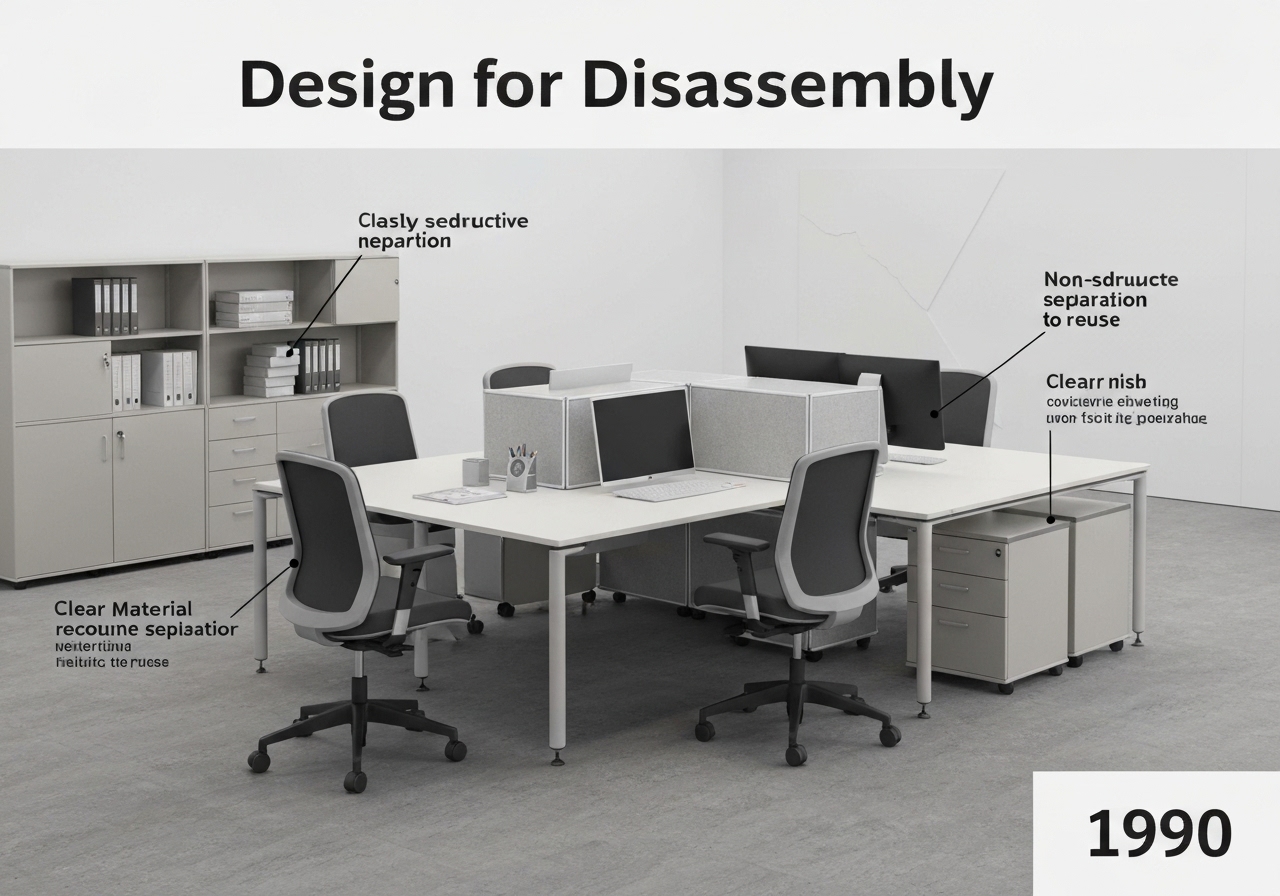
Modular office furniture designed for disassembly and reuse in industrial design.

(generated image for illustration only)

Design for Disassembly (DfD) is a design strategy focused on enabling the easy and cost-effective separation of a product’s components and materials at its end-of-life. By prioritizing non-destructive separation, DfD facilitates repair, reuse, remanufacturing, and high-purity recycling. Key techniques include using mechanical fasteners over adhesives, modular construction, and clear material labeling to maximize value recovery.


Design for Disassembly is a practical application of circular economy principles. Its technical execution involves a deliberate choice of product architecture and joining methods. Designers employing DfD minimize the variety and quantity of fasteners, opting for common types like screws instead of permanent bonds like glue or ultrasonic welds. Products are often designed with a clear hierarchy, allowing major modules to be removed without disturbing the entire assembly. Materials are selected not only for performance but also for their compatibility in recycling streams, and are clearly marked with international recycling codes to aid in sorting. This approach stands in contrast to conventional Design for Assembly (DfA), which often prioritizes initial production speed and can lead to integrated, inseparable designs that are destined for landfill. The novelty of DfD was its explicit consideration of the end-of-life phase as a critical design constraint, shifting the perspective from a linear ‘take-make-dispose’ model to a circular one where components and materials retain their value through multiple life cycles.

UNESCO Nomenclature: 3301
– Architecture

Type

Abstract System

Disruption

Substantial

Usage

Widespread Use

Precursors

  • traditional repair and maintenance practices
  • design for assembly (dfa) principles
  • growing awareness of landfill limitations and resource scarcity
  • legislation on extended producer responsibility (epr)
  • the rise of the electronics industry and associated e-waste problem

Applications

  • modular smartphones (e.g., fairphone)
  • repairable home appliances
  • automotive design for easier servicing and parts harvesting
  • office furniture designed for reconfiguration and reuse
  • construction systems using bolted connections instead of welding

Patents:

NA

Potential Innovations Ideas

Due to scrapping bot traffic, currently more than 40k per day, this content is reserved to community members.
> Login < or > Register < (100% free) to access this, so as all other restricted content and tools.

Related to: design for disassembly, dfd, circular economy, repairability, recycling, modular design, product end-of-life, sustainable engineering, right to repair, e-waste.

Historical Context

Design for Disassembly (DfD)

1987-03
1990
1990
1990
1990
1990
1990
1987
1989
1990
1990
1990
1990
1990
1990

(if date is unknown or not relevant, e.g. "fluid mechanics", a rounded estimation of its notable emergence is provided)

Related Invention, Innovation & Technical Principles

Full size images and downloads are only available, 100% free, for registered members.

> Login <