Product Design, Manufacturing & Innovation Resources
Home » CRISPR-Cas9 as a Programmable Gene Editing Tool

CRISPR-Cas9 as a Programmable Gene Editing Tool

2012
  • Jennifer Doudna
  • Emmanuelle Charpentier
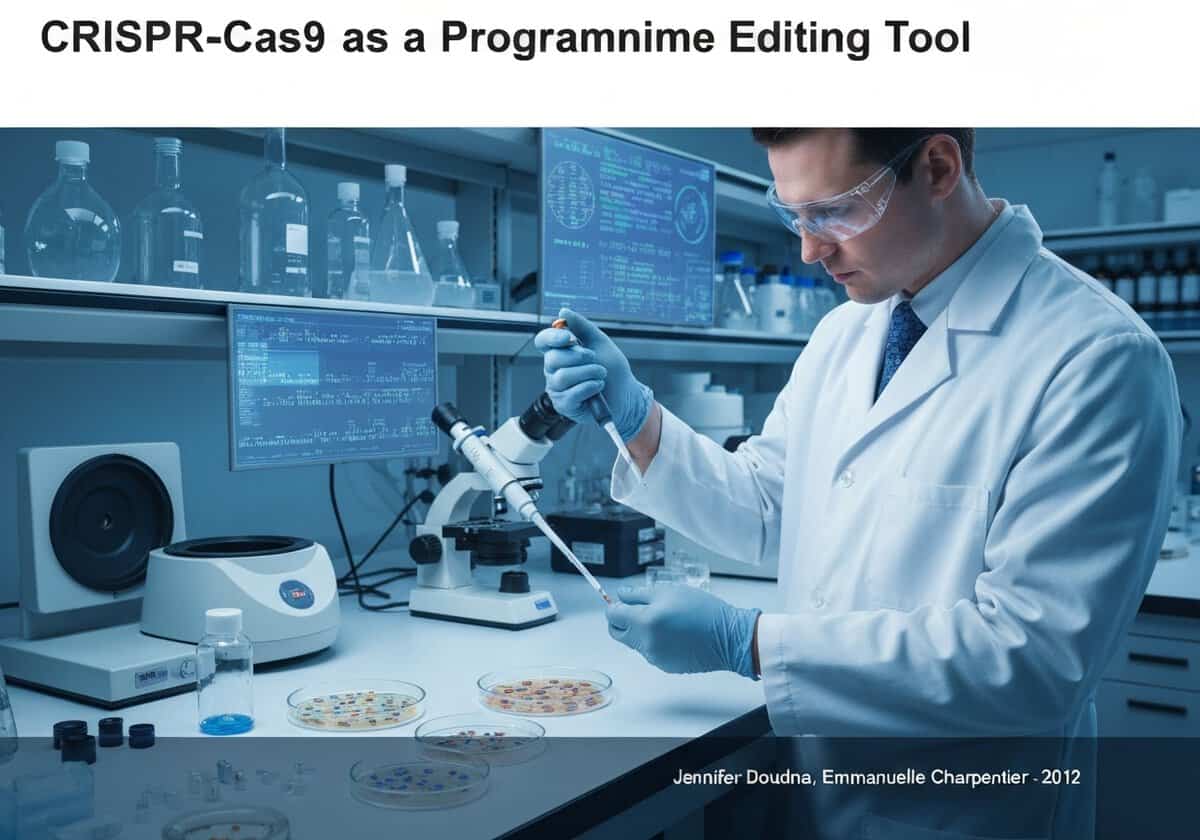
Biotechnology laboratory with CRISPR-Cas9 gene editing tools and modified cells.

(generated image for illustration only)

The natural CRISPR-Cas9 system was repurposed into a revolutionary gene-editing technology. By fusing the two essential RNA components (crRNA and tracrRNA) into a synthetic single-guide RNA (sgRNA), scientists created a simple two-component system. This sgRNA directs the Cas9 nuclease to any desired DNA location to create a precise double-strand break, which can then be repaired by the cell to introduce targeted mutations or insert new genetic material.

The transformation of the CRISPR-Cas9 bacterial immune system into a universal tool for genome editing was a landmark achievement in molecular biology. The key insight was recognizing its potential for being reprogrammed. In its natural form, the Type II system uses three components: the Cas9 protein, a crRNA that contains the targeting sequence, and a tracrRNA that is crucial for crRNA maturation and Cas9 activation. The Doudna and Charpentier labs demonstrated that this system could be simplified. They engineered a single chimeric RNA, which they termed a single-guide RNA (sgRNA), by linking the 3′ end of the crRNA to the 5′ end of the tracrRNA with a synthetic hairpin loop. This sgRNA retained all the necessary functions of the dual-RNA system.

This simplification was revolutionary because it meant that to retarget the Cas9 nuclease to a new DNA site, one only needed to synthesize a new sgRNA with a different 20-nucleotide guide sequence. This made the technology remarkably easy to use, cheap, and scalable compared to previous editing methods like Zinc Finger Nucleases (ZFNs) and TALENs, which required complex and costly protein engineering for each new target. When the Cas9-sgRNA complex is introduced into a cell, it locates its target DNA sequence and creates a double-strand break (DSB). The cell’s natural DNA repair machinery then takes over. The error-prone Non-Homologous End Joining (NHEJ) pathway often introduces small insertions or deletions (indels), effectively knocking out the gene. Alternatively, if a donor DNA template is supplied, the more precise Homology-Directed Repair (HDR) pathway can be used to insert new sequences or correct mutations.

UNESCO Nomenclature: 3101
– Biotechnology

Type

Biotechnology

Disruption

Revolutionary

Usage

Widespread Use

Precursors

  • discovery of the natural crispr-cas9 mechanism in bacteria
  • identification and functional characterization of the tracrrna
  • understanding of cellular dna repair mechanisms (nhej and hdr)
  • prior gene editing technologies like zfns and talens, which established the principle of targeted double-strand breaks
  • advances in rna synthesis and genetic engineering techniques

Applications

  • gene therapy for genetic disorders like sickle cell anemia and beta-thalassemia
  • development of disease-resistant crops and livestock
  • creation of animal models for human diseases
  • functional genomics research to study gene function (gene knockouts)
  • development of rapid diagnostics for infectious diseases
  • cancer immunotherapy (e.g., car-t cell therapy)

Patents:

  • US8697359B1
  • US10000772B2
  • EP2771468B1

Potential Innovations Ideas

Due to scrapping bot traffic, currently more than 40k per day, this content is reserved to community members.
> Login < or > Register < (100% free) to access this, so as all other restricted content and tools.

Related to: gene editing, CRISPR-Cas9, sgrna, jennifer doudna, emmanuelle charpentier, genetic engineering, double-strand break, nhej, hdr, biotechnology.

Historical Context

Related Invention, Innovation & Technical Principles

Full size images and downloads are only available, 100% free, for registered members.

> Login <