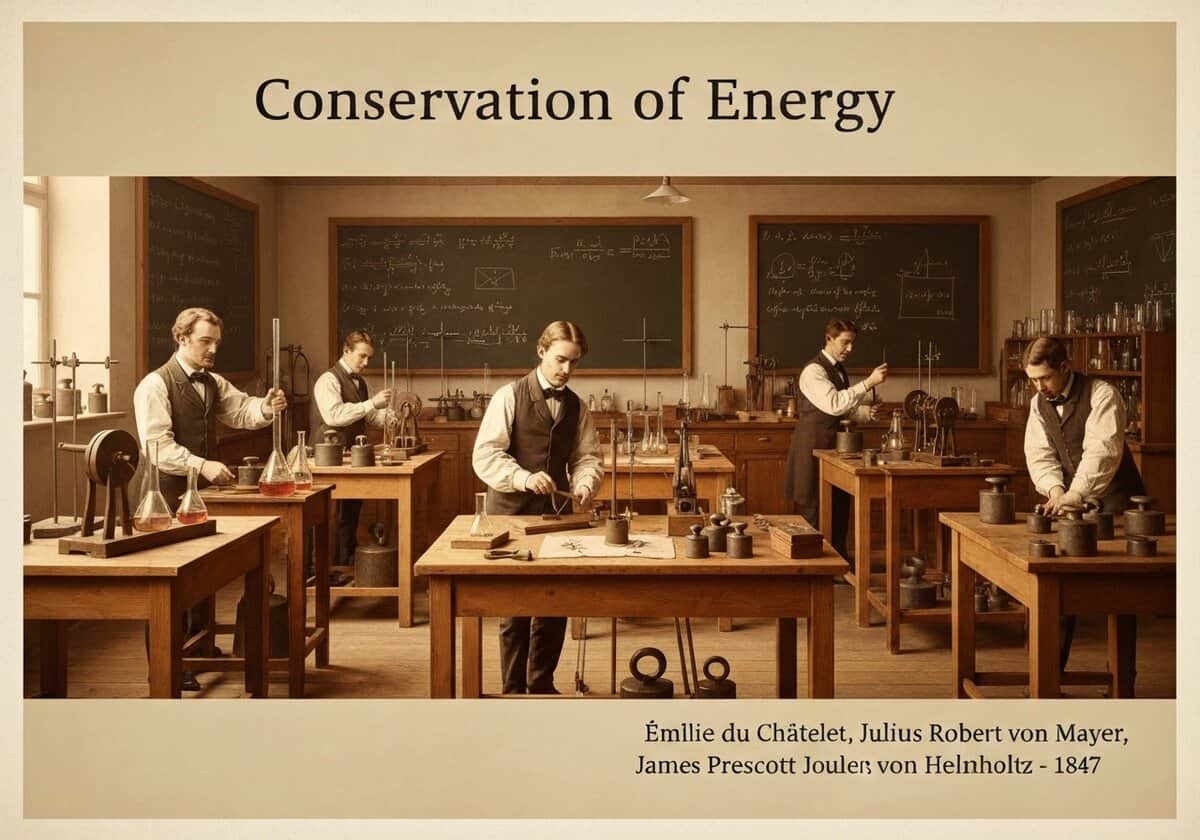
Conservation of Energy
1847
- Émilie du Châtelet
- Julius Robert von Mayer
- James Prescott Joule
- Hermann von Helmholtz
A fundamental principle stating that the total energy of an isolated system remains constant over time. Energy can neither be created nor destroyed, only transformed from one form to another, such as from potential to kinetic energy. In classical mechanics, for systems with only conservative forces, the total mechanical energy \(E = T + V\) is conserved.
The law of conservation of energy is one of the most fundamental and universally applicable principles in all of science. Its development spanned centuries, evolving from early ideas about motion into a precise mathematical statement in the 19th century that unified mechanics, heat, and chemistry.
In the context of classical mechanics, the principle is most clearly seen in systems subject only to conservative forces, such as gravity or the force from an ideal spring. A force is conservative if the work it does on an object moving between two points is independent of the path taken. For such forces, a potential energy function \(V\) can be defined. The work-energy theorem states that the net work done on an object equals the change in its kinetic energy, \(W_{net} = \Delta T\). For conservative forces, this work can be expressed as the negative change in potential energy, \(W_{cons} = -\Delta V\). Combining these gives \(\Delta T = -\Delta V\), or \(\Delta T + \Delta V = \Delta(T+V) = 0\). This shows that the total mechanical energy, \(E = T + V\), is a constant of motion.
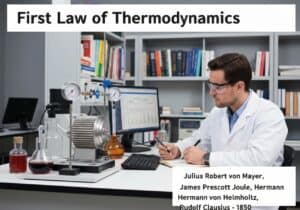
When non-conservative forces like friction are present, mechanical energy is not conserved; it is typically dissipated as heat. However, the total energy of the isolated system, including this thermal energy, is still conserved. This broader principle is the First Law of Thermodynamics.
In the 20th century, Emmy Noether’s theorem provided a deeper understanding of this law. It showed that the conservation of energy is a direct mathematical consequence of a fundamental symmetry of the universe: the fact that the laws of physics do not change over time (time-translation invariance).
UNESCO Nomenclature: 2211
– Physics
Precursors
- Vis viva concept (Gottfried Leibniz)
- Studies on heat and work (Sadi Carnot, Émile Clapeyron)
- Newtonian mechanics
- Galileo’s experiments with pendulums
Applications
- power generation (hydroelectric dams, thermal plants)
- thermodynamics and engine design
- chemical reaction analysis (enthalpy)
- roller coaster design
- understanding metabolic processes in biology
Potential Innovations Ideas
Due to scrapping bot traffic, currently more than 40k per day, this content is reserved to community members.
> Login < or > Register < (100% free) to access this, so as all other restricted content and tools.
Related to: conservation of energy, kinetic energy, potential energy, work-energy theorem, thermodynamics, isolated system, noether’s theorem, conservative force.