Product Design, Manufacturing & Innovation Resources
Home » Concurrent Engineering

Concurrent Engineering

1986
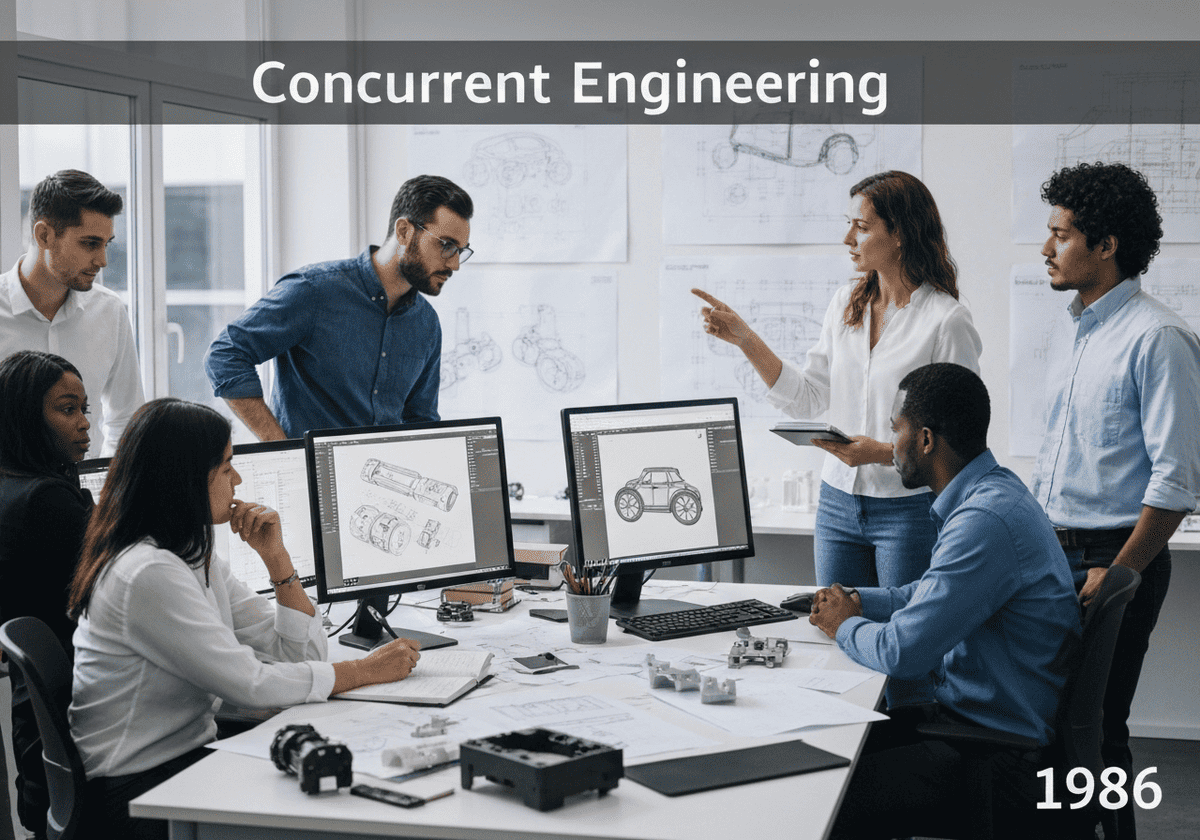
Team collaboration in engineering design for product development.

(generated image for illustration only)

Concurrent engineering, also known as simultaneous engineering, is a design philosophy that emphasizes the parallelization of tasks. Instead of a sequential process where design is completed before manufacturing is considered, it involves a team-based approach where designers, manufacturing engineers, and other stakeholders work together from the outset. This overlap significantly reduces product development time and improves design quality.


The core principle of concurrent engineering is to integrate downstream process considerations into the upstream design phase. Traditionally, a product would be designed, then ‘thrown over the wall’ to the manufacturing team, who might then discover it was difficult or impossible to produce as designed, forcing costly and time-consuming redesigns. Concurrent engineering breaks down these departmental silos.

By forming cross-functional teams, potential manufacturing, assembly, serviceability, and quality issues are identified and addressed early in the design cycle. This proactive approach is often called ‘Design for X’ (DFX), where ‘X’ can be manufacturability (DFM), assembly (DFA), or serviceability. The collaborative nature of concurrent engineering relies heavily on effective communication and shared digital models (CAD/CAM/CAE), allowing all team members to work on a single, up-to-date representation of the product. The result is a more holistic and optimized design, fewer late-stage changes, lower costs, and a faster time-to-market.

UNESCO Nomenclature: 3307
– Engineering Design

Type

Abstract System

Disruption

Substantial

Usage

Widespread Use

Precursors

  • waterfall model of product development (as a system to improve upon)
  • just-in-time (jit) manufacturing principles
  • total quality management (tqm) concepts
  • advances in computer-aided design (cad) and computer-aided manufacturing (cam)

Applications

  • automotive industry for rapid model development
  • aerospace industry (e.g., boeing 777 development)
  • consumer electronics product launches
  • integrated product development (ipd) processes

Patents:

NA

Potential Innovations Ideas

Due to scrapping bot traffic, currently more than 40k per day, this content is reserved to community members.
> Login < or > Register < (100% free) to access this, so as all other restricted content and tools.

Related to: concurrent engineering, simultaneous engineering, integrated product development, design for manufacturability, DFM, cross-functional teams, time-to-market, product lifecycle.

Historical Context

Concurrent Engineering

1980
1980
1981
1986
1986
1987
1989
1980
1980
1980
1984
1986
1986
1987-03
1990

(if date is unknown or not relevant, e.g. "fluid mechanics", a rounded estimation of its notable emergence is provided)

Related Invention, Innovation & Technical Principles

Full size images and downloads are only available, 100% free, for registered members.

> Login <