The Three-Stage Compiler Structure
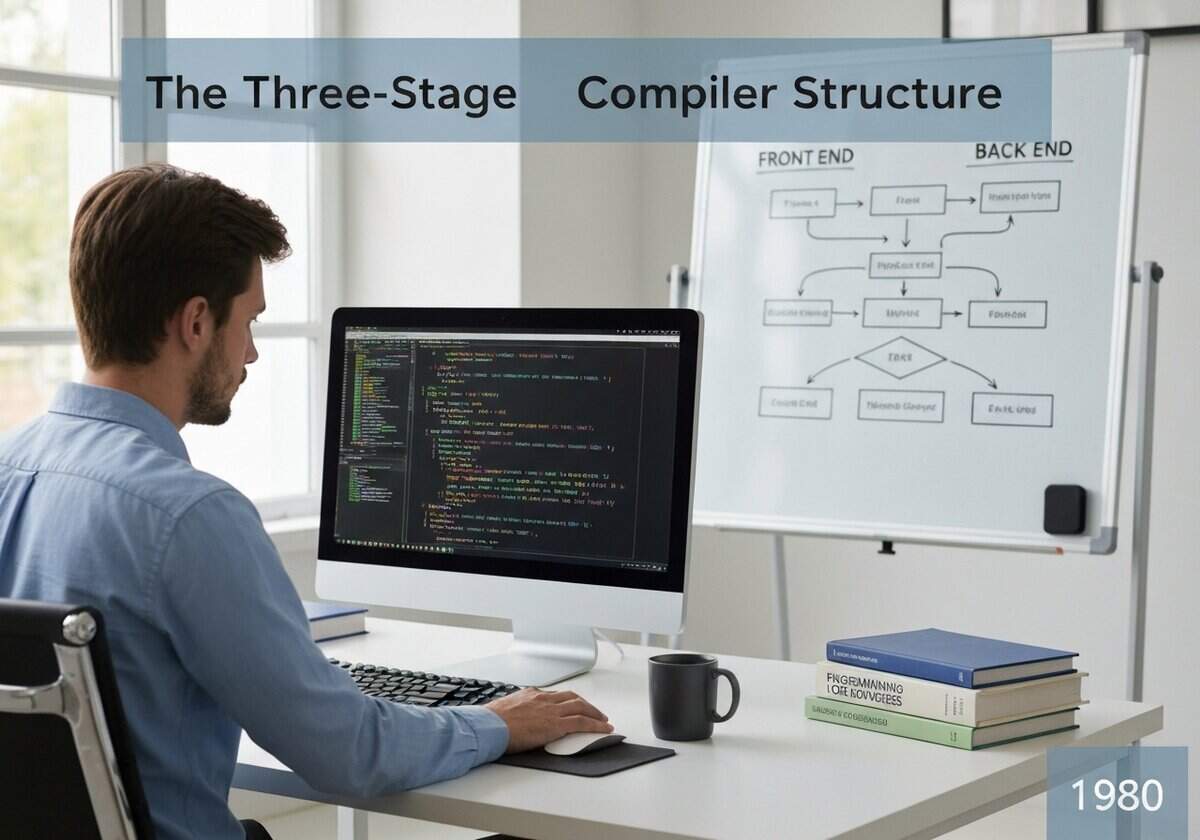
A modern compiler is typically structured in three stages: the front end, the middle end, and the back end. The front end parses the source code, checks it for correctness, and builds an intermediate representation (IR). The middle end performs optimizations on this IR. The back end then translates the optimized IR into target machine code for a specific CPU architecture.
This modular three-stage design provides a crucial separation of concerns. The front end is language-dependent but machine-independent; it understands the syntax and semantics of a specific language like C++ or Rust. Its output, the Intermediate Representation (IR), is an abstract, machine-agnostic data structure like an Abstract Syntax Tree (AST) or Three-Address Code. This decouples the source language from the target machine.
The middle end is largely language- and machine-independent. It takes the IR and applies a series of optimization passes, such as dead code elimination, constant folding, and loop optimizations. Because it operates on the generic IR, these complex optimizations can be written once and applied to any language that can be compiled to that IR.
Finally, the back end is machine-dependent but language-independent. It takes the optimized IR and performs instruction selection, register allocation, and instruction scheduling to generate efficient machine code for a specific target architecture, like x86-64 or ARM. This structure makes it possible to build compilers that support M languages and N targets by writing M front ends and N back ends, rather than M*N individual compilers. This principle is exemplified by modern compiler infrastructures like GCC and LLVM.
UNESCO Nomenclature: 1203
– Computer science
Precursors
- early monolithic compiler designs
- concept of abstraction in software engineering
- development of intermediate languages in early systems
- research into portable software (e.g., the p-code system)
Applications
- retargetable compilers (e.g., GCC, llvm)
- cross-compilation for different hardware platforms
- language-agnostic optimization frameworks
- development of new programming languages by only creating a new front end
- static analysis tools that operate on intermediate representation
Potential Innovations Ideas
Due to scrapping bot traffic, currently more than 40k per day, this content is reserved to community members.
> Login < or > Register < (100% free) to access this, so as all other restricted content and tools.
Related to: compiler design, front end, middle end, back end, intermediate representation, ir, optimization, code generation, modularity, GCC, llvm.