Product Design, Manufacturing & Innovation Resources
Home » The “China Export” Mark Myth

The “China Export” Mark Myth

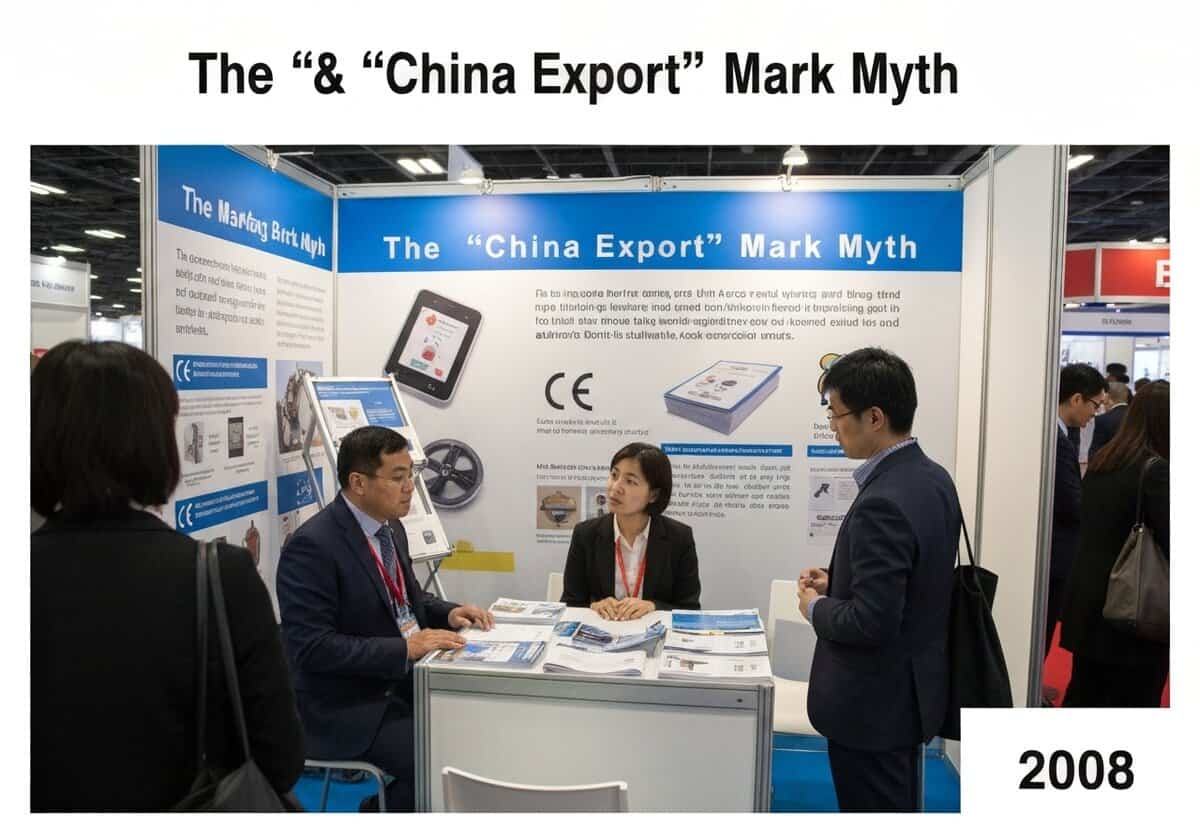
2008
Consumer awareness booth on CE marking and counterfeit marks in international trade.

(generated image for illustration only)

A persistent urban myth suggests a “China Export” mark exists that is confusingly similar to the official CE marking, with closer letter spacing, to mislead consumers. After an individual member had wrongly reported this, the European Commission has investigated this and found no evidence of such a mark being systematically used. Any mark that can be confused with the official CE marking is considered an infringement, regardless of its claimed origin or meaning.


The ‘China Export’ myth gained traction in the mid-2000s, primarily through email chains and online forums, and . The claim was that some Chinese manufacturers were using a logo, where the C and E were very close together, to imply compliance with European standards while claiming it simply stood for ‘China Export’. This would theoretically provide a legal loophole if they were accused of fraudulent CE marking. The story was often accompanied by images comparing the two logos.

In response to a formal question in the European Parliament in 2008, the European Commission clarified its position. The Commission stated it was unaware of any ‘China Export’ mark and that the allegation was unfounded. It reiterated that under EU law, the only valid marking is the official ‘CE’ marking with its legally defined proportions. Any other mark that could be confused with it is illegal. The non-compliant marks seen on some products are simply incorrectly designed CE marks, whether due to ignorance or deliberate deception to create ambiguity. The Commission’s stance is that the motivation is irrelevant; a non-compliant mark is an infringement and subject to action by member state market surveillance authorities. This clarification was important to combat misinformation and reinforce that responsibility for correct marking lies with the manufacturer, and no such ‘loophole’ exists.

UNESCO Nomenclature: 5311
– International economics

Type

Abstract System

Disruption

Incremental

Usage

Widespread Use

Precursors

  • general issues with counterfeit goods and trademark infringement
  • consumer concerns about the safety of imported products
  • the rise of internet forums and email as vectors for misinformation

Applications

  • consumer awareness campaigns about genuine vs. counterfeit marks
  • increased scrutiny by market surveillance authorities on improperly marked goods
  • legal actions against manufacturers using misleading marks
  • clarification of ce marking rules by regulatory bodies

Patents:

NA

Potential Innovations Ideas

Due to scrapping bot traffic, currently more than 40k per day, this content is reserved to community members.
> Login < or > Register < (100% free) to access this, so as all other restricted content and tools.

Related to: China Export, CE mark myth, counterfeit, misleading marking, European Commission, infringement, consumer protection, market surveillance, product fraud, misinformation.

Historical Context

The “China Export” Mark Myth

1995
1995
2000
2008
2011
1994
1995
2000
2002-05-01
2010
2021-01-01

(if date is unknown or not relevant, e.g. "fluid mechanics", a rounded estimation of its notable emergence is provided)

Related Invention, Innovation & Technical Principles

Full size images and downloads are only available, 100% free, for registered members.

> Login <