Product Design, Manufacturing & Innovation Resources
Home » Chemiluminescence

Chemiluminescence

1890
  • Eilhard Wiedemann
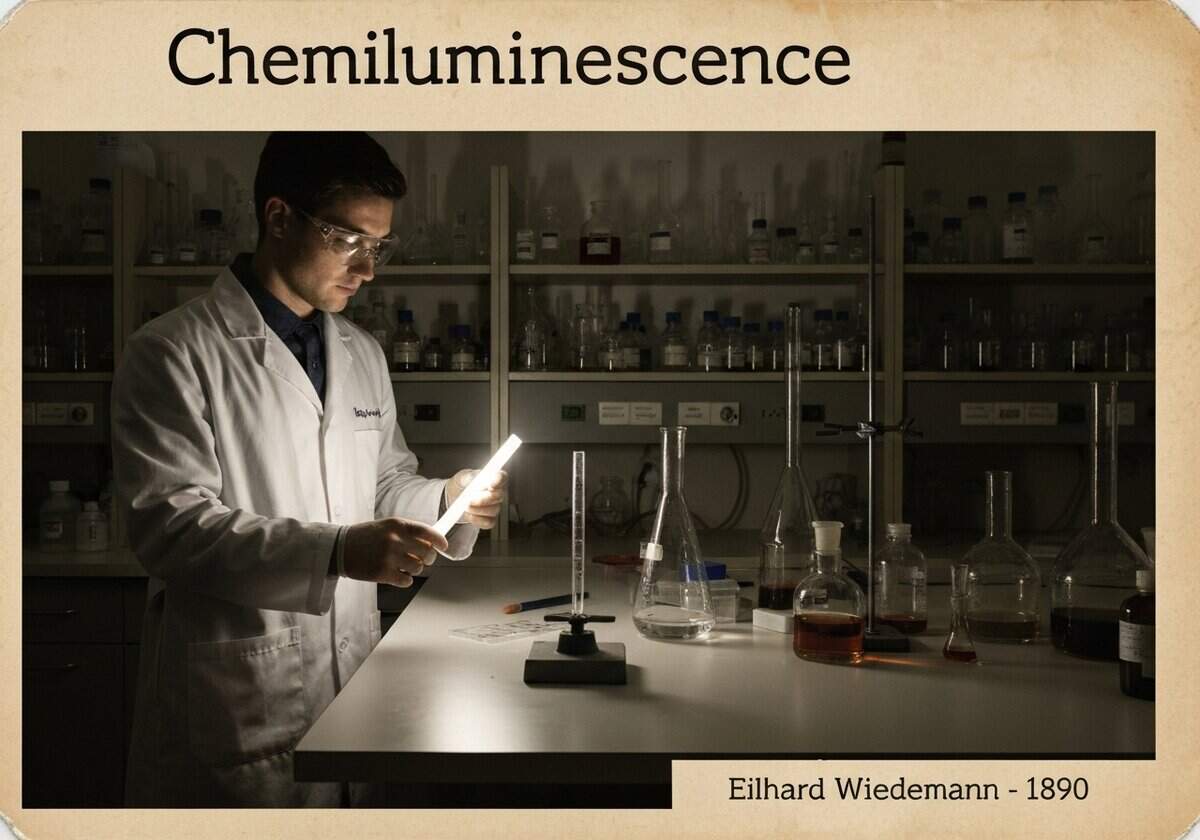
Chemiluminescence experiment in a laboratory with light stick and glassware.

(generated image for illustration only)

Chemiluminescence, or chemoluminescence,  is the emission of light (luminescence) as a result of a chemical reaction. An excited state intermediate, denoted as [Product]* (note the asterisk frequently used for that), is formed. This intermediate then decays to a lower energy ground state, releasing energy in the form of a photon. The overall process can be represented as \(A + B \rightarrow [Product]* \rightarrow Product + light\).
Chemiluminescence is a distinct phenomenon from fluorescence or phosphorescence, where a substance absorbs light and then re-emits it. In chemiluminescence, the energy required to create the excited state comes directly from the chemical potential energy stored in the reactants. The reaction pathway typically involves a highly exothermic step that produces an electronically excited intermediate. For light to be produced, this decay must be a radiative process (emission of a photon) rather than a non-radiative one (loss of energy as heat). The color of the emitted light depends on the energy gap between the excited state and the ground state of the product molecule, governed by the equation \(E = h\nu = hc/\lambda\), where E is the energy, h is Planck’s constant, c is the speed of light, and λ is the wavelength. The efficiency of this process is described by the quantum yield, which is the ratio of emitted photons to the number of reacting molecules. Most chemiluminescent reactions have low quantum yields, but some, like those used in light sticks, are optimized for high efficiency.

UNESCO Nomenclature: 2202
– Physical chemistry

Type

Chemical Process

Disruption

Substantial

Usage

Widespread Use

Precursors

  • discovery of phosphorus’s glow in the dark (1669)
  • Robert Boyle’s studies on bioluminescence and ‘cold light’ (17th century)
  • understanding of chemical reactions and energy conservation (18th-19th centuries)
  • development of quantum mechanics to explain electron states and photon emission (early 20th century)

Applications

  • light sticks
  • forensic blood detection
  • immunoassays
  • biomedical imaging
  • environmental pollutant analysis

Patents:

NA

Potential Innovations Ideas

Due to scrapping bot traffic, currently more than 40k per day, this content is reserved to community members.
> Login < or > Register < (100% free) to access this, so as all other restricted content and tools.

Related to: chemiluminescence, light emission, chemical reaction, excited state, photon, luminescence, exothermic, quantum yield, radiative decay, photochemistry.

Historical Context

Chemiluminescence

1887
1889
1890
1890
1895
1895
1896
1887
1888
1889
1890
1890
1895
1895
1899

(if date is unknown or not relevant, e.g. "fluid mechanics", a rounded estimation of its notable emergence is provided)

Related Invention, Innovation & Technical Principles

Full size images and downloads are only available, 100% free, for registered members.

> Login <