Product Design, Manufacturing & Innovation Resources
Home » Cathodic Protection

Cathodic Protection

1824
  • Humphry Davy
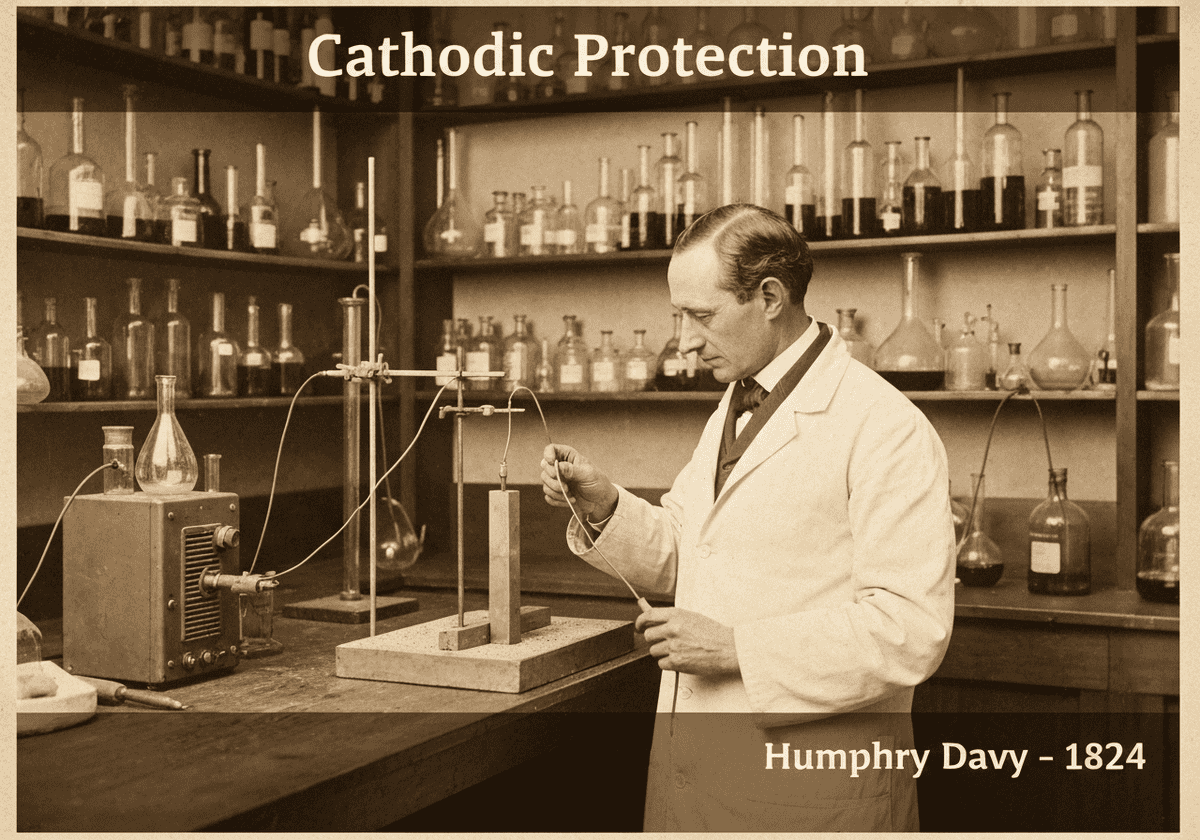
Electrochemical cell experiment for cathodic protection by Humphry Davy.

(generated image for illustration only)

Cathodic protection (CP) is a technique used to control the corrosion of a metal surface by making it the cathode of an electrochemical cell. This is achieved by supplying an external electrical current that suppresses the natural corrosion currents. The protected metal’s potential is polarized to a more negative value, shifting it into a region of immunity or passivity.

There are two primary methods of applying cathodic protection. The first is the Galvanic Anode Cathodic Protection (GACP) system, which uses sacrificial anodes. In this method, a more electrochemically active metal (like zinc, aluminum, or magnesium) is electrically connected to the protected metal (e.g., steel). The active metal becomes the anode and corrodes preferentially, ‘sacrificing’ itself to protect the steel structure, which becomes the cathode. This system is simple, requires no external power, but the anodes must be periodically replaced.

The second method is the Impressed Current Cathodic Protection (ICCP) system. This involves using an external DC power source (like a transformer-rectifier) to impress a current from an inert anode (such as high-silicon cast iron or mixed metal oxide) through the electrolyte onto the structure to be protected. The structure is forced to be the cathode, and corrosion is mitigated. ICCP systems can protect much larger structures and are adjustable, but they are more complex and require a continuous power supply and monitoring.

The effectiveness of a CP system is monitored by measuring the structure-to-electrolyte potential. A sufficient negative shift in potential indicates that protection is being achieved. This technique effectively halts most forms of electrochemical corrosion by overpowering the natural corrosion cells on the metal’s surface.

UNESCO Nomenclature: 2203
– Electrochemistry

Type

Chemical Process

Disruption

Substantial

Usage

Widespread Use

Precursors

  • Alessandro Volta’s invention of the voltaic pile (1800)
  • Understanding of the electrochemical nature of corrosion
  • Michael Faraday’s laws of electrolysis (1834)

Applications

  • protecting steel pipelines for oil, gas, and water
  • preserving the hulls of ships and offshore platforms
  • reinforcing steel in concrete structures (rebar)
  • water heaters and storage tanks

Patents:

NA

Potential Innovations Ideas

Due to scrapping bot traffic, currently more than 40k per day, this content is reserved to community members.
> Login < or > Register < (100% free) to access this, so as all other restricted content and tools.

Related to: cathodic protection, corrosion control, sacrificial anode, impressed current, electrochemistry, pipeline, ship hull, rebar.

Historical Context

Cathodic Protection

1820
1820
1822
1824
1827
1831
1831
1820
1820
1821
1822
1827
1831
1831
1832

(if date is unknown or not relevant, e.g. "fluid mechanics", a rounded estimation of its notable emergence is provided)

Related Invention, Innovation & Technical Principles

Full size images and downloads are only available, 100% free, for registered members.

> Login <