Product Design, Manufacturing & Innovation Resources
Lar » Proteção catódica

Proteção catódica

1824
  • Humphry Davy
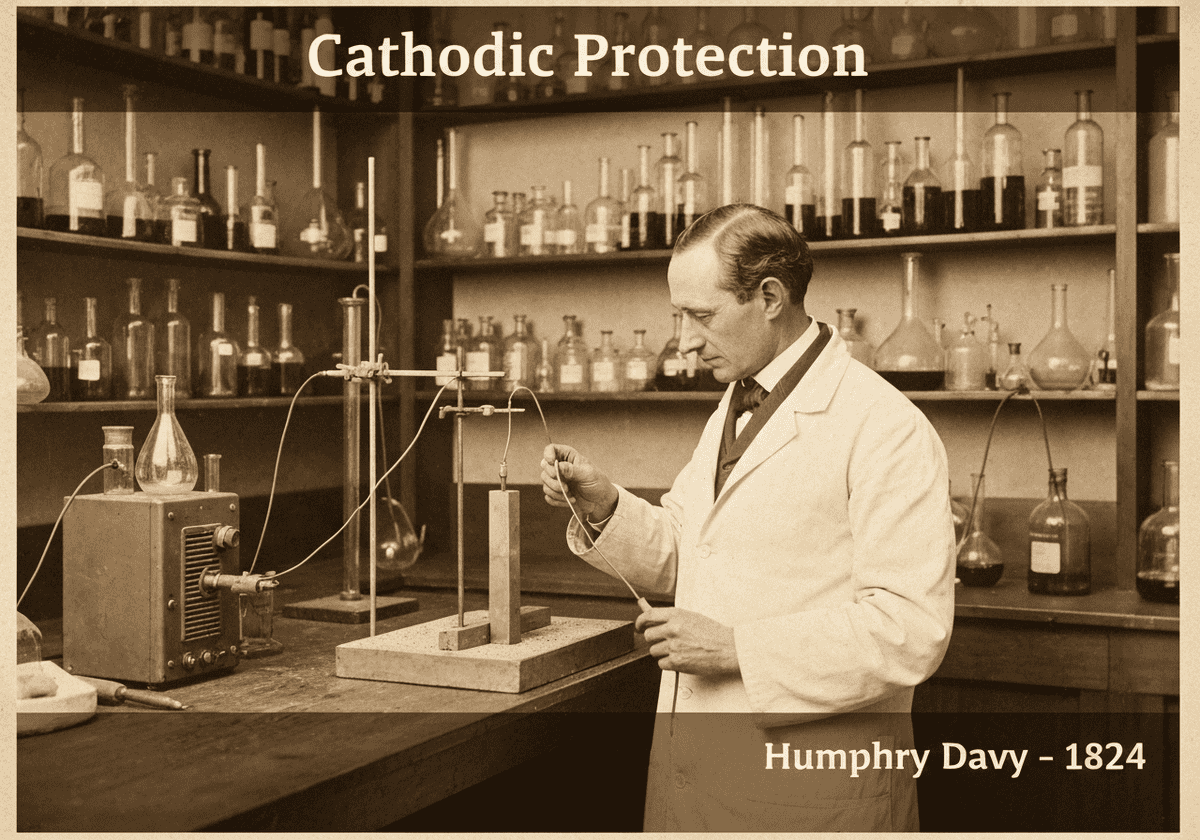
Electrochemical cell experiment for cathodic protection by Humphry Davy.

(Imagem gerada apenas para fins ilustrativos)

Cathodic protection (CP) is a technique used to control the corrosion of a metal surface by making it the cathode of an electrochemical cell. This is achieved by supplying an external electrical current that suppresses the natural corrosion currents. The protected metal’s potential is polarized to a more negative value, shifting it into a region of immunity or passivity.

There are two primary methods of applying cathodic protection. The first is the Galvanic Anode Cathodic Protection (GACP) system, which uses sacrificial anodes. In this method, a more electrochemically active metal (like zinc, aluminum, or magnesium) is electrically connected to the protected metal (e.g., steel). The active metal becomes the anode and corrodes preferentially, ‘sacrificing’ itself to protect the steel structure, which becomes the cathode. This system is simple, requires no external power, but the anodes must be periodically replaced.

The second method is the Impressed Current Cathodic Protection (ICCP) system. This involves using an external DC power source (like a transformer-rectifier) to impress a current from an inert anode (such as high-silicon cast iron or mixed metal oxide) through the electrolyte onto the structure to be protected. The structure is forced to be the cathode, and corrosion is mitigated. ICCP systems can protect much larger structures and are adjustable, but they are more complex and require a continuous power supply and monitoring.

The effectiveness of a CP system is monitored by measuring the structure-to-electrolyte potential. A sufficient negative shift in potential indicates that protection is being achieved. This technique effectively halts most forms of electrochemical corrosion by overpowering the natural corrosion cells on the metal’s surface.

UNESCO Nomenclature: 2203
Eletroquímica

Tipo

Processo Químico

Interrupção

Substancial

Uso

Uso generalizado

Precursores

  • Alessandro Volta’s invention of the voltaic pile (1800)
  • Understanding of the electrochemical nature of corrosion
  • Leis da eletrólise de Michael Faraday (1834)

Aplicações

  • protecting steel pipelines for oil, gas, and water
  • preserving the hulls of ships and offshore platforms
  • reinforcing steel in concrete structures (rebar)
  • water heaters and storage tanks

Patentes:

NA

Ideias de Inovação Potencial

Devido ao tráfego de bots de coleta de dados, atualmente superior a 40 mil por dia, este conteúdo é reservado aos membros da comunidade.
> Login < ou > Registrar < (100% gratuito) para acessar isso, assim como todo o restante do conteúdo e das ferramentas restritas.

Related to: cathodic protection, corrosion control, sacrificial anode, impressed current, electrochemistry, pipeline, ship hull, rebar.

Contexto histórico

Proteção catódica

1820
1820
1822
1824
1827
1831
1831
1820
1820
1821
1822
1827
1831
1831
1832

(Caso a data seja desconhecida ou irrelevante, por exemplo, "mecânica dos fluidos", é fornecida uma estimativa aproximada de seu surgimento notável)

Princípios relacionados à invenção, inovação e tecnologia

Imagens em tamanho real e downloads estão disponíveis apenas, 100% gratuitos, para membros registrados.