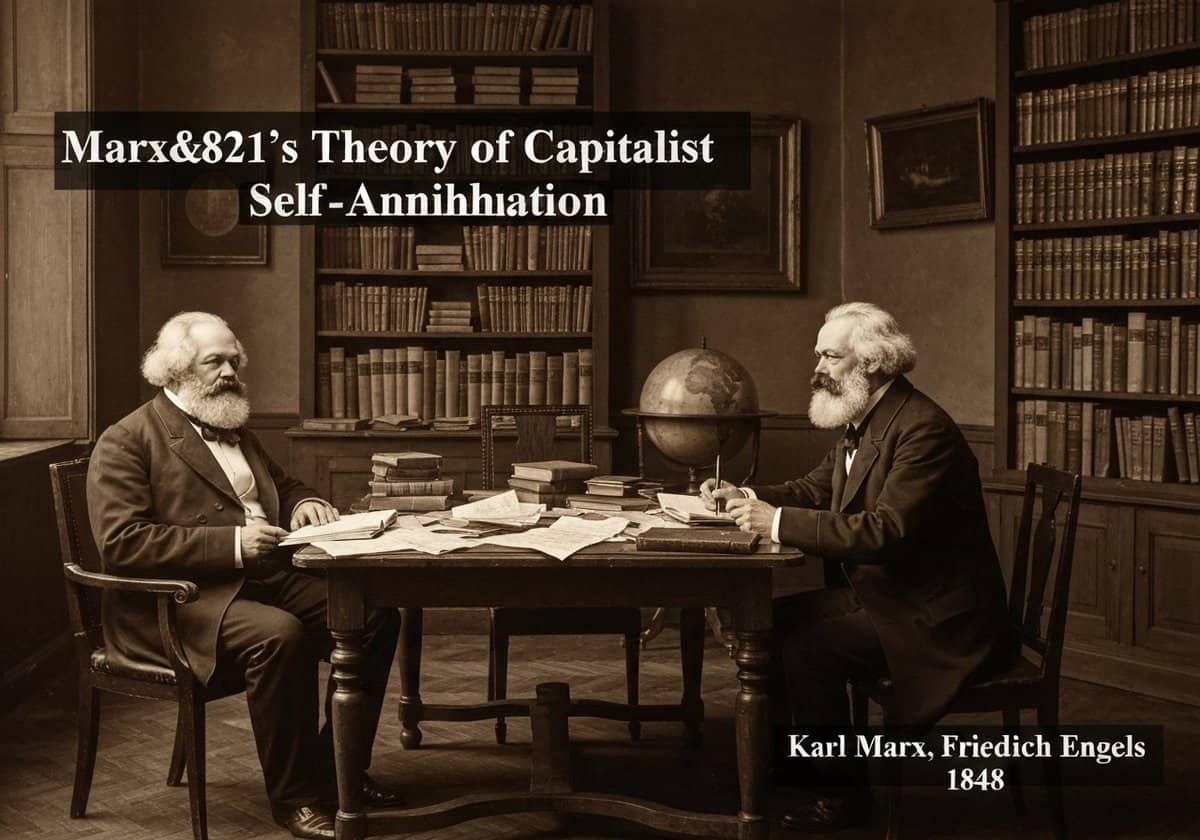
Marx’s Theory of Capitalist Self-Annihilation
1848
- Karl Marx
- Friedrich Engels
Karl Marx’s analysis of capitalism identified a dynamic where the bourgeoisie, to expand capital, must “constantly revolutionize the instruments of production.” This process leads to periodic crises where existing products and productive forces are destroyed. This concept, articulated in “The Communist Manifesto,” foreshadowed Schumpeter’s idea but framed it as a fundamental, self-destructive contradiction of capitalism rather than a healthy growth mechanism.
Long before Schumpeter, Karl Marx and Friedrich Engels described a similar process, but with a vastly different interpretation and conclusion. For Marx, this constant upheaval was not a sign of capitalism’s vitality but of its inherent instability and internal contradictions. The relentless drive for capital accumulation and profit forces capitalists to continually improve technology and cut labor costs, leading to crises of overproduction—where the system produces more goods than the population can afford to buy.
According to Marx, these crises are resolved through the forceful destruction of productive capacity, devaluation of capital, and the creation of new markets. This is a destructive, not creative, process that intensifies class conflict. While Schumpeter saw the entrepreneur as a heroic agent of progress, Marx saw the process as an impersonal and brutal logic of capital that ultimately exploits the working class and sows the seeds of its own demise. The destruction was a symptom of a failing system, not the engine of its long-term success.
UNESCO Nomenclature: 5311
– Economic theory
Precursors
- Georg Wilhelm Friedrich Hegel’s dialectical method
- Adam Smith’s analysis of competition and capital accumulation
- David Ricardo’s labor theory of value
Applications
- marxist economic theory
- crisis theory in economics
- dependency theory in international relations
- world-systems theory
- critical theory and cultural studies
Potential Innovations Ideas
Due to scrapping bot traffic, currently more than 40k per day, this content is reserved to community members.
> Login < or > Register < (100% free) to access this, so as all other restricted content and tools.
Related to: Karl Marx, capitalism, crisis theory, means of production, capital accumulation, bourgeoisie, communist manifesto, economic contradiction, historical materialism, class conflict.