Product Design, Manufacturing & Innovation Resources
Home » The Calvin Cycle (Carbon Fixation)

The Calvin Cycle (Carbon Fixation)

1950
  • Melvin Calvin
  • Andrew Benson
  • James Bassham
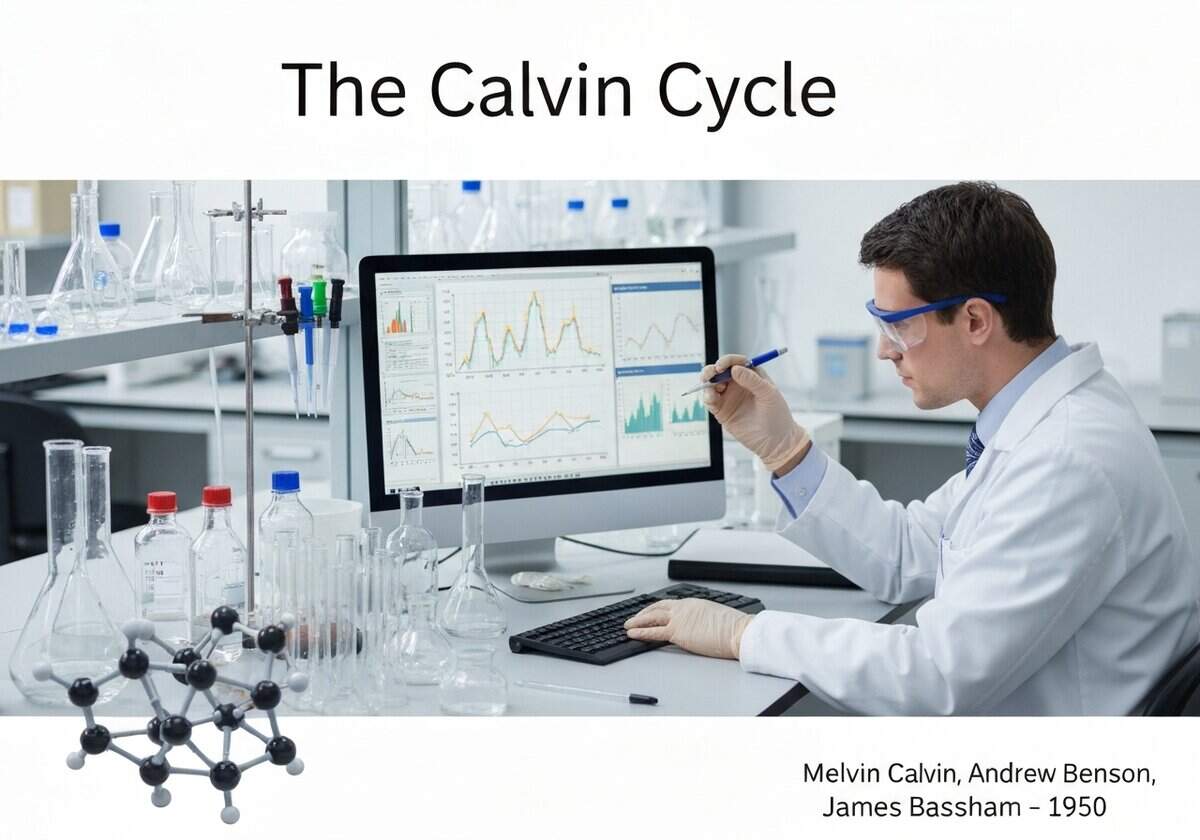
Biochemist studying the Calvin Cycle and RuBisCO enzyme in a laboratory.

(generated image for illustration only)

The Calvin cycle, or light-independent reactions, uses the ATP and NADPH produced during the light-dependent stage to convert inorganic carbon dioxide into organic sugar molecules. This process occurs in the stroma of the chloroplast. The key enzyme, RuBisCO, catalyzes the first step: the fixation of \(CO_2\) into an organic molecule, initiating a cycle that produces carbohydrates.
The Calvin cycle proceeds in three main stages. The first is carbon fixation, where the enzyme RuBisCO attaches a molecule of CO2 to a five-carbon sugar, ribulose-1,5-bisphosphate (RuBP). This creates an unstable six-carbon intermediate that immediately splits into two molecules of a three-carbon compound, 3-phosphoglycerate (3-PGA).

The second stage is reduction. Using energy from ATP and reducing power from NADPH (both supplied by the light reactions), the 3-PGA molecules are converted into a three-carbon sugar, glyceraldehyde-3-phosphate (G3P). This is an energy-intensive step that effectively stores the light energy in chemical bonds.

The third stage is regeneration. For every six molecules of G3P produced, one exits the cycle to be used by the plant to synthesize glucose and other organic molecules. The other five G3P molecules, along with more ATP, are used to regenerate the three molecules of RuBP that began the cycle. This ensures the process is sustainable, ready to fix more CO2.

UNESCO Nomenclature: 2402
– Biochemistry

Type

Biochemical Process

Disruption

Foundational

Usage

Widespread Use

Precursors

  • discovery of radioactive carbon-14 by martin kamen and sam ruben, which was used as a tracer
  • development of paper chromatography by archer martin and richard synge
  • understanding of ATP and NADPH from the light-dependent reactions
  • f.f. blackman’s law of limiting factors, suggesting a two-stage process

Applications

  • genetic engineering of crops to improve RuBisCO efficiency
  • understanding the global carbon cycle
  • developing strategies to increase crop yields
  • modeling plant responses to elevated atmospheric CO2

Patents:

NA

Potential Innovations Ideas

Due to scrapping bot traffic, currently more than 40k per day, this content is reserved to community members.
> Login < or > Register < (100% free) to access this, so as all other restricted content and tools.

Related to: Calvin cycle, light-independent reactions, carbon fixation, RuBisCO, stroma, ATP, NADPH, G3P, ribulose-1,5-bisphosphate, carbon cycle.

Historical Context

The Calvin Cycle (Carbon Fixation)

1930
1940
1950
1950
1954
1960
1967
1930
1930
1940
1950
1951
1958
1960
1970

(if date is unknown or not relevant, e.g. "fluid mechanics", a rounded estimation of its notable emergence is provided)

Related Invention, Innovation & Technical Principles

Full size images and downloads are only available, 100% free, for registered members.

> Login <