Product Design, Manufacturing & Innovation Resources
Home » Buffon’s Needle Problem

Buffon’s Needle Problem

1777
  • Georges-Louis Leclerc, Comte de Buffon
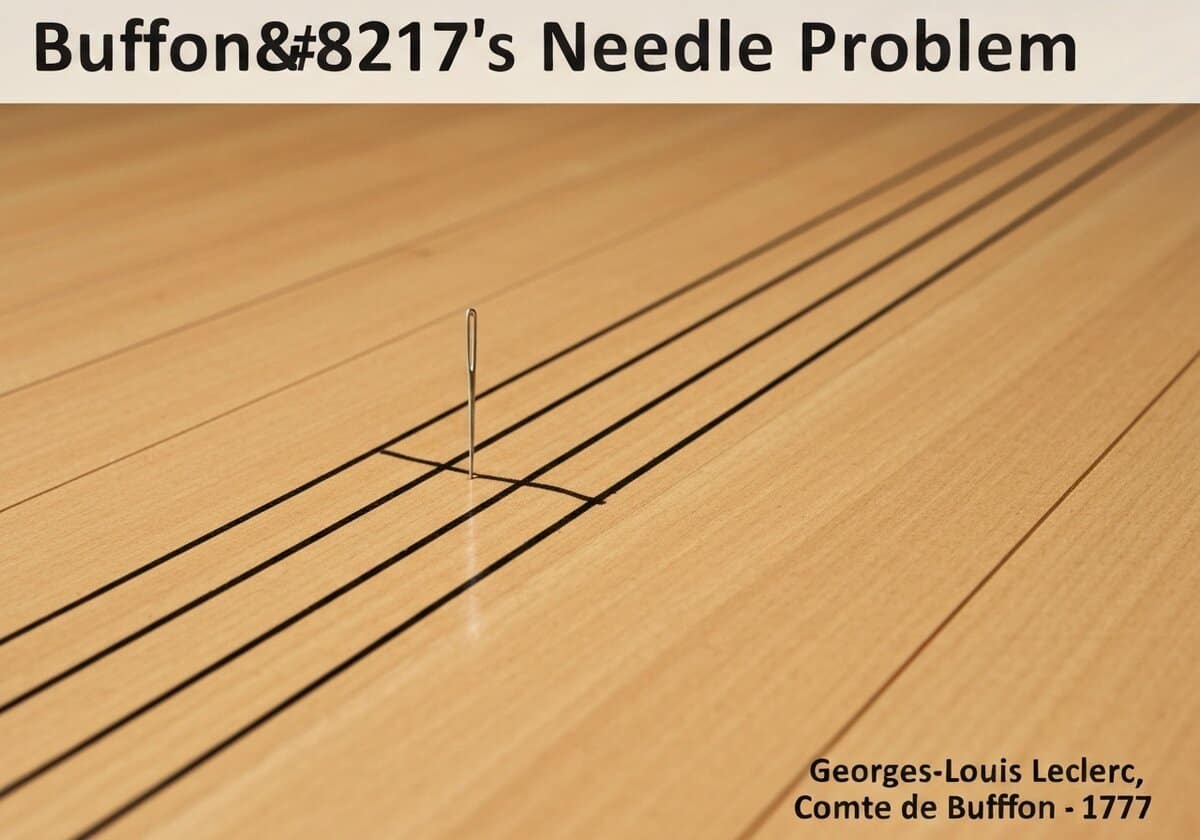
Geometric probability experiment with needle and parallel lines on a wooden floor.

(generated image for illustration only)

One of the earliest problems in geometric probability, it is considered a precursor to the Monte Carlo method. It involves dropping a needle of length \(l\) onto a floor with parallel lines a distance \(t\) apart. The probability that the needle will cross a line is \(P = \frac{2l}{\pi t}\) (for \(l \le t\)). This provides a physical experiment to estimate \(\pi\).


In 1733, Georges-Louis Leclerc, Comte de Buffon, posed the question: what is the probability that a needle, when dropped randomly on a ruled surface, will intersect one of the lines? The solution, published in 1777, is a classic result in geometric probability. To solve it, let the needle have length \(l\) and the parallel lines be separated by a distance \(t \ge l\). The position of the needle can be described by two variables: the distance \(x\) from the center of the needle to the nearest line, and the angle \(\theta\) the needle makes with the lines. The variable \(x\) is uniformly distributed in \([0, t/2]\), and \(\theta\) is uniformly distributed in \([0, \pi/2]\).

The needle crosses a line if \(x \le \frac{l}{2}\sin\theta\). The problem is to find the area of this region in the \((x, \theta)\) parameter space and divide it by the total area of the parameter space, which is \(\frac{t}{2} \times \frac{\pi}{2} = \frac{\pi t}{4}\). The area of the “favorable” region (where a crossing occurs) is given by the integral \(\int_0^{\pi/2} \frac{l}{2}\sin\theta \,d\theta = \frac{l}{2}[-\cos\theta]_0^{\pi/2} = \frac{l}{2}\). The probability is the ratio of these areas: \(P = \frac{l/2}{\pi t/4} = \frac{2l}{\pi t}\). By performing the experiment many times and observing the frequency of crossings, one can rearrange the formula to estimate \(\pi\): \(\pi \approx \frac{2l}{tP}\). This physical simulation to solve a mathematical problem is a direct intellectual ancestor of modern Monte Carlo methods.

UNESCO Nomenclature: 1209
– Statistics

Type

Abstract System

Disruption

Foundational

Usage

Widespread Use

Precursors

  • development of probability theory (Bernoulli, De Moivre)
  • invention of integral calculus (Newton, Leibniz)
  • early work on geometric figures and their properties (Euclid)

Applications

  • early example of geometric probability
  • pedagogical tool for integral calculus and probability
  • historical foundation for stochastic simulation methods

Patents:

NA

Potential Innovations Ideas

Due to scrapping bot traffic, currently more than 40k per day, this content is reserved to community members.
> Login < or > Register < (100% free) to access this, so as all other restricted content and tools.

Related to: Buffon’s needle, geometric probability, Pi, Monte Carlo, stochastic geometry, integral calculus, simulation, probability theory, needle problem, estimation.

Historical Context

Buffon’s Needle Problem

1650
1747
1758
1777
1799
1812
1822
1650
1736
1750
1763-12-23
1780
1805
1822
1822

(if date is unknown or not relevant, e.g. "fluid mechanics", a rounded estimation of its notable emergence is provided)

Related Invention, Innovation & Technical Principles

Full size images and downloads are only available, 100% free, for registered members.

> Login <