Product Design, Manufacturing & Innovation Resources
Home » Black Holes

Black Holes

1916
  • Karl Schwarzschild
  • John Archibald Wheeler
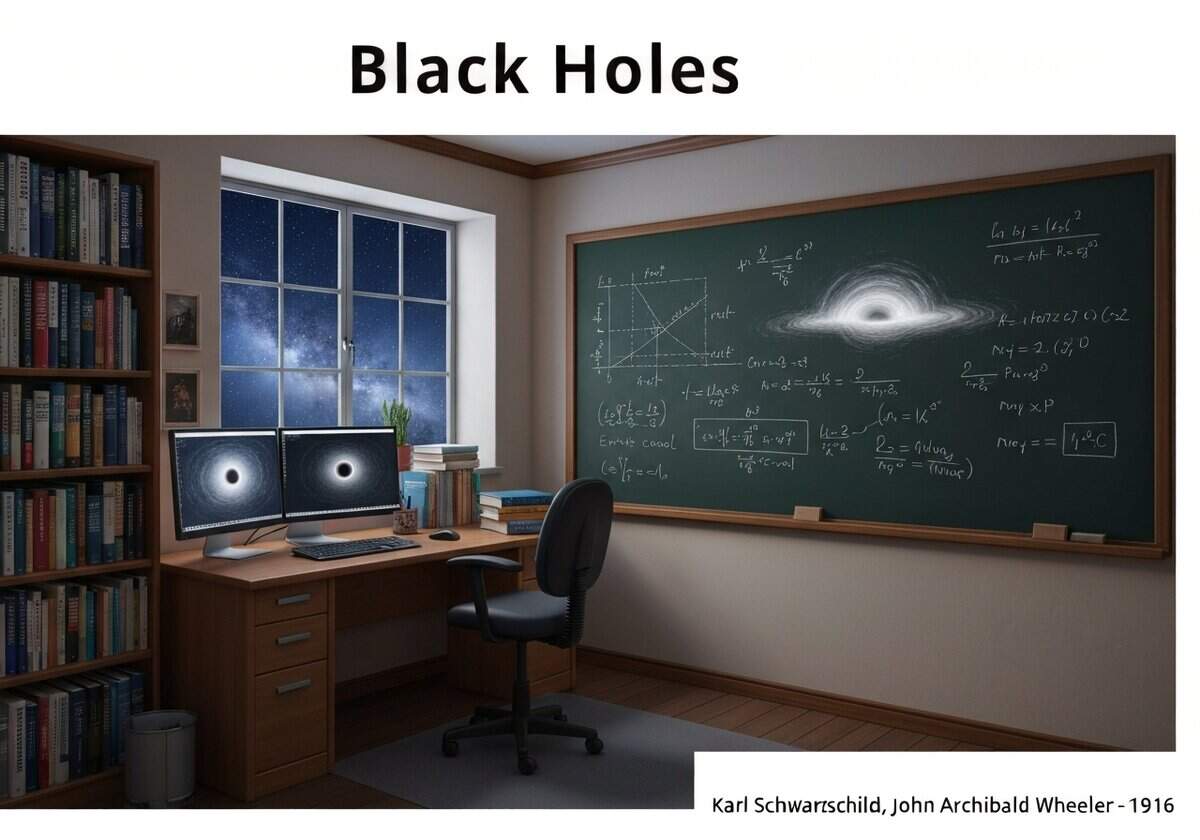
Office of a physicist studying black holes and relativity with equations and simulations.

(generated image for illustration only)

A black hole is a region of spacetime where gravity is so strong that nothing—no particles or even light—can escape. The boundary of this region is called the event horizon. Predicted by general relativity as a solution to the field equations, a black hole is the result of the complete gravitational collapse of a massive star.


The concept of a black hole is a direct solution to the Einstein Field Equations. Shortly after Einstein published his theory, Karl Schwarzschild found the first exact solution for the gravitational field of a non-rotating, spherically symmetric mass. This solution featured a characteristic radius, now known as the Schwarzschild radius, at which the equations exhibit a coordinate singularity. This radius defines the event horizon, the point of no return. Any object crossing it is inevitably pulled towards the central singularity, a point of theoretically infinite density where the known laws of physics cease to apply. The ‘no-hair theorem’ posits that a stable black hole is completely characterized by only three properties: its mass, angular momentum (spin), and electric charge.

For a long time, black holes were considered a mathematical curiosity. However, astronomical evidence has since confirmed their existence. Stellar-mass black holes form when very massive stars exhaust their nuclear fuel and collapse. Supermassive black holes, with masses millions to billions of times that of our Sun, are found at the centers of most large galaxies, including our own Milky Way (Sagittarius A*). While black holes are invisible, their presence is inferred through their interaction with other matter, such as the orbits of nearby stars or the intense X-ray radiation from matter heated in an accretion disk before falling in.

UNESCO Nomenclature: 2211
– Relativity

Type

Abstract System

Disruption

Foundational

Usage

Widespread Use

Precursors

  • Einstein Field Equations
  • Concept of escape velocity from Newtonian mechanics
  • John Michell’s 18th-century concept of ‘dark stars’

Applications

  • explaining the power source of quasars and active galactic nuclei (accretion disks)
  • understanding stellar evolution for massive stars
  • a theoretical laboratory for testing the limits of general relativity and quantum mechanics
  • explaining the orbits of stars at the center of galaxies like the Milky Way

Patents:

NA

Potential Innovations Ideas

Due to scrapping bot traffic, currently more than 40k per day, this content is reserved to community members.
> Login < or > Register < (100% free) to access this, so as all other restricted content and tools.

Related to: black hole, general relativity, event horizon, singularity, schwarzschild radius, spacetime, stellar evolution, sagittarius a*.

Historical Context

Black Holes

1911-04-08
1913
1915
1916
1917
1918
1920
1910
1912
1915
1915-11
1916
1918
1919-05-29
1920

(if date is unknown or not relevant, e.g. "fluid mechanics", a rounded estimation of its notable emergence is provided)

Related Invention, Innovation & Technical Principles

Full size images and downloads are only available, 100% free, for registered members.

> Login <