Product Design, Manufacturing & Innovation Resources
Home » The Alpha-Helix (biochemistry)

The Alpha-Helix (biochemistry)

1951
  • Linus Pauling
  • Robert Corey
  • Herman Branson
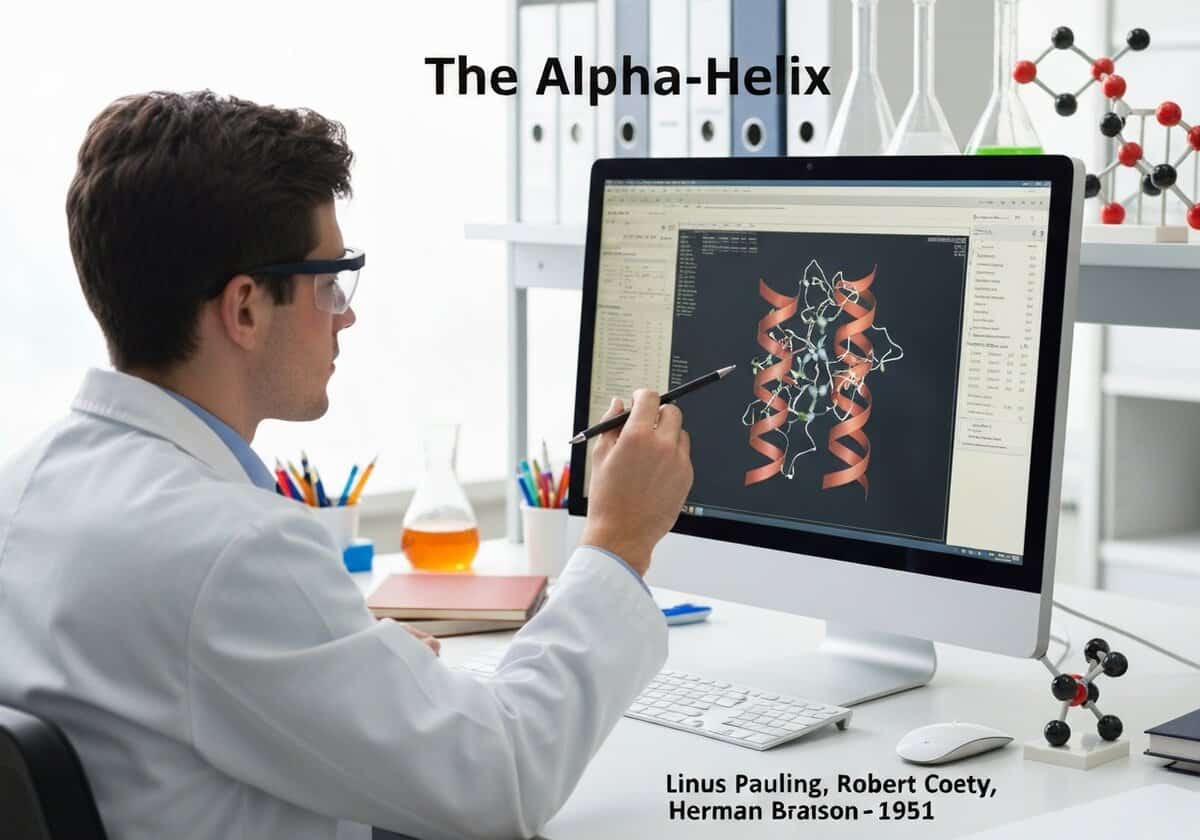
3D model of an alpha-helix protein structure in a biochemistry lab.

(generated image for illustration only)

The alpha-helix (\(\alpha\)-helix) is a common secondary structure motif in proteins. It is a right-handed coiled conformation in which every backbone N-H group donates a hydrogen bond to the backbone C=O group of the amino acid located four residues earlier (\(i+4 \rightarrow i\) hydrogen bonding). This regular pattern pulls the polypeptide chain into a helical shape.
Linus Pauling and his colleagues predicted the existence of the alpha-helix in 1951 before it was experimentally observed in detail by Max Perutz in the structure of myoglobin. Their prediction was based on a deep understanding of the planar nature of the peptide bond and the principles of hydrogen bonding. They meticulously built physical models to find stable conformations of a polypeptide chain that maximized hydrogen bonding while respecting steric constraints.

The alpha-helix has specific geometric properties: 3.6 residues per turn, a pitch of 5.4 Å (0.54 nm), and backbone dihedral angles (\(\phi, \psi\)) typically around (-60°, -45°). The side chains of the amino acids extend outwards from the helical axis, allowing them to interact with the environment or other parts of the protein. Certain amino acids, like alanine, leucine, and methionine, are considered ‘helix formers,’ while others, like proline (which lacks a backbone N-H for hydrogen bonding and has a rigid ring) and glycine (which is too flexible), are ‘helix breakers.’ The discovery of the alpha-helix and the beta-sheet provided the first fundamental insights into how a simple linear chain of amino acids could fold into complex, stable, and functional three-dimensional structures.

UNESCO Nomenclature: 2401
– Biochemistry

Type

Abstract System

Disruption

Incremental

Usage

Widespread Use

Precursors

  • x-ray diffraction studies of fibrous proteins like keratin by william astbury
  • understanding of the planar geometry of the peptide bond
  • elucidation of the principles of hydrogen bonding by linus pauling
  • development of physical molecular models

Applications

  • understanding the structure of fibrous proteins like keratin in hair and skin
  • designing alpha-helical peptides for antimicrobial or anti-cancer therapies
  • modeling transmembrane domains of proteins, which are often alpha-helical
  • protein structure prediction and validation
  • rational drug design targeting alpha-helical protein-protein interaction interfaces

Patents:

NA

Potential Innovations Ideas

Due to scrapping bot traffic, currently more than 40k per day, this content is reserved to community members.
> Login < or > Register < (100% free) to access this, so as all other restricted content and tools.

Related to: alpha-helix, protein secondary structure, linus pauling, hydrogen bond, polypeptide, conformation, dihedral angles, keratin, protein structure, molecular modeling.

Historical Context

The Alpha-Helix (biochemistry)

1930
1940
1950
1951
1958
1960
1970
1930
1940
1950
1950
1954
1960
1967
1970

(if date is unknown or not relevant, e.g. "fluid mechanics", a rounded estimation of its notable emergence is provided)

Related Invention, Innovation & Technical Principles

Full size images and downloads are only available, 100% free, for registered members.

> Login <