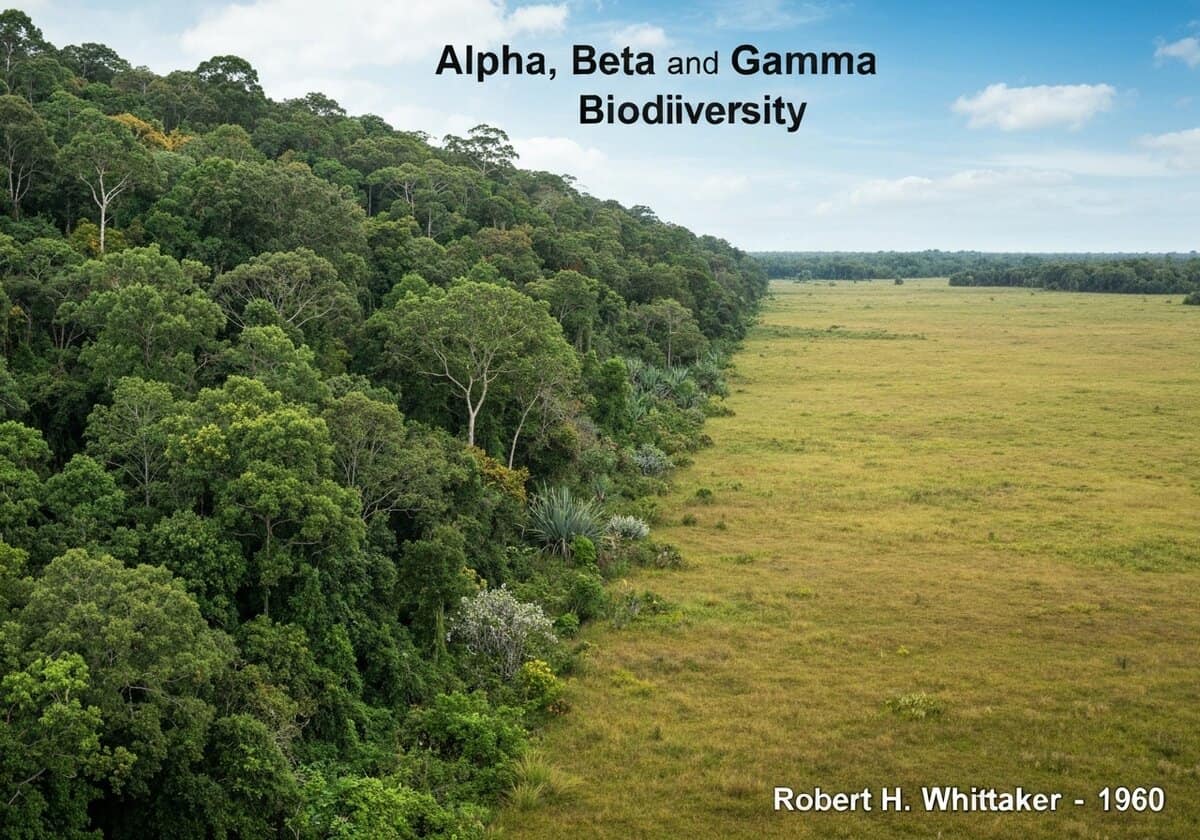
Alpha, Beta, and Gamma Biodiversity
This framework partitions biodiversity into three spatial scales. Alpha (α) diversity is the species richness within a single, local habitat or ecosystem. Beta (β) diversity measures the change or turnover in species composition between different habitats. Gamma (γ) diversity represents the total species richness over a large geographical area or landscape, encompassing both alpha and beta diversity.
Introduced by ecologist Robert H. Whittaker in the 1960s, the concepts of alpha, beta, and gamma diversity provided a crucial vocabulary and mathematical framework for analyzing biodiversity at different spatial scales. Prior to this, ecologists often just counted species in a given area (a measure of richness) without a standardized way to compare diversity within and between locations. Whittaker’s partitioning clarified these comparisons. Alpha diversity is the most intuitive measure: it’s the number of species found at a local scale, like a specific pond, forest patch, or coral reef. It is a measure of local community richness.
Beta diversity is the conceptual link between local and regional diversity. It quantifies how different the species compositions are between two or more local habitats. A high beta diversity implies that the habitats have very different sets of species, meaning there is high species turnover along an environmental gradient. Conversely, low beta diversity means the same species are found across multiple habitats. Whittaker originally proposed simple formulas, such as \(beta = gamma / alpha\), but numerous other metrics have since been developed to measure beta diversity more robustly, such as the Jaccard index or Sørensen index, which account for shared and unshared species between sites.
Gamma diversity is the total biodiversity across a larger landscape or region that comprises multiple habitats. It is the product of the diversity within those habitats (alpha) and the diversity between them (beta). This hierarchical framework is fundamental to conservation biology and landscape ecology. For example, a conservation plan might aim to protect a network of sites that, while having moderate alpha diversity individually, collectively exhibit high beta diversity. This strategy would conserve more total species (high gamma diversity) than protecting a single, large, homogenous area with high alpha diversity but low beta diversity. The framework allows scientists to understand how processes like habitat fragmentation or climate change affect biodiversity not just by reducing local species counts, but by altering the distinctiveness of ecological communities across the landscape.
UNESCO Nomenclature: 2407
– Ecology
Type
Conceptual Framework
Precursors
- Gleason’s individualistic concept of the plant association
- early studies on species-area relationships
- foundational concepts of the ecological niche
- development of quantitative methods in ecology
Applications
- comparing biodiversity across different ecosystems for environmental impact assessments
- designing networks of protected areas to maximize species representation
- monitoring the effects of habitat fragmentation on species turnover
- guiding ecological restoration projects to recreate complex community structures
- studying biogeographical patterns of species distribution
Potential Innovations Ideas
Due to scrapping bot traffic, currently more than 40k per day, this content is reserved to community members.
> Login < or > Register < (100% free) to access this, so as all other restricted content and tools.
Related to: alpha diversity, beta diversity, gamma diversity, Robert Whittaker, community ecology, species richness, species turnover, spatial scale, biodiversity measurement, landscape ecology.