Product Design, Manufacturing & Innovation Resources
Home » Aghion-Howitt Model of Creative Destruction

Aghion-Howitt Model of Creative Destruction

1992
  • Philippe Aghion
  • Peter Howitt
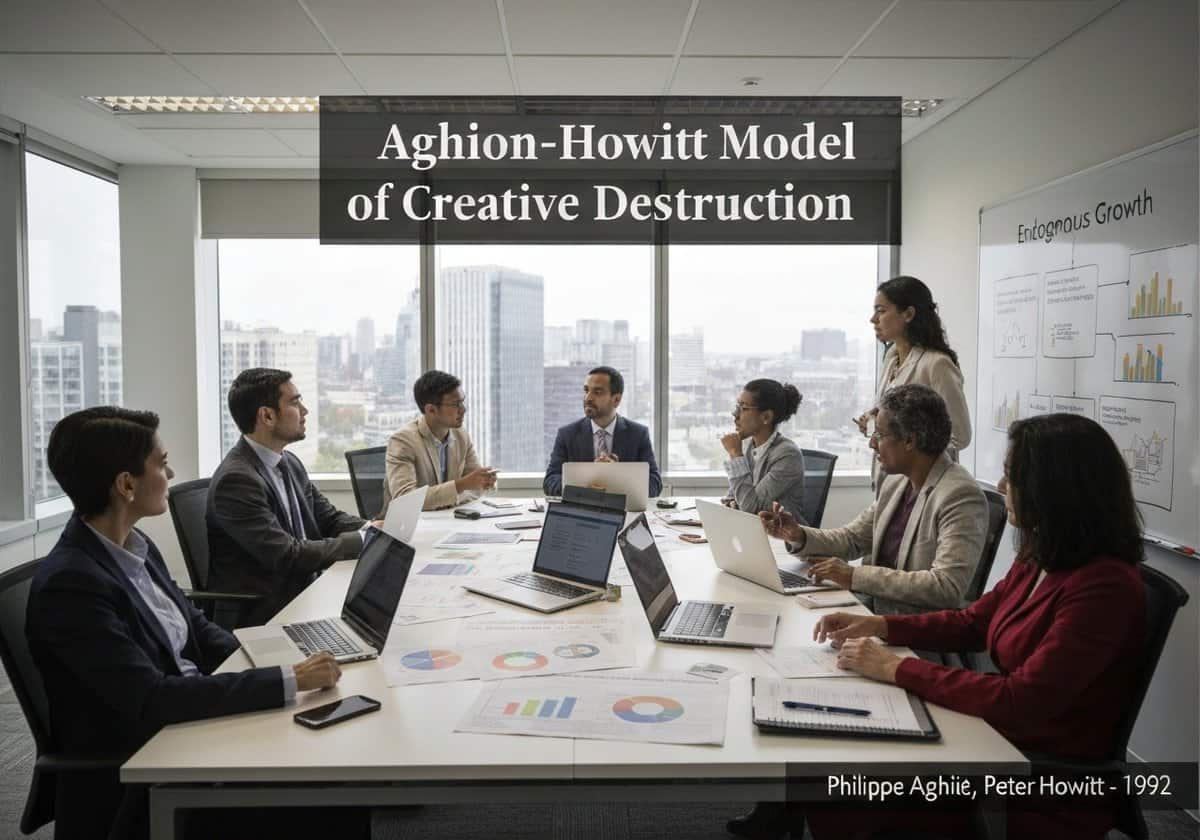
Economists discussing the Aghion-Howitt Model of Creative Destruction in a modern office.

(generated image for illustration only)

Philippe Aghion and Peter Howitt developed a mathematical model of creative destruction based on Schumpeter’s ideas. In their endogenous growth model, technological progress is the engine of long-run economic growth. New innovations destroy the monopoly rents of previous innovators, creating a process where growth is inherently uncertain and occurs in bursts as new, higher-quality products replace old ones.

The Aghion-Howitt model was a landmark achievement in formalizing Schumpeter’s insights within a general equilibrium framework. It belongs to the class of endogenous growth models, where the rate of technological progress, and thus long-term economic growth, is determined by economic factors within the model, rather than being assumed as an external, exogenous force as in earlier neoclassical models like the Solow-Swan model.

In the model, innovation is a purposeful R&D activity undertaken by firms seeking to gain monopoly profits. A successful innovation creates a new, better-quality product that displaces the existing one, granting the innovator a temporary monopoly. However, this monopoly is itself vulnerable to future innovation. This constant threat of displacement is the “destruction” aspect. The “creative” aspect is that each new innovation builds upon the last, increasing the overall productivity of the economy. The model generates a clear trade-off: stronger patent protection can increase the incentive to innovate by protecting monopoly rents, but it can also slow down the diffusion of technology and subsequent innovations. This makes it a powerful tool for analyzing policies related to R&D, competition, and intellectual property.

UNESCO Nomenclature: 5312
– Macroeconomics

Type

Abstract System

Disruption

Substantial

Usage

Widespread Use

Precursors

  • Joseph Schumpeter’s theory of creative destruction
  • Paul Romer’s work on endogenous growth theory
  • Robert Solow’s neoclassical growth model (as a point of departure)
  • Kenneth Arrow’s work on the economics of information and R&D

Applications

  • endogenous growth theory
  • economic policy analysis regarding r&d subsidies
  • intellectual property law and patent policy design
  • macroeconomic modeling of technological change
  • competition policy analysis

Patents:

NA

Potential Innovations Ideas

Due to scrapping bot traffic, currently more than 40k per day, this content is reserved to community members.
> Login < or > Register < (100% free) to access this, so as all other restricted content and tools.

Related to: endogenous growth, Aghion-Howitt model, Schumpeterian growth, technological progress, R&D, monopoly rents, economic modeling, macroeconomics, innovation economics, patent policy.

Historical Context

Aghion-Howitt Model of Creative Destruction

1980
1986
1990
1992
1995
1995
2000
1980
1983
1990
1992
1994
1995
2000
2002-05-01

(if date is unknown or not relevant, e.g. "fluid mechanics", a rounded estimation of its notable emergence is provided)

Related Invention, Innovation & Technical Principles

Full size images and downloads are only available, 100% free, for registered members.

> Login <