The 3 Domains of Ergonomics
1990
- International Ergonomics Association (IEA)
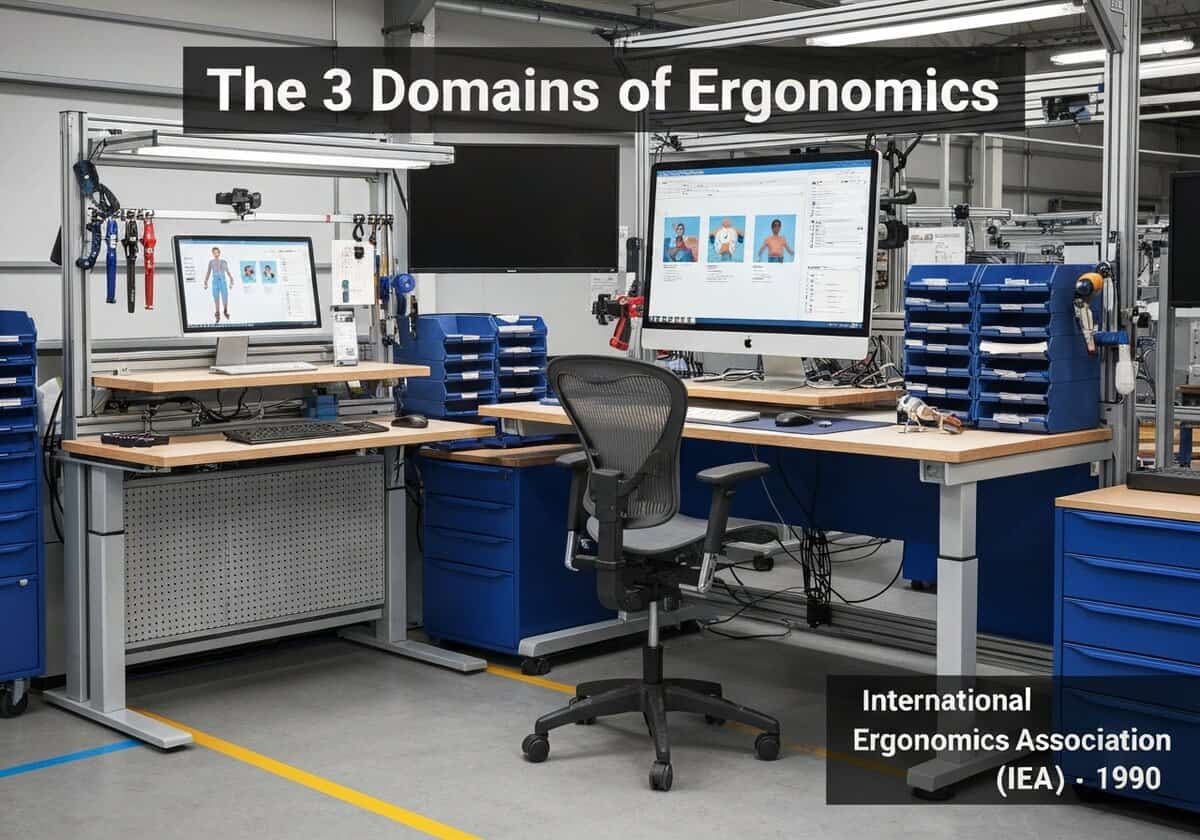
The International Ergonomics Association divides the discipline into three primary domains of specialization: physical ergonomics focuses on human anatomical, anthropometric, physiological, and biomechanical characteristics as they relate to physical activity, cognitive ergonomics concerns mental processes like perception, memory, and reasoning, and finally organizational ergonomics deals with the optimization of sociotechnical systems, including organizational structures, policies, and processes.
These three domains provide a framework for addressing the multifaceted nature of human-system interaction. Physical ergonomics is perhaps the most traditionally recognized domain, addressing topics like workplace layout, material handling, repetitive movements, work-related musculoskeletal disorders (MSDs), and workplace safety. It relies heavily on anthropometry (the study of human body measurements) and biomechanics to ensure that physical tasks are within the capabilities of the workforce.
Cognitive ergonomics, often used interchangeably with human factors engineering, focuses on the mental aspects of work. It covers mental workload, decision-making, skilled performance, human reliability, work stress, and training as these relate to human-system interaction. A key application is in human-computer interaction (HCI), ensuring that software and systems are intuitive and do not overload the user’s cognitive capacity.
Organizational ergonomics, also known as macroergonomics, takes a broader, systems-level view. It aims to optimize the overall work system by considering personnel, tasks, technology, and the environment. Topics include communication, crew resource management, work design, teamwork, participatory design, and quality management. This domain recognizes that individual performance is heavily influenced by the organizational context in which the work is performed.
UNESCO Nomenclature: 3307
– Industrial engineering
Precursors
- development of industrial psychology in the early 20th century
- systems theory development in the mid-20th century
- early research on human error in aviation and military systems
Applications
- design of manufacturing workstations (physical)
- user interface (ui) and user experience (ux) design for software (cognitive)
- implementation of quality management systems like lean manufacturing (organizational)
- development of safety protocols in high-risk industries (organizational/physical)
- design of aircraft cockpits (cognitive/physical)
Potential Innovations Ideas
Due to scrapping bot traffic, currently more than 40k per day, this content is reserved to community members.
> Login < or > Register < (100% free) to access this, so as all other restricted content and tools.
Related to: physical ergonomics, cognitive ergonomics, organizational ergonomics, macroergonomics, human factors, sociotechnical systems, anthropometry, biomechanics, human-computer interaction, IEA.